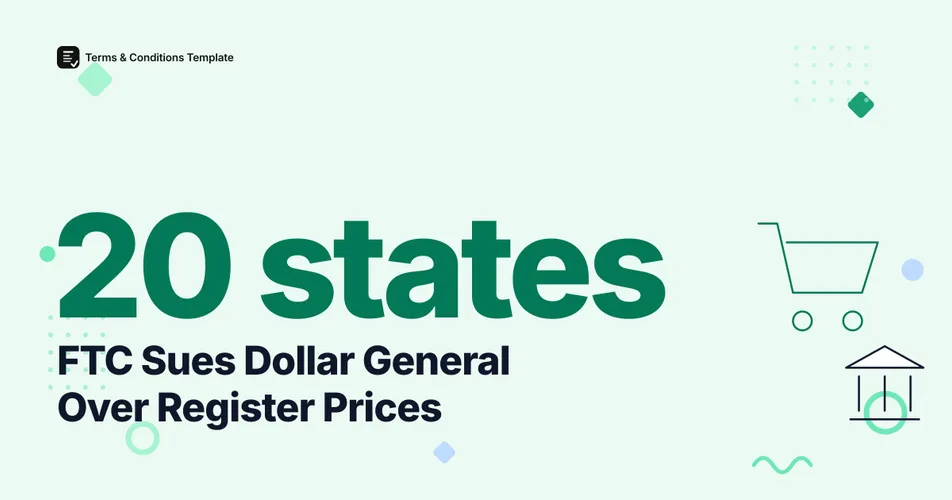
On October 26, 2026, the Federal Trade Commission and 20 states filed a lawsuit in the U.S. District Court for the Middle District of Tennessee against Dollar General Corporation. The complaint alleges that the retailer has long charged customers more at the register than the prices shown on shelves, tags, and advertisements. These are allegations only. Dollar General has said it will defend the case, and a court has not ruled on any of it.
The case is about a brick-and-mortar chain, but the lesson applies to any seller who publishes a price. If the number a customer sees is not the number they are charged, the gap is a legal problem, not just a customer service one. This post covers what the FTC says it filed, and then what a small seller can do in a price-error clause and a refund policy.
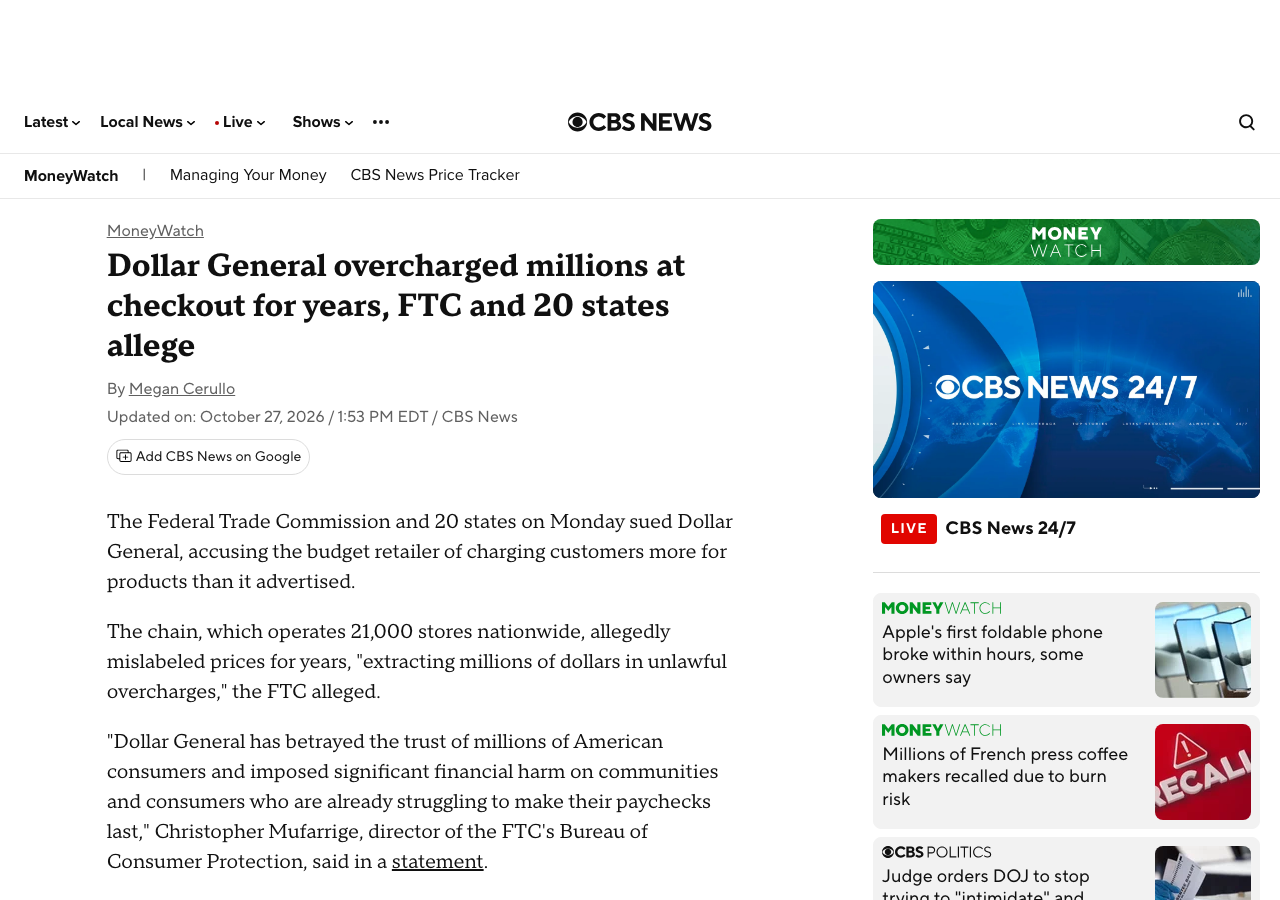
Source: CBS News, captured October 31, 2026.
What the FTC says it filed
According to the FTC press release, the plaintiffs are the FTC and 20 states: Alabama, Arizona, Arkansas, California, Connecticut, Florida, Illinois, Iowa, Kansas, Louisiana, Michigan, Mississippi, Nebraska, New Jersey, North Carolina, Ohio, Oklahoma, Tennessee, Utah, and Wisconsin. The release says Dollar General operates more than 21,000 stores, that it received tens of thousands of consumer complaints about advertised prices not being honored, and that it allegedly knew of the problem without adequately fixing it. The Commission vote to authorize the complaint was 2-0.
The release lists the FTC Act, the Gramm-Leach-Bliley Act, and state laws as the legal basis. We are repeating that exactly as it appears, because the Gramm-Leach-Bliley Act is a financial privacy statute that most readers would not expect in a pricing case, and the press release page does not explain the connection. We have not read the complaint itself, so we will not guess at how that statute fits.
Figure: The scale of the alleged problem, as described in the FTC’s release: a chain of more than 21,000 stores, with 20 states joining the federal suit.
Christopher Mufarrige, Director of the FTC’s Bureau of Consumer Protection, said in the release that “Dollar General has betrayed the trust of millions of American consumers.” Dollar General told CBS News that “Our goal is 100% accuracy between shelf and register prices in every store” and that it would defend the litigation vigorously. CBS reports that the plaintiffs seek a permanent injunction plus monetary and other relief, with no dollar figure given in its article. The FTC release itself, as we read it, does not state the relief sought.
Why price accuracy is a legal issue, not a pricing detail
A displayed price is a representation. When a shopper picks up an item because the tag says one amount and the register rings up another, regulators can treat that difference as a deceptive practice, whatever the cause. The FTC’s framing in this case is that the company knew about the mismatches, which is a different matter from a one-off typo. The allegation turns on what a business does after it learns that its advertised prices and its checkout prices disagree.
That makes the practical question for a seller less about whether errors ever happen, and more about what your documented process is when one does. If you sell online, the same logic covers a product page that says $19 while the cart says $24, a promo code that fails to apply, or a sale banner that outlives the sale. We covered a related pricing disclosure case in our post on the StubHub FTC drip pricing settlement, which focused on fees added late in checkout. This case is the reverse angle: the headline price itself not holding.
What a price-error clause should say
Many sellers add a line to their terms that reserves the right to cancel orders placed at a mistaken price. That is a reasonable start, but a clause protects you only as far as it is clear, reasonable, and actually followed. A clause that lets you cancel an order at an obviously wrong price, such as a $0.99 television, is easier to defend than one used to quietly charge a higher amount after the customer has agreed to buy.
A good clause names three things. It states that errors can occur, it says what you will do when one is found (cancel and refund in full, or offer the item at the correct price with the customer’s consent), and it commits to a timeframe for telling the customer. What it should not do is give you a right to charge more than the displayed price without asking. In a physical store, the equivalent is a posted policy at the register and staff who are trained to follow it.
How your refund policy should handle a price mismatch
Your refund and return policy is where a price complaint ends up, so it should say plainly what happens. If a customer was charged more than the advertised price, the simplest rule is to refund the difference promptly, to the original payment method, without requiring a return of the item. Many sellers go further and honor the lower price whenever the mismatch came from their own tag or listing.
The table below sets out common mismatch situations and what the policy language should address.
| Situation | What the policy should say |
|---|---|
| Shelf or listing price lower than the register or cart price | Refund the difference to the original payment method; no return required |
| Obvious pricing error (far below cost) | Right to cancel before shipment, full refund, prompt notice to the customer |
| Expired sale price still displayed | State who bears the error; honoring the displayed price is the lower-risk default |
| Promo code that did not apply at checkout | Adjust the order or refund the discount within a stated number of days |
| Customer reports a mismatch after purchase | Named contact channel and a stated response time |
If you want more detail on how these policies fit together, our guides on refund policies for ecommerce and on the difference between a refund policy and a return policy cover the structure and wording choices.
Process matters as much as wording
The FTC’s description of tens of thousands of complaints is a reminder that complaints are evidence of notice. A policy on paper does little if complaints about price mismatches pile up in an inbox with no fix behind them. Keep a simple log of mismatch reports, check the products that appear repeatedly, and correct the source, whether that is a product feed, a shelf label, or a point-of-sale price file. Review sale end dates on a schedule so that expired promotions come down on time.
For online sellers, test the checkout against your listings after any price change or promotion launch. For physical retail, spot-check shelf tags against register prices on a regular cycle, and give staff a clear instruction that a mismatch is resolved in the customer’s favor or escalated, never absorbed by the customer.
Bottom Line
The Dollar General case is an allegation, not a finding, and its outcome will take time. What it already shows is that regulators and state attorneys general are willing to treat a gap between advertised and charged prices as a consumer protection matter at scale. For your business, the response is modest: put a clear price-error clause in your terms, write a refund policy that says what happens on a mismatch, and keep a record of how you fix them. Our Refund Policy Generator builds a policy that spells out how price adjustments and refunds work for your actual sales channels.
Sources
- FTC, FTC and State Partners Sue Dollar General for Charging Consumers More Than Advertised on Many Products
- CBS News, Dollar General sued by FTC over overcharging prices
The information in this article is for informational purposes only and should not be construed as legal advice on any matter, and does not create a lawyer-client relationship.