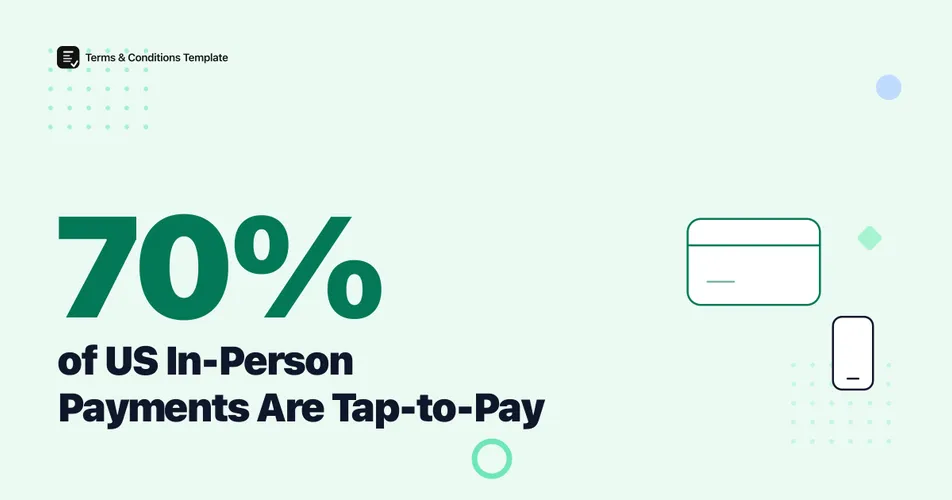
Nearly 70% of all in-person transactions in the United States are now tap-to-pay, according to Visa’s own Q1 fiscal 2026 earnings disclosure, reported January 29, 2026. Globally, the figure has already crossed 80%. Mastercard reports a parallel climb on its own network, from 70% to 77% of in-person transactions contactless in the eighteen months to Q4 2025. The chip insert at checkout is fading fast, and the numbers behind that shift come directly from the two networks that process most of it.
How much of US in-person spending is tap-to-pay in 2026?
Visa does not publish one annual tap-to-pay percentage. It discloses the figure each quarter on its own earnings calls, and the trend across those calls is the clearest paper trail available. In July 2024, McInerney told analysts that domestic penetration had passed 50% and that 30 US cities had crossed 60% penetration, while the figure outside the US had grown 4 percentage points to 80% of face-to-face transactions. By April 2025, the US figure surpassed 60% for the first time, with global penetration at 76%. By the Q1 fiscal 2026 call on January 29, 2026, McInerney reported that tap-to-pay had “crossed the 80% mark of all face-to-face transactions with the US at nearly 70%.”
Figure 1: US tap-to-pay penetration at three points Visa has disclosed on its own earnings calls. Values reflect Visa’s stated thresholds each quarter (just over 50%, surpassing 60%, nearing 70%), not exact percentages the company has published. Source: Visa Q3 FY2024, Q2 FY2025, and Q1 FY2026 earnings calls.
Card issuers do not need a survey to see this shift. It shows up directly in their own settlement data, one quarter at a time.
How does Mastercard’s contactless growth compare to Visa’s?
Mastercard’s network shows the same direction. CFO Sachin Mehra told analysts in October 2024 that contactless payments “now represent 70% of all in-person transactions.” By the company’s Q4 2025 earnings call on January 29, 2026, the same year Visa reported its own 80%/70% milestone, Mehra reported contactless penetration at 77% of all in-person switched purchase transactions, “a five percentage point increase year over year,” implying a Q4 2024 baseline of about 72%.
| Network | In-person contactless share | Reporting period | Change |
|---|---|---|---|
| Visa (US) | Nearly 70% | Q1 FY2026 (Jan 2026) | Up from just over 50% (Jul 2024) |
| Visa (global) | Over 80% | Q1 FY2026 (Jan 2026) | Up from 76% (Apr 2025) |
| Mastercard (in-person) | 77% | Q4 2025 (Jan 2026) | +5 percentage points year over year |
Figure 2: Mastercard’s own quarterly disclosure of contactless share of in-person transactions. Source: Mastercard Q3 2024 and Q4 2025 earnings calls.
Two competing networks reporting the same direction, on their own settlement data rather than a survey, is about as strong a confirmation as this kind of figure gets.
Is tap-to-pay replacing chip insertion at the register?
Mostly, yes, though neither network publishes a clean breakdown of what fills the remaining share. With close to 70% of US in-person Visa transactions now tapped, the leftover roughly 30% covers chip insertion, magnetic-stripe swipe, and manual card entry combined, without a published split between them. In the US, a chip transaction is typically chip-and-signature or no-signature rather than chip-and-PIN, unlike much of Europe, but functionally it still means removing the card and waiting for the terminal rather than a single tap.
Figure 3: How US in-person Visa transactions split by payment method as of Visa’s Q1 FY2026 disclosure. The non-tap share is not broken out further by Visa and is presumed to be mostly chip insertion, since magnetic-stripe and manual entry are now uncommon at EMV-compliant terminals. Source: Visa Q1 FY2026 earnings call, January 29, 2026.
Chip insertion has not disappeared, but it has gone from the default to the fallback in roughly three years.
What does the contactless timeline look like heading into 2026?
Figure 4: Quarterly contactless milestones disclosed by Visa and Mastercard, 2024 to 2026. Source: Visa and Mastercard quarterly earnings calls.
Every milestone on this timeline came from a network’s own earnings call rather than a market research forecast, which is why the trend line holds together so cleanly across two separate companies.
Does a refund still work the same way on a tap-to-pay purchase?
Yes, and the routing logic does not change based on how the customer paid. A tap-to-pay transaction still refunds to whatever card or account sat behind the tap.
Figure 5: Where a refund lands after a tap-to-pay purchase, regardless of which device did the tapping. Source: standard card network and wallet refund routing rules.
A tap-to-pay purchase still refunds to the same card or account behind the tap, whether that is a physical contactless card, an Apple Pay or Google Pay wallet, or a linked PayPal account. A Refund Policy Generator that only describes “refunds to your original card” technically still covers the roughly 70% of US shoppers who tap to pay, since the underlying card is the same one, but spelling out wallet and phone taps explicitly reads as current to a shopper checking the policy before a return.
How much do Apple Pay and Google Pay contribute to tap-to-pay volume?
Not every tap comes from a physical card. Apple Pay’s weekly in-store usage among US consumers doubled from 8% in 2024 to 16% in 2025, according to PYMNTS Intelligence’s “Apple Pay @11” survey of 3,339 US consumers, fielded August through September 2025 and published February 2026. Apple Pay’s annual US sales volume grew from $268 billion to $450 billion over the same period, though PYMNTS estimates that still accounts for only about 10% of eligible in-store purchases and under 5% of all transactions once online and card-not-present spending is included. Google Pay’s usage more than doubled over the same period, off a smaller base, and PayPal’s and Cash App’s in-store usage each nearly doubled too.
| Wallet | US weekly in-store usage, 2025 | Change vs 2024 |
|---|---|---|
| Apple Pay | 16% of consumers | Up from 8% |
| Google Pay | Smaller base, fast growth | More than doubled |
| PayPal / Cash App | Smaller base, fast growth | Nearly doubled |
Digital wallets’ overall share of in-person payments has grown from a rounding error to a real slice of the register: PYMNTS Intelligence puts wallet-based transactions at 11.8% of in-store payments in 2025, up from 0.9% in 2022. PayPal alone processed $1.79 trillion in total payment volume in 2025; see our PayPal statistics for 2026 for the full account and volume breakdown. For the wallet-by-wallet detail behind these numbers, including Apple Pay’s global user base and how wallet growth compares to overall digital wallet adoption, see our mobile wallet statistics for 2026.
No single wallet drives the tap-to-pay trend by itself. A physical contactless card still accounts for most of the shift; wallets are the fastest-growing slice riding on top of it.
The Bottom Line
Tap-to-pay stopped being a novelty payment method sometime around Q2 2025, when Visa’s own US figure crossed 60% for the first time, and it is now closing in on 70%. Mastercard’s network tells the same story from a different angle, with contactless in-person share climbing from 70% to 77% over the same stretch. Neither company had to survey anyone to produce these numbers; they came straight from settlement data. For a store owner, the practical shift is small but real: refunds still route to the same card or wallet that was tapped, so the mechanics have not changed, but a payment or refund policy that only mentions inserting or swiping a card now describes a shrinking minority of checkout traffic.
Frequently Asked Questions
What percentage of payments are contactless in 2026? Nearly 70% of US in-person transactions and more than 80% of face-to-face transactions globally are tap-to-pay, according to Visa’s Q1 fiscal 2026 earnings call on January 29, 2026.
Is Mastercard seeing the same contactless growth as Visa? Yes. Mastercard’s own network data shows contactless payments rose from 70% of in-person transactions in the third quarter of 2024 to 77% by the fourth quarter of 2025, a five-percentage-point year-over-year gain.
Has tap-to-pay replaced chip insertion at US checkouts? Tap-to-pay has become the majority method, not a full replacement. With close to 70% of US in-person Visa transactions now tapped, the remaining roughly 30%, split across chip insertion, magnetic-stripe swipe, and manual card entry, is shrinking every quarter.
How much do Apple Pay and Google Pay contribute to tap-to-pay volume? Apple Pay’s weekly in-store usage among US consumers doubled from 8% to 16% between 2024 and 2025, with its US sales volume growing from $268 billion to $450 billion, according to PYMNTS Intelligence. Google Pay’s usage more than doubled over the same period.
Sources and References
- Visa Inc.. Q1 Fiscal 2026 Earnings Call Transcript, January 29, 2026. Remarks by CEO Ryan McInerney on tap-to-pay penetration.
- PYMNTS. (2024). “Visa: 80% of Face-to-Face Transactions Internationally Are Tap to Pay.” Coverage of Visa’s Q3 FY2024 earnings call, July 23, 2024.
- PYMNTS. (2025). Coverage of Visa’s Q2 FY2025 earnings call, April 29, 2025, reporting 76% global tap-to-pay penetration and the US surpassing 60% for the first time.
- PYMNTS. (2024). “Mastercard: Contactless Payments Now 70% of Face-to-Face Transactions.” Coverage of Mastercard’s Q3 2024 earnings call, October 31, 2024.
- Mastercard Inc.. Q4 2025 Earnings Call Transcript, January 29, 2026. Remarks by CFO Sachin Mehra on contactless penetration.
- Visa Inc.. (2025). “Visa Tap to Phone Adoption Soars: 200% Year-over-Year Growth Worldwide.” Official press release, March 3, 2025.
- PYMNTS Intelligence. (2026). “Mobile Wallet Usage Soars, Even as Apple Pay Leaves Spend on the Table.” Survey of 3,339 US consumers, fielded August-September 2025, published February 2, 2026.
Note: All figures verified as of October 2026. Visa and Mastercard both disclose contactless share as an evolving quarterly metric on their own earnings calls, so headline figures are refreshed at least twice a year.