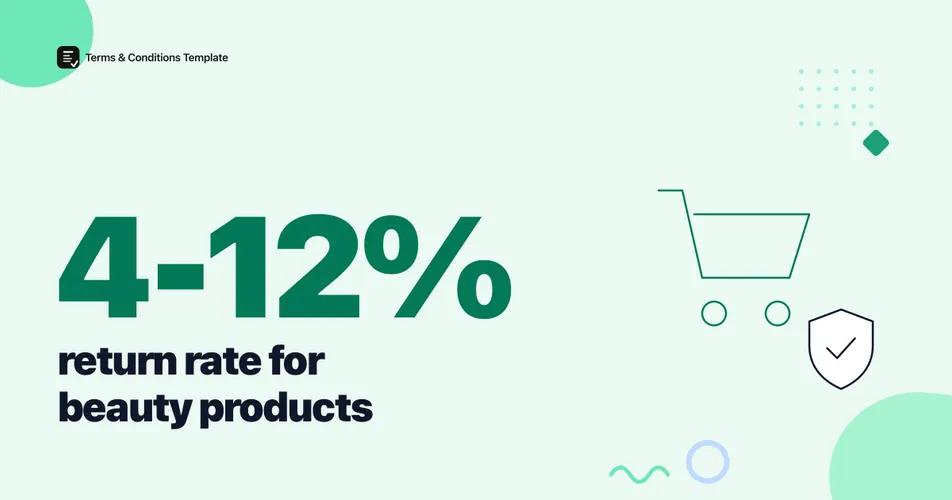
Beauty and personal care products post one of the lowest return rates in ecommerce: an estimated 4% to 12% of online purchases come back, compared with a 19.3% ecommerce-wide average in 2025, according to the National Retail Federation and Happy Returns’ joint Retail Returns Landscape report. The low rate hides a messier reality underneath: once a lipstick or foundation bottle is opened, hygiene rules mean most retailers cannot resell it, and many will not even accept it back.
How does beauty compare to other ecommerce return rates?
Beauty and personal care purchases return at roughly 4% to 12% online, well under the 19.3% blended average the National Retail Federation and Happy Returns reported for 2025 across a survey of 2,006 consumers and 358 ecommerce professionals. NRF’s own report does not break returns down by product category, so the beauty-specific range comes from compiled 2025-2026 returns-platform benchmarks (Richpanel, Saara, and similar aggregators) rather than one controlled study, and should be read as directional rather than exact.
Figure 1: Beauty sits well below the ecommerce-wide return rate. Sources: compiled 2025-2026 returns-platform benchmarks; National Retail Federation and Happy Returns, 2025 Retail Returns Landscape.
The gap is large enough to matter for how a beauty brand plans its returns budget. For a full breakdown of the ecommerce-wide number, including fraud and cart-abandonment data, see our ecommerce return rate benchmarks for 2026.
Low as it is, beauty’s return rate is a policy artifact as much as a customer-satisfaction one: much of what would otherwise come back never gets returned at all, because it cannot be.
Why do beauty retailers restrict returns on opened products?
Retailers in the EU have explicit legal cover to refuse a cosmetics return once it has been opened. Article 16(e) of Directive 2011/83/EU exempts “the supply of sealed goods which are not suitable for return due to health protection or hygiene reasons and were unsealed after delivery” from the standard 14-day right of withdrawal that applies to most online purchases.
US retailers do not operate under an identical statute, but most apply an equivalent informal rule for the same reason: an opened lipstick, cracked-open palette, or unsealed skincare jar cannot legally be resold as new in most states, and reverse logistics cannot safely inspect a used cosmetic for contamination the way it can inspect a returned sweater.
Figure 2: How long shoppers get to return a beauty purchase, in days. Sources: Directive 2011/83/EU Article 9 (EU standard withdrawal period); Sephora and Ulta Beauty published return policies.
That 14-day EU minimum is a floor, not a norm among beauty specialty retailers, several of which offer far longer windows in exchange for tighter condition requirements.
Do any beauty retailers accept opened returns?
Yes, and the two biggest US beauty specialty chains are more generous than the hygiene-exception norm would suggest. Sephora’s published policy states it “welcomes you to return new or gently used products for a full refund” within 30 days of purchase in most cases. Ulta Beauty offers a 30-day window for a full refund and extends eligibility to 60 days for store credit, also accepting opened and gently used items, according to Ulta’s published return terms.
Figure 3: The decision path that determines whether an opened beauty return is even accepted, and what happens to it afterward. Source: synthesized from Directive 2011/83/EU Article 16(e) and published Sephora and Ulta Beauty return policies.
Accepting an opened return does not mean the item goes back on a shelf. Even at retailers with generous windows, a used cosmetic almost never re-enters inventory; the generosity is a customer-retention decision, not a resale one.
What is the biggest reason beauty products get returned?
Shade or color mismatch is the reason cited most often across the beauty-returns commentary from returns-technology vendors, though the published estimates vary enormously, from 20% to 65% of beauty returns depending on the product type and how a given vendor defines a “mismatch.” That spread itself is a data point: there is no single standardized study measuring this the way NRF measures the ecommerce-wide rate, so any specific percentage should be treated as a vendor estimate rather than a settled figure.
Figure 4: Compiled 2025-2026 return-rate estimates by beauty subcategory, for products where a retailer allows a return at all. Source: compiled returns-platform and vendor benchmark data (Eightx, Netcore Unbxd), not a single controlled study.
Foundation and concealer sit well above the rest of the category, near 23% where returns are permitted, which lines up with the shade-match explanation: color-critical products carry the highest return risk, while lower-risk categories like hair care and tools return at closer to the beauty-wide average.
How do beauty return rates compare at a glance?
| Category | Typical online return rate |
|---|---|
| All online orders (blended, NRF/Happy Returns 2025) | 19.3% |
| Apparel and footwear | 20% to 40% |
| Beauty and personal care (overall) | 4% to 12% |
| Foundation and concealer (where returnable) | ~23% |
| Skincare (where returnable) | ~11.2% |
Sources: National Retail Federation and Happy Returns, 2025 Retail Returns Landscape; compiled 2025-2026 returns-platform benchmarks.
A merchant selling both apparel and beauty under one storefront is really running two different returns businesses. A single blanket return policy copied from the apparel side will either overpromise on beauty condition requirements or underpromise on the window shoppers expect.
What happens to beauty returns, and what does it cost the industry in waste?
Most opened cosmetics that do get returned cannot be donated or resold, so they are typically destroyed rather than restocked, adding to a packaging-waste problem the beauty industry is already fighting on a separate front. Pact Collective, the nonprofit beauty-packaging collection program backed by more than 140 member brands, collected 227,632 lbs of beauty packaging in 2024, its largest annual total since launching, according to its own 2024 Impact Report.
Figure 5: How Pact Collective’s record 2024 haul of beauty packaging was collected. Source: Pact Collective, 2024 Impact Report.
Of that total, 138,673 lbs came through consumer-facing drop-off programs, nearly triple the prior year’s consumer collection volume, while the rest came from brand and retailer inventory recovery. None of Pact’s figures measure returns specifically, but the scale gives useful context: an industry already struggling to keep packaging out of landfill is also routinely destroying opened returns it cannot legally resell, a cost that does not show up in a return-rate percentage at all.
The Bottom Line
The headline number, 4% to 12%, makes beauty look like the easy category. It is not. A low return rate here is partly a legal and hygiene artifact: shoppers who would return a bad shade match often cannot, because the product is already unsealed, so dissatisfaction shows up later as a lost repeat customer rather than as a return on the books. Retailers that publish a clear, plain-language beauty return policy, spelling out exactly what “gently used” means and how long the window runs, convert some of that silent churn back into a resolvable return instead. Our Refund Policy Generator builds one from your actual return window, condition requirements, and product categories in a few minutes.
Frequently Asked Questions
What percentage of beauty products get returned online? An estimated 4% to 12% of beauty and personal care purchases are returned online, well below the 19.3% ecommerce-wide average for 2025, according to National Retail Federation and Happy Returns data plus compiled 2025-2026 returns-platform benchmarks. Most estimates cluster near 8% to 9%.
Why won’t beauty retailers accept opened makeup as a return? EU law gives them the explicit right to refuse: Article 16(e) of Directive 2011/83/EU exempts sealed goods that are unsuitable for return for health or hygiene reasons once unsealed. US retailers follow similar informal rules, though some, like Sephora and Ulta, still accept gently used products.
What is the biggest reason beauty products get returned? Shade or color mismatch is cited most often. Vendor benchmark estimates range widely, from 20% to 65% of beauty returns, depending on category and measurement method, with foundation and concealer returning at around 23% where retailers allow it.
Do Sephora and Ulta accept returns on opened cosmetics? Yes, both do, which is unusual for the category. Sephora accepts new or gently used products within 30 days for a full refund in most cases, and Ulta Beauty offers 30 days for a full refund and up to 60 days for store credit.
Sources and References
- National Retail Federation and Happy Returns. (2025). “2025 Retail Returns Landscape.” Survey of 2,006 consumers and 358 ecommerce professionals; 19.3% ecommerce-wide return rate.
- Directive 2011/83/EU. Article 16(e), Exceptions from the right of withdrawal, sealed goods unsuitable for return for health or hygiene reasons.
- Sephora. Returns and Exchanges policy, accessed 2026. 30-day window, new or gently used products accepted for a full refund in most cases.
- Ulta Beauty. Return Policy, Guest Services FAQ, accessed 2026. 30-day full-refund window, 60-day store-credit window, opened and gently used products accepted.
- Pact Collective. (2025). “2024 Impact Report.” 227,632 lbs of beauty packaging collected in 2024, including 138,673 lbs through consumer-facing programs.
- Eightx. (2025-2026). Compiled beauty and cosmetics return-rate benchmarks, including subcategory estimates and shade-mismatch vendor data.
Note: All figures verified as of October 2026. Category-level return-rate figures in this article are compiled from returns-platform benchmarks rather than a single audited study and are refreshed at least twice a year; retailer return policies are subject to change and should be reverified against the retailer’s own current published terms before relying on them.