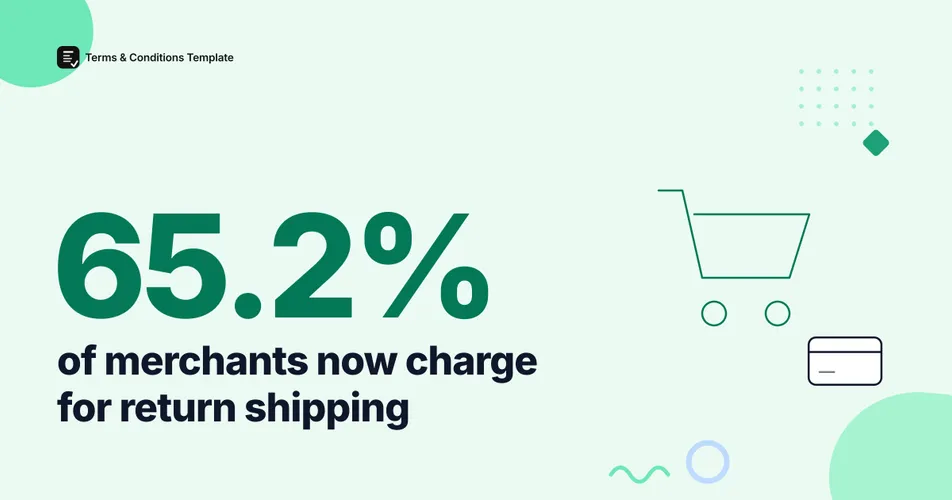
As of late 2025, 65.2% of online merchants charge a fee on at least some returns, averaging $9.04 per return, according to Loop Returns’ analysis of 23.4 million returns processed by more than 4,000 Shopify merchants between November 2024 and October 2025. Free return shipping, once treated as a table-stakes competitive expectation, is now the exception rather than the rule, even as 82% of shoppers still say free returns are a major factor in where they choose to buy.
The gap between what retailers can afford to offer and what shoppers expect is the central tension in the numbers below: shipping costs, processing costs, and fraud are all rising at once, and every store owner is choosing a different way to pass that cost along, or absorb it.
How many retailers now charge for return shipping?
65.2% of merchants charge a fee on at least some returns, and the average fee has settled at $9.04, according to Loop Returns’ 2026 Global Ecommerce Report, based on 23.4 million actual returns processed across nine verticals from November 2024 through October 2025. That leaves roughly a third of merchants still offering fully free returns as a competitive differentiator.
Figure 1: Share of merchants charging a return fee on at least some returns. Source: Loop Returns, 23.4M returns, Nov 2024 to Oct 2025.
The shift is broad-based rather than confined to a single category. Loop’s dataset spans nine verticals globally, which means this is now closer to the retail default than an outlier strategy reserved for low-margin categories.
What does it actually cost to process a return?
Processing a single return costs a retailer roughly 27% of the item’s purchase price on average, once reverse shipping, inspection, restocking, and resale markdown are all counted, according to Optoro’s most recent published cross-vertical benchmark (2024 data; Optoro was acquired by Blue Yonder in 2025 and has not yet published a 2025 or 2026 refresh, so treat this as the most current available figure rather than a live number). On a $100 item, that is roughly $27 in total cost, well above the $9.04 fee most merchants actually pass on to the shopper.
Retailers are explicit about why fees are rising. Asked why they charge for returns, ecommerce professionals point to two cost drivers in equal measure, with a third close behind.
Figure 2: Top reasons retailers cite for charging return fees. Source: NRF/Appriss Retail, 2025 survey of 358 ecommerce professionals at $500M+ revenue merchants.
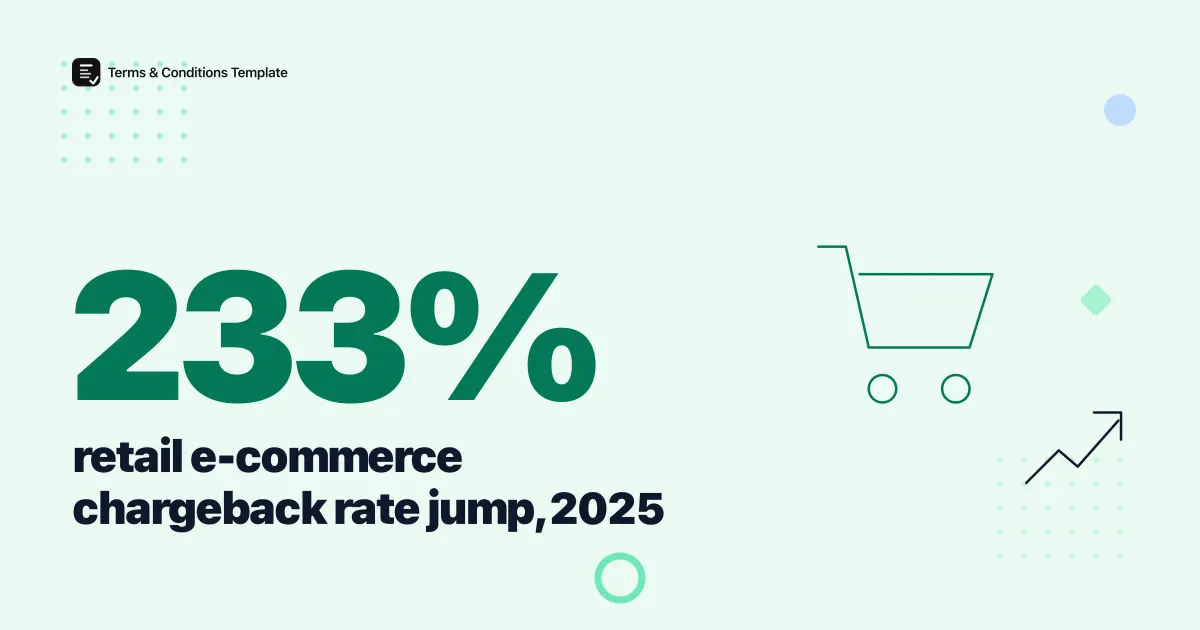
The math is straightforward from the retailer’s side: absorbing 27% of an item’s value on every returned order is no longer sustainable at a 19.3% online return rate, so a $9.04 fee is a partial offset, not full cost recovery. A clear, current refund policy that states your return shipping terms up front reduces disputes over a fee shoppers did not expect, which matters more as more stores add one.
Do shoppers still expect free return shipping?
Yes, and the gap between expectation and reality is widening rather than closing. 82% of consumers say free returns are a major consideration when shopping online, up from 76% the year before, according to NRF and Appriss Retail’s 2025 Consumer Returns survey of 2,006 shoppers who had made an online return in the past year. Gen Z shoppers, aged 18 to 30, averaged 7.7 online returns in the past 12 months, more than any other generation, which puts return costs disproportionately in front of the fastest-growing share of online shoppers.
Figure 3: Total US retail merchandise returns, 2024 vs. 2025. Source: NRF/Appriss Retail 2025 Returns Report.
Figure 4: Return economics milestones, 2024 to 2026. Sources: NRF/Appriss Retail, Loop Returns.
Total return value actually declined slightly year over year, from $890 billion in 2024 to a forecast $849.9 billion in 2025, even as the online-specific return rate stayed close to one in five orders. That suggests retailers are succeeding at reducing returns at the margin, through better sizing tools and product pages, faster than they are succeeding at making returns cheaper to process.
For the category benchmarks behind that overall return rate, see our ecommerce return rate data for 2026, and for how shoppers react to paid return policies specifically, see our paid returns statistics for 2026.
What are retailers doing instead of just charging a fee?
Rather than choosing only between “free” and “charge a fee,” most merchants now offer a third path: keep the money inside the store. 73.6% of Loop merchants offer exchanges and 49.2% offer “Shop Now,” an instant store-credit option, both of which avoid a cash refund and its associated shipping cost. Among merchants offering Shop Now, 51.7% pair it with a bonus credit incentive, averaging $11.28, to make the store-credit option more attractive than a refund.
Figure 5: How the return decision splits between exchange, fee, and full refund paths. Framework based on Loop Returns and NRF/Appriss data on merchant return strategies.
Return and exchange windows have also stayed generous even as fees rose: Loop’s dataset shows an average 39-day refund window and a 41-day exchange window across merchants, only two days apart, suggesting retailers are not compensating for the cost of returns by squeezing the time shoppers get to decide.
Figure 6: Average refund window vs. exchange window, in days. Source: Loop Returns, 23.4M returns, Nov 2024 to Oct 2025.
Which return-cost strategy fits your store?
There is no single right answer, and the right mix depends on margin and category, not on copying a competitor’s policy wholesale.
Figure 7: Where common return-cost strategies sit on retailer cost versus shopper satisfaction. Framework based on Loop Returns and NRF/Appriss data, not a single numeric study.
| Strategy | Retailer cost per return | Shopper reaction |
|---|---|---|
| Fully free returns | Full shipping and processing cost absorbed | Highest satisfaction, cited by 82% as a major factor |
| Flat return shipping fee | Averages $9.04, partial offset only | Accepted by most shoppers if disclosed up front |
| Exchange or store credit only | No cash refund, avoids reverse shipping in some cases | 73.6% of merchants now offer this path |
| Bonus credit incentive | Averages $11.28 paid to shopper to skip a refund | Used by 51.7% of merchants offering Shop Now |
The Bottom Line
The 65.2% figure is the headline, but the 27% processing-cost figure is the reason it exists: retailers cannot keep absorbing roughly a quarter of an item’s value on every return while shoppers return nearly one in five online orders. A $9.04 average fee, generous 39-day return windows, and a fast-growing exchange option are how the industry is splitting that cost, rather than eliminating it. Whichever strategy you choose, state it clearly before checkout, not at the return desk. A published refund policy that spells out who pays for return shipping, under what conditions, and within what window is now a baseline trust signal, not an optional legal formality.
Frequently Asked Questions
What percentage of retailers charge for return shipping? 65.2% of merchants charge a fee on at least some returns, averaging $9.04 per return, according to Loop Returns’ analysis of 23.4 million returns processed by over 4,000 Shopify merchants between November 2024 and October 2025.
How much does it cost a retailer to process a return? Processing a single return costs a retailer roughly 27% of the item’s purchase price on average, once reverse shipping, inspection, and restocking are factored in, according to Optoro’s 2024 cross-vertical benchmark.
Do shoppers still expect free return shipping? Yes. 82% of consumers say free returns are a major factor in where they shop, up from 76% the year before, according to NRF and Appriss Retail’s 2025 survey of 2,006 shoppers who made an online return in the past year.
How much are total retail returns worth in the US? NRF and Appriss Retail estimate $849.9 billion in merchandise returns for 2025, a 15.8% return rate on total retail sales and a 19.3% return rate for online sales specifically, down slightly from $890 billion and a 16.9% rate in 2024.
Sources and References
- Loop Returns. (2026). “2026 Global Ecommerce Report: Retention Benchmarks of High-Performing Brands.” 23.4 million returns, 4,000+ Shopify merchants, Nov 2024 to Oct 2025.
- National Retail Federation. (2025). “Consumers Expected to Return Nearly $850 Billion in Merchandise in 2025.” Survey of 2,006 consumers and 358 ecommerce professionals, fielded summer 2025.
- National Retail Federation. (2025). “2025 Retail Returns Landscape,” with Appriss Retail.
- Optoro. (2024). “State of Retail Returns 2024.” Cross-vertical average return processing cost benchmark.
Note: All figures verified as of August 2026. Return fee and processing-cost data change with each retail cycle, so headline figures here are refreshed at least twice a year. The Optoro processing-cost figure is dated to 2024 and flagged in-text as the most current available benchmark following the company’s 2025 acquisition.