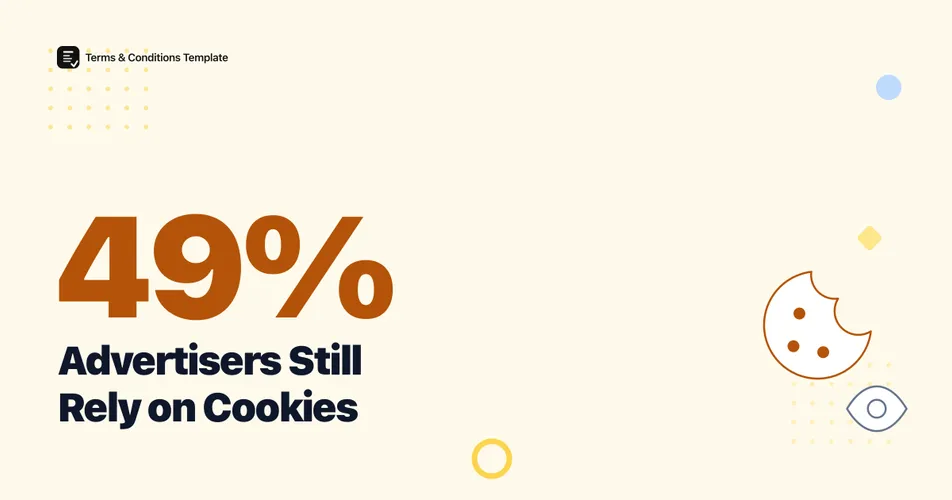
49% of marketers say their marketing strategy still depends on third-party cookie data, according to Adobe’s 2024 survey of 2,841 marketers across the US, Australia, France, Germany, India, Japan, and the UK. That is down sharply from 75% in 2022, but it means roughly half of the advertising industry has not finished the transition even after years of warning that the cookie would go away. The number that matters more for a site owner is the 28% of companies still putting half or more of their ad budget behind cookie-based targeting, since that is the group whose campaigns depend on data your cookie policy has to disclose.
If you run a website with any ads or analytics on it, this gap is not an abstract industry debate. Roughly half the advertisers buying inventory across the web are still setting or reading third-party cookies to do it, which is exactly the tracking activity a compliant cookie policy needs to name.
How many advertisers still use third-party cookies?
49% of marketers report that their marketing strategy still depends on third-party cookie data, per Adobe’s 2024 global survey (n=2,841). That is a real decline from 75% in 2022, but the drop has not been uniform. The share of companies spending 50% or more of their budget on cookie-based activations fell only from 45% to 28% over the same two years, a much smaller move than the headline dependency number suggests. Adobe also found that more than one in three marketers said cookie deprecation had already hurt their ability to track, target, and measure campaigns.
Figure 1: Adobe’s two-wave global marketer survey, 2022 versus 2024. Source: Adobe, 2,841 marketers across seven countries, 2024 study.
Reliance dropped, but it did not collapse. Half the industry, measured by Adobe’s own numbers, is still running campaigns that depend on the exact tracking data a cookie policy exists to disclose.
How many advertisers say they are prepared for a cookieless future?
Only 25% of advertisers say they are fully prepared for the cookie phaseout, according to a YouGov survey conducted for Taboola in May 2024 among 202 advertising and marketing decision-makers at companies with at least 100 employees. Preparedness and reliance are separate problems: an advertiser can stop depending on third-party cookies for daily targeting and still not have a tested, fully built replacement stack in place.
Figure 2: Share of 202 advertising decision-makers reporting full readiness for cookie deprecation. Source: YouGov survey for Taboola, fieldwork May 3 to 9, 2024.
The same survey found only 46% of respondents were satisfied with Google’s decision to delay the Chrome phaseout, so the industry’s low readiness score is not for lack of caring about the outcome.
Does third-party cookie reliance differ by region or survey scope?
Yes, and the gap is wide enough to change the headline answer depending on who you ask. IAB Europe’s February 2024 survey of more than 160 European digital advertising professionals found 76% still relied on third-party cookies, well above Adobe’s global marketer figure of 49% measured the same year. The IAB Europe sample skews toward specialist ad-tech and media buying professionals rather than the broader marketer population Adobe surveyed, which is a plausible reason the two numbers diverge this much even though both were fielded in 2024.
| Survey | Scope and sample | Year | Share still relying / not fully prepared |
|---|---|---|---|
| Adobe | Global marketers, n=2,841, 7 countries | 2024 | 49% still depend on 3P cookie data |
| IAB Europe | European ad-tech/media pros, n=160+ | 2024 | 76% still relied on 3P cookies |
| YouGov for Taboola | Global ad decision-makers, n=202 | 2024 | 75% not fully prepared for deprecation |
Table 1: Third-party cookie reliance and readiness figures by survey, showing how scope changes the headline number even within the same year. Sources: Adobe, IAB Europe, YouGov for Taboola.
Figure 3: Cross-survey comparison of third-party cookie reliance and readiness figures, all fielded in 2024. Sources: IAB Europe, YouGov for Taboola, Adobe.
There is no single correct “advertiser reliance” percentage. The right number depends on whether the question is about specialist ad-tech buyers or the broader marketer population, and a cookie policy has to assume the higher-reliance answer applies to at least some of a site’s ad partners.
How has advertiser reliance on third-party cookies changed since 2021?
The decline has been gradual, not sudden, and it started well before Chrome’s deprecation plan was supposed to take effect. Advertiser Perceptions’ late-2021 buy-side study of 153 US advertisers and agencies found third-party cookie use fell from 97% in May 2021 to 88% by December 2021, a nine-point drop in seven months as early first-party data investments began. Adobe’s later two-wave survey picked up the same trend at a larger scale, from 75% dependency in 2022 down to 49% in 2024. These are different survey houses with different methodologies, so the line below should be read as a directional trend rather than one continuous dataset.
Figure 4: Directional trend across two separate survey houses. Sources: Advertiser Perceptions (2021, n=153), Adobe (2022 and 2024, n=2,841). Different methodologies, shown for trend direction only.
Figure 5: Advertiser reliance and platform milestones, 2021 through 2026. Sources: Advertiser Perceptions, Adobe, 33Across, Google Privacy Sandbox, StatCounter.
Warning
Retail-specific transaction data adds useful texture but is not directly comparable to a survey percentage. 33Across’s Q4 2023 report on its own exchange found retail advertisers put 26% of their programmatic budgets into cookie-alternative inventory, up 117% year over year. That is a share-of-spend figure from one exchange’s transaction log, not a survey of advertiser sentiment, so it should not be read as interchangeable with the Adobe or IAB Europe percentages above.
Why are advertisers still relying on third-party cookies despite the phase-out plans?
Because the browser most of the industry built campaigns around never turned deprecation on. Google confirmed on April 22, 2025 that it would not ship a standalone third-party cookie deprecation prompt in Chrome and would maintain the existing opt-out model instead. Chrome and Edge together still carried about 74.86% of global browser traffic as of StatCounter’s June 2026 data. For an advertiser, that means the targeting infrastructure built over the past decade keeps working for three-quarters of the traffic they can reach, which removes the forcing function that would have pushed reliance toward zero.
Figure 6: Why Chrome and Edge’s continued default cookie support reduces the urgency to migrate off third-party cookies. Sources: Google Privacy Sandbox, StatCounter June 2026.
A cookie policy still has to name whatever third-party trackers a site actually runs, and for most ad-supported sites that list has not gotten meaningfully shorter just because Chrome changed its mind. For more on why Chrome’s reversal happened and what the browser-level split looks like today, see our third-party cookie phase-out numbers post, and for the exact share of traffic that blocks third-party cookies by default, see what percentage of browsers block third-party cookies.
The Bottom Line
Advertiser reliance on third-party cookies fell hard between 2021 and 2024, but it did not disappear. 49% of marketers still say their strategy depends on third-party cookie data, and depending on which survey and audience you ask, that figure runs as high as 76% among specialist European ad-tech professionals. Only 25% of advertisers describe themselves as fully prepared for deprecation, a number that has not had much reason to improve since Google confirmed in April 2025 that Chrome would keep third-party cookies on by default. For a site owner, the practical result is unchanged by any of these percentages: as long as any meaningful share of your ad partners still run third-party trackers, your cookie policy needs to disclose them, and that requirement does not shrink just because the industry’s own readiness numbers look better than they used to.
Frequently Asked Questions
How many advertisers still use third-party cookies? 49% of marketers say their marketing strategy still depends on third-party cookie data, down from 75% in 2022, per Adobe’s 2024 global survey of 2,841 marketers across seven countries. 28% still spend 50% or more of their budget on cookie-based targeting.
Are advertisers ready for third-party cookies to go away? Not fully. Only 25% of advertisers say they are fully prepared for cookie deprecation, per a YouGov survey of 202 advertising and marketing decision-makers conducted for Taboola in May 2024.
Does third-party cookie reliance differ by region? Yes. IAB Europe’s February 2024 survey of over 160 European digital advertising professionals found 76% still relied on third-party cookies, a higher share than Adobe’s global marketer figure of 49% measured the same year.
Why do advertisers still rely on third-party cookies if Chrome was supposed to phase them out? Because Chrome never did. Google confirmed on April 22, 2025 that it would not deprecate third-party cookies in Chrome, and Chrome plus Edge still carry about 74.86% of global browser traffic as of June 2026, per StatCounter, so the infrastructure most advertisers built campaigns on kept working.
Sources and References
- Adobe. (2024). “Brands Make Progress Weaning Off Third-Party Cookies, Yet Feel Less Prepared Than Ever for a World Without Them.” Global survey of 2,841 marketers across the US, Australia, France, Germany, India, Japan, and the UK, published July 15, 2024.
- Marketing Interactive, citing YouGov. (2024). “Survey: Only 25% of Advertisers Ready for Cookie Deprecation.” YouGov survey for Taboola, 202 advertising and marketing decision-makers, fieldwork May 3 to 9, 2024, published June 13, 2024.
- IAB Europe. (2024). “Post-Third-Party Cookie Survey Results.” Over 160 European digital advertising professionals surveyed, published February 2024.
- Advertiser Perceptions. (2021). “Cookieless Future Report.” Buy-side study of 153 US advertisers and agencies, fieldwork November 18 to December 15, 2021.
- MediaPost, citing 33Across. (2024). “Advertisers Still Too Reliant On Third-Party Cookies.” 33Across Q4 2023 Programmatic Cookie Alternative Trends Report, transaction-level analysis of retail advertiser spend.
- Google Privacy Sandbox. (2025). “Next steps for Privacy Sandbox and tracking protections in Chrome.” Published April 22, 2025.
- StatCounter Global Stats. (2026). “Browser Market Share Worldwide.” Data for June 2026.
Note: All figures verified as of August 2026. Advertiser reliance figures are self-reported survey data and browser market share shifts monthly, so headline figures in this article are refreshed at least twice a year.