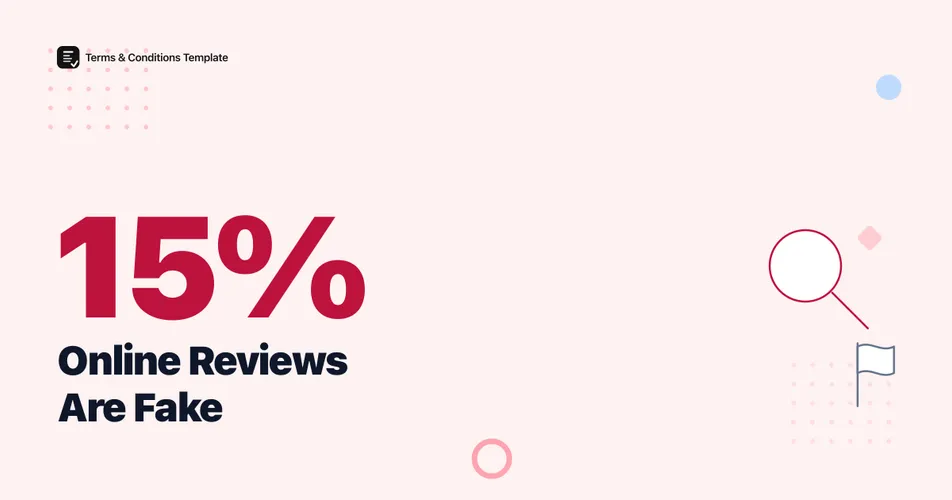
Up to 15% of online reviews are fake, according to UK government-commissioned research published in April 2023 that audited 2.1 million reviews across nine e-commerce platforms. Enforcement has since caught up with the scale of the problem: in 2024 alone, Amazon blocked 275 million suspected fake reviews and the FTC finalized a rule that now carries penalties of up to $53,088 per violation. The numbers below cover how big the problem actually is, who is catching it, and what changed in 2024 and 2025.
If you run a business that collects reviews or testimonials, the practical stakes are direct. A single incentivized review published without a disclosure, or a testimonials page that quietly hides negative feedback, now falls under a federal rule with real financial teeth.
How many online reviews are actually fake?
Estimates vary by platform and methodology, but the most rigorous recent figure comes from the UK Department for Business and Trade, which commissioned Alma Economics to analyze 2.1 million product reviews across nine UK e-commerce platforms and three common categories: consumer electronics, home and kitchen, and sports and outdoors. Published in April 2023, the study estimated that 11% to 15% of reviews in those categories were fake. A companion experiment with 4,900 UK shoppers, built with input from consumer group Which?, found that well-written fake reviews measurably increased purchase intent.
Other studies land in a similar range using different data. A 2024 peer-reviewed study by Florian Schneider and Timm Teubner, published in the International Journal of Electronic Commerce, analyzed an Airbnb dataset and found fake review estimates ranging from 6.2% to more than 21%, depending on which detection classifier was used. An older, widely cited baseline from CHEQ and the University of Baltimore put the average fake review rate at just 4% across Amazon, Trustpilot, Yelp, and Tripadvisor, based on 2021 data, a figure now five years old and likely understating today’s problem given how much AI-generated review volume has grown since.
Figure 1: Share of audited sites with no disclosed fake-review prevention measures. Source: European Commission consumer protection sweep, 223 websites, 2022.
The variation across studies is a methodology story, not a contradiction. Different researchers test different product categories, platforms, and detection models, and none of them claim a single universal rate. The consistent finding is that the fake share is never close to zero and rarely below one in ten reviews for the categories studied.
How do prevalence estimates compare across studies?
Lining up the four most citable figures side by side shows the spread runs from a conservative cross-platform average to a much higher single-platform estimate.
Figure 2: Fake review prevalence estimates by study, year, and scope. Source: see comparison table below.
| Source | Year | Scope | Estimated fake share |
|---|---|---|---|
| CHEQ and University of Baltimore | 2021 | Amazon, Trustpilot, Yelp, Tripadvisor (cross-platform average) | 4% |
| UK Department for Business and Trade (Alma Economics) | 2023 | 3 product categories, 9 UK e-commerce platforms, 2.1M reviews | 11% to 15% |
| Schneider and Teubner, International Journal of Electronic Commerce | 2024 | Airbnb, closed reputation system | 6.2% to 21%, depending on classifier |
Every figure in that table is a lower or upper bound from a named, methodology-disclosed study rather than a rounded-off headline number. Treat any single blended figure you see elsewhere with the same caution.
Which platforms catch the most fake reviews?
Amazon and Google both publish their own enforcement numbers, and the scale involved is enormous relative to any prevalence estimate above. Amazon’s 2024 Brand Protection Report states the company proactively blocked over 275 million suspected fake reviews before publication in 2024, alongside taking legal or account action against thousands of review brokers. Google reported blocking or removing more than 240 million policy-violating reviews in 2024, a 40% increase over the 170 million it removed in 2023, crediting expanded machine learning and Gemini-based detection.
Figure 3: Platform-reported enforcement volume by year. Sources: Amazon 2024 Brand Protection Report; Google’s own 2024 policy enforcement reporting.
These self-reported numbers are not independently audited, and both companies have an incentive to publicize enforcement scale as evidence their platforms are trustworthy. Still, the year-over-year trend, especially Google’s 40% jump, tracks with independent researchers’ observation that AI tools have made bulk fake review generation cheaper and faster since 2023.
What is the FTC doing about fake reviews?
The FTC’s Trade Regulation Rule on the Use of Consumer Reviews and Testimonials, finalized August 14, 2024 and effective October 21, 2024, is the first federal rule of its kind. It prohibits selling or buying fake reviews, “review hijacking” where a listing’s reviews are repurposed for a different product, undisclosed insider reviews from company employees or their relatives, fake indicators of social media influence such as purchased followers, and suppressing negative reviews through non-disparagement contract terms. Violations can carry civil penalties up to $53,088 per violation as of 2025, adjusted annually for inflation from the rule’s original $51,744 figure.
The rule’s insider-review and incentivized-review provisions matter most for site owners: if your testimonials page includes employee reviews, affiliate feedback, or anything collected through a discount or free product, it needs a clear disclosure. This is the same disclosure principle behind the FTC’s broader endorsement guidance for influencer marketing, where 96% of sponsored posts in one peer-reviewed dataset carried no disclosure at all and even paid campaigns that do disclose meet a full compliance bar only 57% of the time. Fake reviews and undisclosed endorsements are treated as the same category of deception by regulators, and both start with a clear, written disclaimer. You can generate a testimonials and reviews disclaimer that covers incentivized reviews, employee testimonials, and affiliate relationships in a few minutes.
Figure 4: A practical red-flag test for spotting a fake review. Source: pattern criteria used in UK DBT’s 2023 detection research.
Is the fake review problem getting better or worse?
Enforcement scale has grown every year since 2021, but that measures detection effort, not necessarily a shrinking problem. The European Commission’s January 2022 sweep of 223 websites across 26 EU member states plus Iceland and Norway found 55% violated EU consumer protection law on reviews, and 118 of the 223 sites disclosed no information at all about how they prevent fake reviews. A year later, the UK’s DBT study put a more precise number on prevalence with its 11% to 15% estimate. By 2024, platform-level enforcement had scaled into the hundreds of millions, and by 2025 the FTC’s penalty ceiling had risen again with inflation.
Figure 5: Key research and enforcement milestones. Sources: CHEQ/University of Baltimore, European Commission, UK DBT, FTC, Amazon, Google.
The honest read is that both the fake review supply and the detection capacity are growing at once. AI-generated review text has made bulk fabrication cheaper since 2023, which is part of why Google’s removal volume jumped 40% in a single year rather than leveling off.
The Bottom Line
The most defensible number available is the UK government’s 11% to 15% estimate, built from a 2.1-million-review dataset rather than a marketing survey. That means somewhere between roughly one in nine and one in seven reviews in the studied categories cannot be trusted at face value, and platform-reported enforcement in the hundreds of millions confirms the scale is real, not a rounding error. If your business collects reviews or testimonials of any kind, the FTC’s 2024 rule means the safest move is a clear, current disclaimer covering how reviews are solicited, verified, and disclosed, published before a regulator or a skeptical customer asks first.
Frequently Asked Questions
What percentage of online reviews are fake? Up to 15% of online reviews are fake, per UK Department for Business and Trade research (Alma Economics, published April 2023) that estimated an 11% to 15% fake share across 3 product categories in a dataset of 2.1 million reviews on 9 UK e-commerce platforms. A separate 2021 CHEQ and University of Baltimore report put the cross-platform average lower, at 4%, across Amazon, Trustpilot, Yelp, and Tripadvisor.
How many fake reviews does Amazon remove? Amazon proactively blocked over 275 million suspected fake reviews in 2024, before they were ever published, according to its 2024 Brand Protection Report. Google reported a similar scale of enforcement, removing more than 240 million policy-violating reviews in 2024, up 40% from 170 million in 2023.
What is the FTC’s rule on fake reviews? The FTC’s Trade Regulation Rule on the Use of Consumer Reviews and Testimonials took effect October 21, 2024. It bans buying or selling fake reviews, review hijacking, undisclosed insider reviews, and suppressing negative reviews through contracts. Violations can carry civil penalties of up to $53,088 per violation as of 2025.
How can you tell if a review is fake? Common red flags include extreme, generic language with no product specifics, a burst of reviews posted within a short time window, no verified purchase tag, and a reviewer profile with little history beyond one brand. UK DBT researchers built their 2023 detection benchmarks from a dataset of 2.1 million reviews using exactly these kinds of patterns.
Sources and References
- UK Department for Business and Trade / Alma Economics. (2023). “Fake Online Reviews Research: Executive Summary.” Published April 25, 2023. 2.1 million reviews across 9 UK e-commerce platforms.
- European Commission. (2022). “Protecting consumers from misleading online reviews.” Published January 20, 2022. Sweep of 223 websites, 26 EU member states plus Iceland and Norway.
- Federal Trade Commission. (2024). “FTC Announces Final Rule Banning Fake Reviews and Testimonials.” Announced August 14, 2024, effective October 21, 2024.
- Federal Trade Commission. “The Consumer Reviews and Testimonials Rule: Questions and Answers.” Maximum civil penalty figures, updated for 2025.
- Amazon. (2025). “Amazon’s latest actions against fake review brokers.” 2024 Brand Protection Report figures.
- Google. (2025). Google Business Profiles fake review enforcement figures for 2024.
- Schneider, F. and Teubner, T. (2024). “Fake It Till You Make It: A Statistical Assessment of the Proportion of Fake Reviews in Closed Reputation Systems.” International Journal of Electronic Commerce.
- World Economic Forum, citing CHEQ and University of Baltimore. (2021). “Fake online reviews cost $152 billion a year.” Published June 2021.
Note: All figures verified as of August 2026. Fake review prevalence and enforcement volumes change quickly as platforms update detection systems, so headline figures are refreshed at least twice a year.
![$68.6B: Amazon Advertising 2026 [Spend Data]](/_astro/amazon-advertising-2026.DFxB0rDi_1ebTR.webp)

![Amazon Affiliate Rate Falls to 10% in 2026 [Full List]](/_astro/commission-programs-2026.DvBRm6Oc_Z44gbJ.webp)