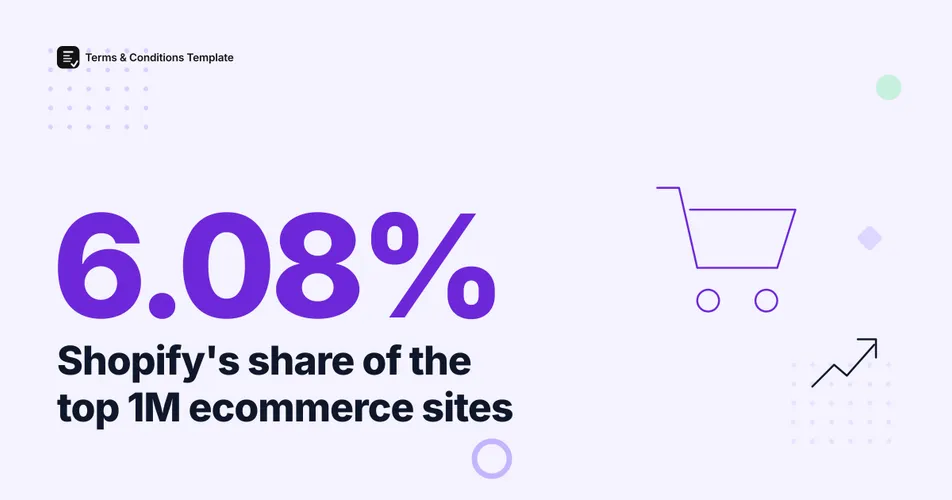
Shopify leads the top 1 million ecommerce sites with 6.08% market share in 2026, nearly double WooCommerce’s 3.12% in that same tier, according to HTTP Archive’s May 2026 crawl of roughly 8.9 million mobile sites via the Chrome User Experience Report. But zoom out to the entire measurable web and the ranking flips: WooCommerce leads at 6.64% share versus Shopify’s 4.76%, because WooCommerce also runs on millions of blogs and content sites that never process a single order.
Which number is “correct” depends entirely on the question you are actually asking. Below is the full ranked list, both ways of counting, and the growth trends behind each platform’s current position.
Which ecommerce platform has the largest market share in 2026?
There is no single correct answer, only a correct answer to a specific question. HTTP Archive’s May 2026 crawl, covering roughly 8.9 million sites, gives two different leaders depending on the denominator used.
| Rank | Platform | Share of measurable web | Share among named platforms |
|---|---|---|---|
| 1 | WooCommerce | 6.64% | 39.0% |
| 2 | Shopify | 4.76% | 27.9% |
| 3 | Wix eCommerce | 1.48% | 8.7% |
| 4 | Squarespace Commerce | 1.12% | 6.6% |
| 5 | PrestaShop | 0.60% | 3.5% |
| 6 | 1C-Bitrix | 0.57% | 3.4% |
| 7 | Magento / Adobe Commerce | 0.38% | 2.2% |
| 8 | OpenCart | 0.24% | 1.4% |
| 9 | Tiendanube | 0.20% | 1.2% |
| 10 | Nuvemshop | 0.15% | 0.9% |
| 11 | BigCommerce | 0.14% | 0.8% |
Figure 1: Top 6 ecommerce platforms by share of the measurable web. Source: HTTP Archive, May 2026 crawl, ~8.9M sites.
WooCommerce’s whole-web lead is a detection artifact as much as a market signal: it is a WordPress plugin, and WordPress powers a huge share of all websites regardless of whether they sell anything. That is exactly why the next section, restricted to sites actually built to sell, tells a different story. For a deeper look at either platform individually, see our Shopify stores and sales data for 2026 and WooCommerce stores and market share data for 2026.
How does market share change among the biggest stores?
Restrict the same HTTP Archive dataset to the top 1 million sites by traffic, a rough proxy for sites doing meaningful commerce volume, and Shopify pulls ahead decisively: 6.08% versus WooCommerce’s 3.12%, roughly a 1.95x lead.
Figure 2: Relative share held by Shopify versus WooCommerce among the top 1 million ecommerce sites (excludes smaller platforms). Source: HTTP Archive, May 2026 crawl.
This is the number that matters most for a merchant sizing up which platform serves the businesses closest to their own scale. A small blog running a WooCommerce plugin for one product does not compete with a mid-market Shopify store, and the top-1M-sites cut filters most of that noise out.
How much revenue actually flows through each platform?
Site count and dollar volume are not the same measurement, and Shopify’s own numbers show why. Shopify merchants generated $378 billion in gross merchandise volume (GMV) in 2025, up from $292 billion in 2024, a 24% increase, according to the company’s investor filings. Cumulative GMV processed through the platform since launch surpassed $1 trillion in 2024 and exceeded $1.8 trillion by the second quarter of 2026. Shopify now powers more than 3 million active stores across 175-plus countries.
Figure 3: Shopify gross merchandise volume, 2024 vs. 2025. Source: Shopify investor filings and press releases.
Figure 4: Ecommerce platform milestones, 2020 to 2026. Sources: HTTP Archive, Shopify investor filings, StoreLeads.
Public store-count and share figures do not disclose per-platform GMV outside Shopify’s own reporting, since most competitors are privately held or bundle ecommerce revenue into larger corporate results. Treat the GMV comparison as a spotlight on Shopify specifically, not a like-for-like ranking against WooCommerce or the others. If you run a store on any of these platforms, a clear terms and conditions agreement covering orders, refunds, and liability travels with your business if you ever migrate platforms, which a growing share of merchants are doing given the share shifts below.
Which platforms are gaining and losing ground?
Growth is concentrated at the top. Shopify’s web share grew 11.7% year over year through May 2026, the fastest among major platforms, followed by Wix eCommerce at 8.4% and Squarespace Commerce at 2.0%. On the losing side, WooCommerce’s web share fell 6.8%, PrestaShop fell 16.1%, and Magento fell 19.0%, the steepest decline of any platform tracked.
Figure 5: Year-over-year web share change by platform, May 2025 to May 2026, shown as absolute percentage change. Source: HTTP Archive.
WooCommerce’s decline shows up on a second, independent measure too: StoreLeads reports WooCommerce’s live store count fell from a Q4 2024 peak of 4,748,170 stores to roughly 4.3 to 4.5 million by 2026, about an 8.6% drop from peak, even though quarter-over-quarter counts have bounced around within that range. Two different methodologies pointing the same direction is a stronger signal than either one alone.
Figure 6: Where major platforms sit on growth versus top-tier scale. Framework based on HTTP Archive share and growth data, not a single numeric study.
Which platform should you actually build on?
That question depends on the “full list” numbers above matched to what you are building, not on whichever platform posts the biggest headline share. A content-heavy site adding a small shop leans toward WooCommerce’s WordPress-native reach. A dedicated store prioritizing growth and a large top-tier peer group leans toward Shopify’s current momentum. A single flowchart-style decision framework:
Figure 7: A simplified decision path based on current platform share and growth trends. Framework based on this article’s own data, not a single numeric study.
One region-specific caveat worth flagging: US-focused vendor tracking suggests Shopify holds roughly 30% of US ecommerce sites specifically, with Wix around 23%, Squarespace around 16%, and WooCommerce around 14%, a notably different mix than the global figures above. That regional breakdown comes from a single vendor’s blog without a disclosed sample size, so treat it as directional rather than as precise as the HTTP Archive figures elsewhere in this piece.
The Bottom Line
WooCommerce still touches more of the internet, Shopify still leads where the money moves. Both statements are true at once, and neither one is the whole picture on its own. If you are picking a platform, match the measurement to your actual question: raw web presence favors WooCommerce, top-tier commerce peer group and growth momentum favor Shopify, and every platform on this list requires the same legal groundwork before you take a single order. A published terms and conditions agreement covering returns, liability, and acceptable use is not platform-specific, and it is one of the few parts of running a store that survives a migration between any of the eleven platforms above.
Frequently Asked Questions
Which ecommerce platform has the biggest market share in 2026? It depends how you count. Among the top 1 million ecommerce sites, Shopify leads with 6.08% share versus WooCommerce’s 3.12%, per HTTP Archive’s May 2026 crawl. Across the entire measurable web, WooCommerce leads at 6.64% because it also powers non-store WordPress sites, versus Shopify’s 4.76%.
How much revenue flows through Shopify? Shopify merchants generated $378 billion in gross merchandise volume in 2025, up from $292 billion in 2024, according to Shopify’s own investor filings. Cumulative GMV since the platform launched exceeded $1.8 trillion by the second quarter of 2026.
Is WooCommerce losing market share? Yes, on two independent measures. HTTP Archive data shows WooCommerce’s share of the web fell 6.8% year over year through May 2026, and StoreLeads reports WooCommerce’s live store count is down about 8.6% from its Q4 2024 peak of 4.75 million stores.
Which ecommerce platforms are growing the fastest in 2026? Shopify grew its web share fastest among major platforms at 11.7% year over year, followed by Wix eCommerce at 8.4% and Squarespace Commerce at 2.0%, according to HTTP Archive’s May 2026 data. Magento and PrestaShop both declined by double digits over the same period.
Sources and References
- GravityKit. (2026). “Ecommerce Platform Market Share 2026.” Analysis of HTTP Archive Tech Report data, May 2026 crawl, ~8.9M mobile sites via Chrome User Experience Report.
- Shopify Investor Relations. (2026). Quarterly and annual GMV disclosures, 2024 to Q2 2026.
- US Securities and Exchange Commission. Shopify Inc. periodic filings (10-K, 10-Q, 8-K), fiscal years 2025 to 2026.
- Mobiloud. (2026). “Ecommerce Platform Market Share in the USA.” Regional US platform share estimates; methodology and sample size not disclosed.
Note: All figures verified as of August 2026. Platform market share shifts with every HTTP Archive crawl, so headline figures here are refreshed at least twice a year. The US-specific regional breakdown is flagged in-text as lower confidence due to undisclosed methodology.