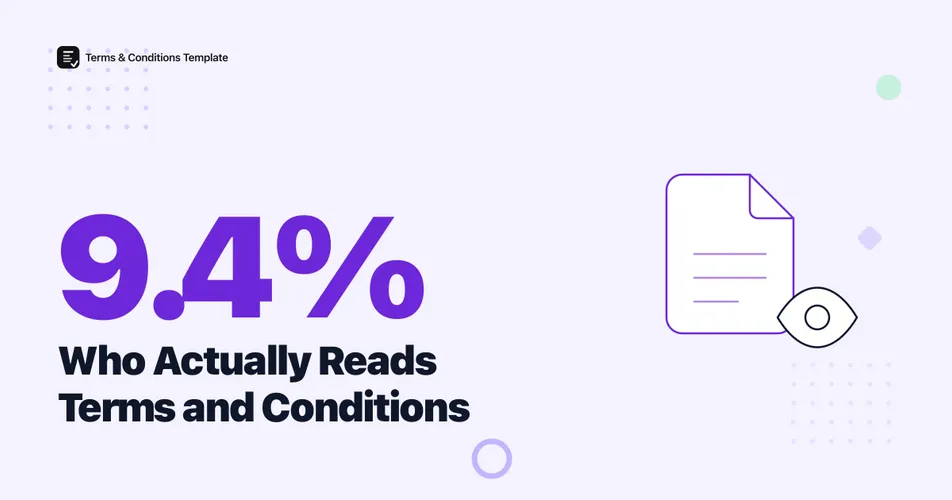
The honest answer to “what percentage of people read terms and conditions” is that it depends on how the terms are shown to them. The European Commission’s study of 12,000 consumers across 12 EU member states found reading rates ranging from 9.4% to 77.9% for the exact same type of document, based entirely on whether opening the terms was optional or required. Presentation format moves the number more than any other factor measured.
That range matters more than any single top-line figure, because it tells site owners something they can actually act on: reading behavior is not fixed, it is designed. Below is the current data on who reads terms and conditions, what changes the rate, and what that means for a document you are publishing today.
What percentage of people read terms and conditions?
The share of people who read terms and conditions swings hard depending on how much effort it takes to see them. In the European Commission’s 2016 study, when consumers had to click a separate link to view the terms, only 9.4% opened them at all, in the absence of any other prompt. When scrolling through the terms was built into the checkout flow itself, 77.9% reported at least scanning through them, and only 22.1% said they had not read any of it.
Figure 1: Reading engagement by presentation format, n=12,000 across 12 EU member states. Source: European Commission, Study on Consumers’ Attitudes Towards Online Terms and Conditions, 2016.
Warning
These figures measure self-reported scanning or opening, not full comprehension. A person who scrolled past a document is counted as having engaged with it even if they read none of the actual text, so the 77.9% figure describes exposure, not understanding.
The design of the checkout flow, not the content of the terms, is the single biggest lever over how many people even look.
How does the reading rate change with age?
Reading rates rise steadily with age. Pew Research Center’s 2019 survey of US adults found 65% of adults aged 50 and older say they have ever read a privacy policy or terms and conditions, compared to 56% of adults under 50. Among people who do read them, the gap widens further: 26% of adults 65 and older report reading all the way through, compared to just 15% of adults 18 to 29.
Figure 2: Full-document reading rate by age group. Source: Pew Research Center, Americans and Privacy, 2019.
Pew’s data also found lower-income households ($30,000 or less annually) read all the way through at nearly double the rate of higher-income households ($75,000 or more): 30% versus 15%. Together, age and income are stronger predictors of who actually reads a document than any single demographic trait typically assumed to matter, like tech familiarity.
Younger, higher-income users are the group least likely to read a document all the way through, which is also the group most likely to be signing up for a new service on a given day.
Do people who say they read terms actually read them?
Mostly not. Security.org’s 2025 survey of 1,011 American smartphone owners found 11% claimed to typically read user agreements, terms of service, and privacy policies thoroughly before signing. To test that claim, the same survey presented every respondent with a fake consent form containing a clause granting the company rights to name their firstborn child. 98% of all respondents agreed to the form. Only 16 people out of more than 1,000, roughly 1.6%, caught the clause and flagged it.
The gap between the 11% who self-report thorough reading and the roughly 1.6% who actually caught a planted clause is the clearest evidence that self-reported reading habits overstate real behavior by a wide margin.
That gap is the reason a terms and conditions generator built around clear, front-loaded clauses matters more than relying on users to catch problem terms on their own. See our full terms and conditions reading statistics for the underlying acceptance-rate data behind this pattern.
What actually increases how many people read terms and conditions?
Two interventions measurably increase reading rates in the European Commission’s controlled experiments. Shortening and simplifying the document raised the share who reported reading it in full from 10.5%, for a standard long and complex version, to 26.5%, for a short, plain-language version carrying the same substance. Adding a one-line reading-time estimate next to an optional link, stating the terms take less than five minutes to read, raised the share who opened them from 9.4% to 19.8%.
Figure 3: Effect of document length and complexity on full-read rate. Source: European Commission, 2016, Experiment 1.
Both interventions worked without changing what the terms actually said. Length, format, and a small reading-time cue moved behavior more than any appeal to trust or authority tested in the same study.
How has measured readership changed across studies over time?
Reading-rate estimates have been measured for close to two decades, and the European Commission’s own review of prior literature found readership estimates ranging from under 1% to about 65%, depending entirely on the specific situation and methodology used, before its own controlled experiments narrowed that range with disclosed sample sizes and formats.
Figure 4: Milestones in measuring the terms and conditions reading gap. Sources: European Commission (2016), Deloitte Global Mobile Consumer Survey (2017), Pew Research Center (2019), Brookings (2024), Security.org (2025).
Every fresh measurement over this period lands in the same range: a small minority reads any meaningful share of the document, and the range within that minority is driven mostly by how the document is presented, not by who the reader is.
What percentage of consumers say they never read terms of service?
Survey wording changes the number, which is itself part of the story. Brookings’ survey asked US respondents how often they read terms of service before consenting and found 32% say they never read them, 39% read them sometimes, 20% read them most of the time, and 9% were unsure. That “never” figure sits well below Deloitte’s 91%-unread figure because Brookings asked about partial reading habits rather than a single accept-or-reject moment, which is a reminder that “percentage who read terms and conditions” is not one fixed number across every study.
Figure 5: Self-reported reading frequency. Source: Brookings Institution survey on terms of service reading habits.
Two studies asking slightly different questions about the same underlying behavior can produce numbers that look contradictory on the surface but agree on the core finding: full, careful reading is rare, and most engagement is partial or skipped entirely.
Reading rates at a glance
| Measure | Figure | Source (year) |
|---|---|---|
| Open T&Cs when access is an optional link | 9.4% | European Commission (2016) |
| Scan T&Cs when scrolling is required | 77.9% | European Commission (2016) |
| Read T&Cs in full, short/simple version | 26.5% | European Commission (2016) |
| Claim to read user agreements thoroughly | 11% | Security.org (2025) |
| Caught a planted hidden clause | 1.6% (16 of 1,011) | Security.org (2025) |
| Adults 65+ who read privacy policies in full | 26% | Pew Research Center (2019) |
Source: see full citations below.
The Bottom Line
The percentage of people who read terms and conditions is not a fixed number, it is a design outcome. The European Commission’s data puts the floor at 9.4% and the ceiling at 77.9% for the same population reading the same type of document, moved entirely by whether opening the terms was optional or required. Security.org’s 2025 test adds a sharper warning: even the small share who claim to read carefully mostly do not catch problem clauses when it matters, with only 16 out of 1,011 people flagging a planted absurd term. For a business publishing terms and conditions, the lesson from both studies is the same. A document that states its material terms in the first two sentences, in plain language, gets read by more of the small share of people who look, and those numbers move measurably higher without changing the substance of a single clause.
Frequently Asked Questions
What percentage of people read terms and conditions? It depends entirely on how the terms are presented. The European Commission’s study of 12,000 consumers across 12 EU states found only 9.4% open terms and conditions when access requires clicking a separate link, but 77.9% at least scan through when scrolling past the terms is required to complete a purchase.
Do older people read terms and conditions more than younger people? Yes. Pew Research Center’s 2019 survey of US adults found 65% of adults aged 50 and older have ever read a privacy policy or terms and conditions, compared to 56% of adults under 50. Among those who read them, 26% of adults 65 and older read all the way through, versus 15% of adults aged 18 to 29.
Do people who say they read terms and conditions actually read them? Not reliably. Security.org’s 2025 survey of 1,011 American smartphone owners found 11% claimed to read user agreements thoroughly, but when shown a fake consent form containing a clause claiming rights to name their firstborn child, 98% of all respondents agreed anyway and only 16 people, out of more than 1,000, caught the clause.
Does shortening terms and conditions increase how many people read them? Yes. In the European Commission’s controlled experiment, 26.5% of consumers reported reading the whole document when it was rewritten as short and simple, compared to 10.5% who read the standard long, complex version of the same terms.
Sources and References
- European Commission. (2016). “Study on Consumers’ Attitudes Towards Online Terms and Conditions (T&Cs).” Three online experiments across 12 EU member states, n=1,000 per state (12,000 total), nationally representative samples.
- Pew Research Center. (2019). “Americans’ Attitudes and Experiences with Privacy Policies and Laws.” American Trends Panel survey, n=4,272 US adults, fielded June 3-17, 2019.
- Security.org. (2025). “Americans Get an F on Digital Privacy Knowledge.” Survey of 1,011 American smartphone owners, including a fake consent form test.
- Brookings Institution. Survey on how often US respondents read terms of service before consenting.
- Deloitte. (2017). “Global Mobile Consumer Survey, US Edition.” US cut of 2,000 consumers, part of a 51,000-respondent global survey.
Note: All figures verified as of July 2026. The European Commission’s 2016 study remains the largest disclosed-methodology dataset on this question by sample size; reading-behavior figures are refreshed at least twice a year as newer survey data becomes available.