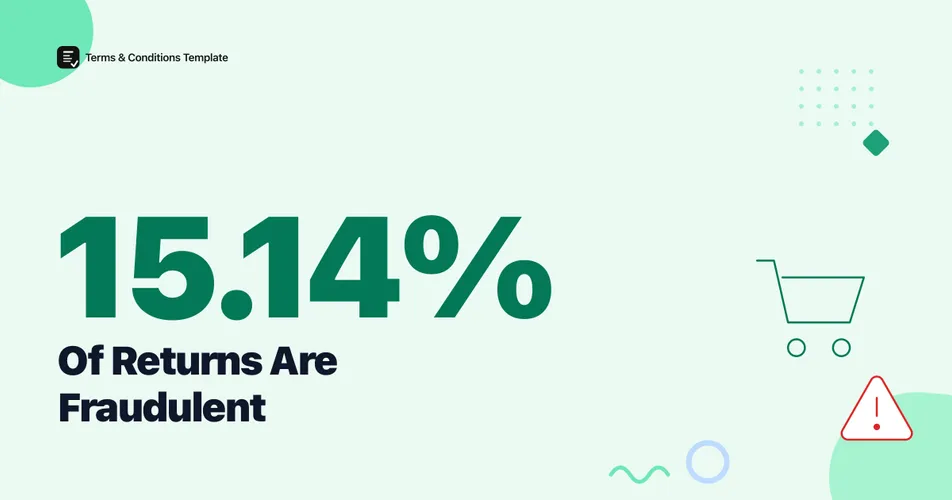
An estimated 15.14% of US retail returns were fraudulent or abusive in 2024, costing retailers $103 billion, according to Appriss Retail and Deloitte’s Consumer Returns in the Retail Industry report. That is up from 13.7% ($101 billion) the year before, and the rate keeps climbing even as overall return volume holds roughly steady.
A separate NRF survey of shoppers and ecommerce professionals puts the 2025 fraud rate at 9% of a record $849.9 billion in total returns. The two numbers describe different populations measured different ways, and neither should be read as a straight-line trend against the other. What both agree on is the direction: return fraud is a growing, measurable cost, and the tactics behind it are increasingly well documented.
How much does return fraud cost retailers?
Retailers lost $103 billion to fraudulent and abusive returns in 2024, up from $101 billion in 2023, according to Appriss Retail and Deloitte’s annual Consumer Returns in the Retail Industry report, now in its seventh year. The report pairs point-of-sale data from more than 60 of the top 100 US retailers with US Census Bureau figures and a survey of 150 retail executives and 1,000 consumers.
Total returns fell slightly even as fraud losses rose: Appriss Retail’s POS-based analysis put 2024 returns at $685 billion (13.2% of retail sales), down from $743 billion (14.5% of sales) in 2023. A separate NRF and Happy Returns survey, which projects returns from retailer and consumer self-reports rather than transaction data, estimated total 2024 returns at $890 billion. The gap between the two 2024 figures is a methodology difference, not a contradiction, and it is worth knowing before you compare any single year’s numbers across sources.
Figure 1: Fraud and abuse as a share of 2024 return dollars. Source: Appriss Retail and Deloitte, Consumer Returns in the Retail Industry, 2024 data.
For every $100 a retailer takes back in returns, about $15.14 of it is now fraud or abuse rather than a genuine change of mind. That single number is why fraud detection has moved from a loss-prevention afterthought to a line item retailers track year over year.
What percentage of returns are fraudulent?
The fraud rate rose from 13.7% of returns in 2023 to 15.14% in 2024, per Appriss Retail and Deloitte’s matched POS methodology, which is the most direct year-over-year comparison available since both figures come from the same underlying data pipeline. NRF’s own 2023 press release explicitly warns that its 2022 figures cannot be compared to 2023 due to a methodology change, so this article does not chart 2022 alongside the more recent years.
Figure 2: Return fraud rate trend, same methodology both years. Source: Appriss Retail and Deloitte, 2023 and 2024 Consumer Returns reports.
Warning
NRF’s separate 2025 Retail Returns Landscape survey reports a 9% fraud rate, lower than the 15.14% Appriss Retail and Deloitte figure for 2024. This is not evidence that fraud fell. The two studies measure different populations with different instruments: Appriss Retail pairs actual POS transaction data from 60-plus large retailers with an executive and consumer survey, while NRF’s 2025 figure comes from a summer 2025 survey of 2,006 consumers who had returned an online purchase and 358 ecommerce professionals at merchants with over $500 million in revenue. Treat the two tracks as separate data series, not points on one trend line.
For scale, a 2.25% refund rate on purchases, as tracked separately in refund statistics for 2026, is not the same measurement as this fraud rate. Refund rate counts what share of all purchases get refunded; return fraud rate counts what share of returns that already happened were fraudulent or abusive. A store can have a low refund rate and still lose real money to fraud within the returns it does process.
| Year | Fraud rate | Fraud losses | Total returns | Source |
|---|---|---|---|---|
| 2023 | 13.7% | $101B | $743B | Appriss Retail / NRF |
| 2024 | 15.14% | $103B | $685B | Appriss Retail / Deloitte |
| 2025 | 9%* | ~$76.5B (implied)* | $849.9B | NRF Returns Landscape |
The 2025 NRF figure uses a different survey methodology than the 2023 and 2024 Appriss Retail data, so it is not directly comparable; the implied dollar figure is this article’s own calculation (9% of $849.9B), not a number NRF published directly.
What are the most common return fraud tactics?
Retail executives and shoppers describe return fraud somewhat differently, because they are answering different questions. Appriss Retail and Deloitte’s 2024 survey asked 150 retail executives which fraud types they consider significant problems; wardrobing, wearing or using merchandise before returning it as new, topped the list at 60%.
Figure 3: Fraud tactics cited as significant by retail executives. Source: Appriss Retail and Deloitte, 2024 executive survey (n=150).
| Tactic (retail executives, 2024) | Cited as significant |
|---|---|
| Wardrobing | 60% |
| Fraudulent or stolen payment tender | 55% |
| Stolen merchandise returned | 48% |
| Counterfeit receipt | 48% |
| Bracketing (buying multiples, returning most) | 47% |
| Employee fraud or collusion | 39% |
NRF’s 2025 survey asked a different question, of a different group: what shoppers themselves reported doing or noticing. There, overstated return quantity led at 71%, followed by empty-box or “box of rocks” returns at 65% and decoy or counterfeit item returns at 64%.
| Tactic (shoppers, 2025) | Share reporting it |
|---|---|
| Overstated return quantity | 71% |
| Empty box / “box of rocks” | 65% |
| Decoy or counterfeit item returned | 64% |
Figure 4: Key return fraud reporting milestones. Sources: Appriss Retail/Deloitte 2023 and 2024 reports, NRF 2025 Retail Returns Landscape.
Do consumers think return fraud is acceptable?
Consumer attitudes help explain why the numbers keep rising. 45% of consumers say it is acceptable to “bend the rules” when returning an item, according to NRF’s 2025 survey of shoppers. Nearly two-thirds admit to at least one costly return practice, such as wardrobing, bracketing, or deliberately sending back the wrong item.
That is not the same as saying most shoppers commit outright fraud. The line between a gray-area habit and a fraud tactic a retailer would flag is often the frequency and pattern, not the single act. A shopper who wardrobes one dress for a wedding is a different risk profile than an account that wardrobes every large purchase, which is exactly the distinction AI fraud-scoring tools are now built to draw.
How are retailers fighting return fraud?
Retailers moved from broad policy tightening toward targeted detection in 2024. 83% tightened their return policies and 67% now require a receipt or proof of purchase, while 59% cap returns at 30 days or less. On the technology side, 54% manually monitor transaction data for fraud signals, 35% use real-time return-verification technology, and 85% now use AI-based fraud scoring to route trusted customers to frictionless returns while flagging risky ones for review, per Appriss Retail and Deloitte’s 2024 data.
Figure 5: A simplified version of the AI fraud-scoring flow retailers describe using. Source: Appriss Retail and Deloitte, 2024 report commentary on AI adoption.
Policy tightening only works if the policy itself is specific: a stated return window, a proof-of-purchase requirement, and clear language on what counts as an acceptable condition all give a fraud-scoring system, or a human reviewer, something concrete to check a claim against. If your current policy is vague on any of those points, you can generate a refund policy that spells out the evidence and timelines your return process actually enforces.
How does return fraud differ between online and in-store purchases?
Online purchases carry a meaningfully higher return rate than in-store ones, which widens the surface for fraud even before intent enters the picture. Appriss Retail’s 2024 data puts the online return rate at 24.52% against 8.72% in-store, and buy-online-return-in-store (BORIS) transactions now account for 52% of return dollars. The broader online return picture, including category-level benchmarks, is covered in ecommerce return rate statistics for 2026.
| Channel | Return rate (2024) |
|---|---|
| Online | 24.52% |
| In-store | 8.72% |
A higher return rate is not the same as a higher fraud rate, since neither Appriss Retail nor NRF publish a fraud-rate split by channel. What the online share does mean is that fraud-scoring systems trained mostly on in-store, receipt-based signals have to work harder on BORIS and mail-back returns, where proof of purchase and item condition are both easier to fake.
The Bottom Line
The number that matters most for 2026 planning is not the total dollar figure, it is the 15.14% fraud rate inside it. Return volume is roughly flat to slightly down, but the share of returns that are fraudulent or abusive keeps climbing, from 13.7% to 15.14% in the one year-over-year comparison that uses consistent methodology. Retailers are responding with AI fraud scoring, receipt requirements, and shorter return windows, and 85% adoption of automated scoring suggests this is now standard practice rather than a leading-edge experiment. If your return policy does not yet state a clear window and proof-of-purchase requirement, that gap is the first thing a fraud-scoring system, or a persistent fraudster, will find.
Frequently Asked Questions
What percentage of returns are fraudulent? About 15.14% of US retail returns were fraudulent or abusive in 2024, per Appriss Retail and Deloitte’s Consumer Returns report, up from 13.7% in 2023. A separate NRF survey of shoppers and ecommerce professionals put the 2025 figure at 9%, but the two studies use different methodology and are not directly comparable.
How much money do retailers lose to return fraud? Retailers lost $103 billion to fraudulent and abusive returns in 2024, up from $101 billion in 2023, according to Appriss Retail and Deloitte. Applying NRF’s 2025 fraud rate of 9% to its $849.9 billion total returns estimate would put 2025 losses at roughly $76 billion, though the two figures are not calculated the same way.
What is the most common type of return fraud? Wardrobing, wearing or using an item then returning it as new, is the tactic cited most often by retail executives, flagged by 60% in Appriss Retail and Deloitte’s 2024 survey. Among shoppers themselves, NRF’s 2025 survey found overstated return quantity (71%) and empty-box or “box of rocks” returns (65%) were the most commonly reported tactics.
How are retailers preventing return fraud? 85% of retailers now use AI-based fraud scoring to flag suspicious returns, according to Appriss Retail’s 2024 data. 83% tightened their return policies and 67% now require a receipt or proof of purchase.
Sources and References
- Appriss Retail. (2024). “Appriss Retail Annual Research: Fraudulent Returns and Claims Cost Retailers $103B in 2024.” Seventh annual Consumer Returns in the Retail Industry report, with Deloitte, based on POS data from 60+ of the top 100 US retailers, US Census Bureau data, and a survey of 150 retail executives and 1,000 consumers.
- National Retail Federation. (2025). “2025 Retail Returns Landscape.” Survey of 2,006 consumers who returned an online purchase in the past 12 months and 358 ecommerce professionals at merchants with $500M+ revenue, conducted summer 2025.
- National Retail Federation and Appriss Retail. (2023). “NRF and Appriss Retail Report: $743 Billion in Merchandise Returned in 2023.” Data from 60 of the top 100 US retailers; explicitly notes 2022 figures are not comparable due to a methodology change.
- National Retail Federation and Happy Returns. (2024). “2024 Retail Returns to Total $890 Billion.” Survey-based total returns projection, a separate methodology from the Appriss Retail POS data cited above.
- Digital Commerce 360. (2025). “Retailers continue battling fraudulent and abusive returns in 2024.” Channel-level return rate breakdown from Appriss Retail and Deloitte data.
Note: All figures verified as of July 2026. Return fraud figures are refreshed at least twice a year, and methodology differences between the Appriss Retail/Deloitte and NRF survey tracks are flagged in-text and should be re-checked before each refresh.