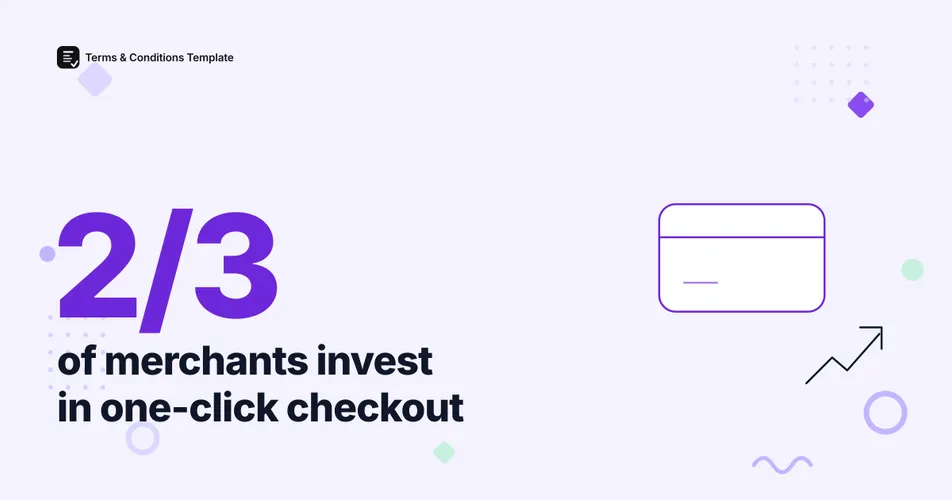
Two-thirds of merchants are now investing in accelerated, one-click checkout, according to an April 2025 Forrester Consulting study commissioned by PayPal that surveyed 553 ecommerce decision-makers. Shop Pay alone processed 32% of all Shopify orders during Black Friday-Cyber Monday 2025. One-click checkout has moved from an Amazon-only patent to a default expectation shoppers now bring to nearly every store.
How many merchants have adopted one-click checkout in 2026?
Two-thirds of merchants are already investing in accelerated checkout, the kind that autofills payment and shipping details and skips forced account creation, according to Forrester Consulting’s April 2025 Opportunity Snapshot commissioned by PayPal. The survey covered 553 ecommerce and payments decision-makers across the United States, Germany, and the United Kingdom, fielded in March 2025.
Merchants aren’t guessing at the payoff. Asked how accelerated checkout would affect their business, decision-makers ranked customer experience and repeat purchases as the top expected gains.
Figure 1: Share of merchant decision-makers who rank accelerated checkout as a strong positive driver of each outcome (score of 9 or 10 out of 10). Source: Forrester Consulting for PayPal, 2025, n=584 decision-makers.
Merchants adopting one-click checkout should not treat the buy button as the whole agreement. A single tap now stands in for the entire order confirmation, so the terms customers are agreeing to need to be just as clear as the checkout itself. Pairing a fast checkout with a current, plain-language policy is easy to do with a terms and conditions generator that spells out what a one-tap purchase commits a shopper to.
Why do shoppers say they want a one-click checkout?
73% of consumers say a checkout with a minimal number of steps is important or extremely important, ranking it above personalization and product recommendations, per Forrester’s 2025 survey of 2,002 North American and European online shoppers. Ease of experience, not price or selection, is what shoppers name as the deciding factor at checkout.
Payment method preference explains part of why one-click checkout works so well. Consumers still favor a credit or debit card first, but a quarter now name a digital wallet, the payment type behind most one-click flows, as their top choice.
Figure 2: Consumers’ preferred online payment method, showing the top two named responses. Source: Forrester Consulting for PayPal, 2025, n=2,002 consumers.
Every digital wallet transaction is a transaction where card entry, address entry, and account login are skipped entirely, which is exactly the friction accelerated checkout is designed to remove.
Where is the gap between shopper struggles and merchant awareness costing sales?
Merchants underestimate checkout friction by a wide margin. Over one-third of consumers report difficulty with basic checkout tasks, yet only about one in ten merchants recognize those same tasks as challenging, according to Forrester’s 2025 survey.
The gap holds across every step of a standard checkout, not just one weak point.
Figure 3: Each checkout task plotted by the share of consumers who call it challenging against the share of merchants who recognize it as challenging. Source: Forrester Consulting for PayPal, 2025 (consumer base n=2,002, merchant base n=584).
The cost of ignoring that gap is direct. When consumers hit a poor checkout experience, 70% look for the same product on a different website, 67% form a negative opinion of the brand, and 59% say they are less likely to buy from that store again. For the full breakdown of what checkout friction does to completed sales, see our cart abandonment statistics for 2026.
What actually counts as one-click checkout?
Not every “fast checkout” button is genuinely one click. Forrester’s respondents defined accelerated checkout specifically as an experience that autofills both payment and shipping information without requiring the shopper to log into an account first, a narrower bar than simply saving a card on file.
Figure 4: The test Forrester’s 2025 study used to define accelerated, one-click checkout. Source: Forrester Consulting for PayPal, methodology section, 2025.
Creating an account before checkout is the single most-cited checkout obstacle among consumers, ahead of shipping cost or delivery speed concerns, and under one-quarter of shoppers say guest checkout even matters to them once autofill is available. The account wall, not the payment step, is what shoppers want removed first.
How has one-click checkout adoption grown since Amazon’s patent expired?
Amazon filed the original 1-Click patent in September 1997 and used it, along with lawsuits and licensing deals, to keep single-click purchasing largely exclusive for nearly two decades. When the patent expired on September 11, 2017, any merchant became free to build the same experience, and platform adoption followed within the same year.
Growth since then has not been steady so much as concentrated around major platform launches and peak shopping weekends.
Figure 5: Key product launches, legal milestones, and adoption data points for one-click checkout. Sources: patent history reporting, Shopify, Stripe, Amazon, Forrester Consulting for PayPal.
For the underlying checkout-speed research that explains why merchants keep building toward one-click, see our checkout speed statistics for 2026, which measures the 5.1-step standard flow that accelerated checkout is built to shortcut.
Which one-click checkout platforms reach the most shoppers?
Reach varies enormously by provider, and no single company discloses every figure the same way, so comparing platforms means pulling each company’s own most recent numbers side by side.
| Checkout method | Reach or adoption | Conversion lift | Source (year) |
|---|---|---|---|
| Any accelerated checkout (merchant adoption) | 2 in 3 merchants investing | up to 42% expect a customer experience lift | Forrester Consulting for PayPal (2025) |
| Shop Pay (Shopify) | 150M+ shoppers, 32% of BFCM 2025 orders | up to 50% vs guest checkout | Shopify (2023, 2025) |
| Link (Stripe) | 300M+ consumers with access | 14% returning-customer lift | Stripe (2025-2026) |
| PayPal | 439M active accounts | not isolated from overall PayPal usage | PayPal 10-K, FY2025 |
| Buy with Prime (Amazon) | undisclosed total reach | 25% avg conversion lift (37-merchant sample) | Amazon (2023 data) |
Note the Buy with Prime figure is Amazon’s own 2023 data point and has not been refreshed publicly since; treat it as directional rather than current.
The Bottom Line
The number that matters most in 2026 is not any single platform’s user count, it is that two-thirds of merchants are now building toward accelerated checkout because shoppers have made clear that step count decides where they buy. Shop Pay’s 32% BFCM order share and Stripe Link’s 300 million-consumer reach show the shift is no longer experimental. The gap merchants still need to close is the perception one: consumers rank account creation and manual data entry as far more painful than merchants believe, and that mismatch is costing repeat business every day it goes unfixed. Closing it is mostly a checkout-flow decision, not a marketing one, and the payoff Forrester’s own respondents expect, higher revenue, more repeat purchases, better brand reputation, is the same one already showing up in Shopify’s and Stripe’s disclosed numbers.
Frequently Asked Questions
What percentage of merchants offer one-click checkout in 2026? Two-thirds of merchants are already investing in accelerated, one-click checkout, according to an April 2025 Forrester Consulting study commissioned by PayPal that surveyed 553 ecommerce decision-makers across North America and Europe.
How much does one-click checkout increase conversion rates? Shop Pay lifts conversion by up to 50% compared to guest checkout, and Stripe’s Link wallet drives an average 14% increase in returning-customer conversion, according to each company’s own published figures.
Which one-click checkout providers have the widest reach? Stripe’s Link wallet is accessible to over 300 million consumers across Stripe-powered sites, and Shopify’s Shop Pay reaches over 150 million global shoppers, per each company’s 2025 and 2026 disclosures.
Why do shoppers say creating an account is the biggest checkout obstacle? 38% of consumers report difficulty creating a new account during checkout, but only 12% of merchants recognize this as a pain point, a 26-point perception gap found in Forrester Consulting’s 2025 survey of 2,002 online shoppers.
Sources and References
- Forrester Consulting. (2025). “The Future Of Checkout Experiences.” Opportunity Snapshot commissioned by PayPal, surveys of 553 merchant decision-makers and 2,002 consumers in North America and Europe, fielded March 2025.
- Shopify. (2025). “Shopify Merchants Generate Record-Breaking $14.6 Billion in Black Friday Cyber Monday Sales.” Official BFCM 2025 results, including Shop Pay order share and year-over-year growth.
- Shopify. (2023). “Shop Pay: The Best-Converting Accelerated Checkout on the Internet.” Conversion figures from an external study with a Big Three global management consulting firm, April 2023.
- Stripe. “Link by Stripe: One-Click Payments.” Official product page, reach and conversion figures, accessed 2026.
- PayPal Holdings, Inc.. (2026). Form 10-K for fiscal year 2025. Active account figures as of December 31, 2025.
- Amazon. (2023). “Amazon’s Buy with Prime Increases Shopper Conversion by 25% on Average.” Based on a sample of 37 merchants, January 2023.
- GeekWire. (2017). “Amazon’s ‘1-Click’ Patent Expires Today.” Reporting on U.S. Patent No. 5,960,411, filed September 1997, expired September 11, 2017.
- TechCrunch. (2026). “Stripe Updates Link, a Digital Wallet That Autonomous AI Agents Can Use, Too.” Coverage of Link’s agentic-commerce update, April 2026.
- Baymard Institute. “50 Cart Abandonment Rate Statistics.” Compilation of checkout abandonment reasons, including forced account creation, 2006 to 2025.
Note: All figures verified as of August 2026. Provider-specific adoption and reach figures are refreshed by each company on its own schedule, so headline figures here are revisited at least twice a year.