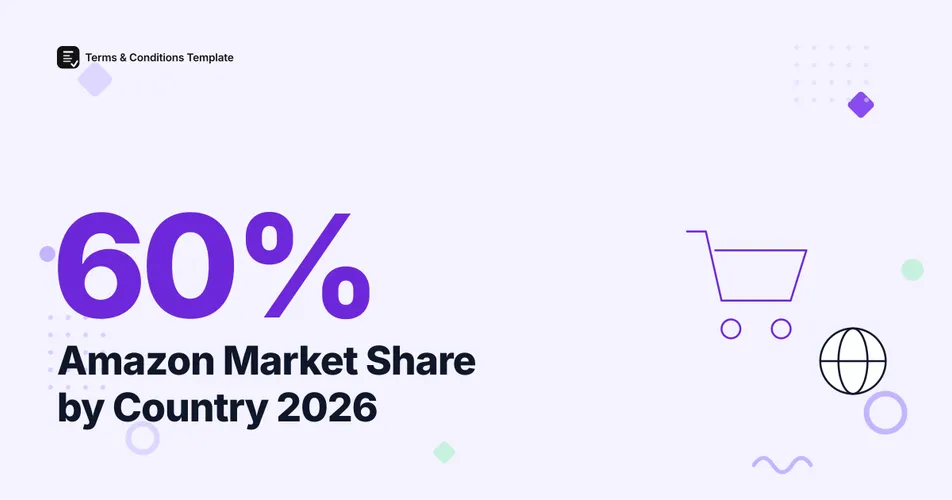
Amazon’s dominance is not the same everywhere. In Germany, Amazon captures roughly 60% of all online retail sales, according to Germany’s Federal Cartel Office (Bundeskartellamt), its highest concentration in any major economy. In the United States, that figure falls to 35.7% of a 1.2 trillion dollar market in 2025, per Marketplace Pulse. Market share by country tells a very different story than any single global number.
That gap matters for anyone selling through Amazon or building a storefront alongside it. A seller strategy tuned for the US market, where Walmart, Temu, and TikTok Shop chip away at Amazon’s lead, does not transfer cleanly to Germany, where Amazon functions closer to a default retail utility, or to India, where Flipkart still leads.
How dominant is Amazon in Germany?
Germany is Amazon’s most concentrated major market. The Bundeskartellamt, Germany’s national competition regulator, has repeatedly cited a figure of around 60% of German online retail sales running through Amazon’s platform across its ongoing abuse-control proceedings against the company. That estimate combines Amazon’s own first-party retail sales with the sales third-party merchants make through Amazon’s German marketplace.
Figure 1: Amazon’s estimated share of national online retail sales, selected countries. Sources: Bundeskartellamt (Germany), Statista (Japan), Marketplace Pulse (US), eMarketer (India), Texintel/ecommerceDB (UK). See Sources for individual report dates.
That concentration has drawn direct regulatory action. On February 5, 2026, the Bundeskartellamt prohibited Amazon from using so-called price control mechanisms against third-party sellers and ordered the disgorgement of an initial 59 million euros in economic benefits, following a preliminary legal assessment issued in June 2025. The size of Amazon’s German footprint is precisely why German regulators, not just EU-level ones, are willing to act unilaterally.
Figure 2: Timeline of Germany’s regulatory response to Amazon’s ~60% market share. Source: Bundeskartellamt press releases, 2023 to 2026.
The lesson for any seller building a German storefront: a 60% share is not a stable equilibrium regulators will leave alone. Compliance documentation, including clear terms for German buyers, is now a live regulatory expectation, not just good practice.
How big is Amazon’s share of the US ecommerce market?
Amazon generated roughly 440 billion dollars in US sales in 2025, a 35.7% share of the 1.2 trillion dollar US ecommerce market, according to Marketplace Pulse’s 2025 tracking. That is a meaningful step down from Amazon’s 2021 peak of about 41.8%, as Walmart, Shopify-powered independent stores, TikTok Shop, and Temu have each carved out share over the past four years.
Figure 3: Amazon’s US ecommerce share, 2021 peak versus 2025. Source: Marketplace Pulse.
If you sell through your own site alongside Amazon, this is where a generate a terms and conditions agreement belongs in your launch checklist. A US ecommerce market fragmenting away from a single dominant platform means more direct-to-consumer stores need their own legal footing rather than leaning on a marketplace’s terms. For more on the broader platform picture, see our Amazon statistics for 2026, which covers seller counts and total sales alongside market share.
Even at a declining share, 35.7% of a 1.2 trillion dollar market is a larger dollar figure than Amazon’s entire US business was worth just a few years ago. Share erosion and revenue growth are happening at the same time.
How does Amazon compare to local rivals in Asia?
Amazon does not lead every market it operates in. In Japan, Amazon holds an estimated 49.6% share of ecommerce sales against Rakuten’s 32.4%, per Statista’s 2025 brand-share data, a genuine two-horse race rather than Amazon-led dominance. In India, the picture flips further: Flipkart, majority owned by Walmart, leads with roughly 48% of retail ecommerce sales, ahead of Amazon’s estimated 30 to 35%, according to eMarketer’s platform forecasts covering 2024 through 2026.
Figure 4: Estimated share of India’s retail ecommerce sales by platform. Source: eMarketer platform-share forecasts.
Both India and Japan share a pattern: a strong domestic or regionally rooted rival got there first, or built deeper category strength, before Amazon could establish the kind of lead it holds in Germany or the UK. That makes India and Japan the two clearest counterexamples to the idea that Amazon simply wins by default.
Is Amazon growing or shrinking as a marketplace?
Globally, Amazon’s own retail sales are now a minority of what moves through its platform. Third-party sellers generated an estimated 575 billion dollars of Amazon’s 830 billion dollars in global gross merchandise value in 2025, a 69% share, according to Marketplace Pulse. On a unit basis the split is narrower: third-party sellers accounted for 60% of paid units in Q1 2026, down slightly from 61% the prior quarter, as Amazon has been regaining first-party unit share in consumables and private-label categories.
Figure 5: Share of Amazon’s global GMV by seller type, 2025. Source: Marketplace Pulse.
This matters for the market share numbers above: in every country listed, a large share of what counts as “Amazon” is actually independent merchants selling through Amazon’s infrastructure, not Amazon-branded retail. For sellers weighing how exposed their business is to platform policy, our average Amazon seller revenue benchmarks and Amazon advertising spend data break down what that marketplace share is actually worth per seller.
Amazon’s market share by country: the numbers side by side
| Country | Amazon’s estimated share | Nearest rival | Source |
|---|---|---|---|
| Germany | 60% | N/A (fragmented) | Bundeskartellamt |
| Japan | 49.6% | Rakuten, 32.4% | Statista |
| United States | 35.7% | Walmart | Marketplace Pulse |
| India | ~32% | Flipkart, 48% | eMarketer |
| United Kingdom | 30%+ | eBay | Texintel / ecommerceDB |
Source figures cover 2025 data unless otherwise noted in the Sources section below; see each report for exact collection dates.
The Bottom Line
Amazon’s global brand hides five very different local realities. In Germany, it is close to a retail utility at 60% share, which is exactly why regulators moved against its pricing practices in 2026. In the US, its 35.7% share is shrinking as Walmart, Temu, and direct-to-consumer stores gain ground. In Japan and India, Amazon is not even the market leader. Any strategy built on “Amazon dominance” as a single global fact will misread at least half of these markets. Sellers and store owners operating across borders need country-specific numbers, and country-specific legal documentation, not a single global assumption.
Frequently Asked Questions
What percentage of German online sales go through Amazon? Around 60% of online retail sales in Germany run through Amazon’s platform, a figure that has appeared consistently across multiple Bundeskartellamt (German Federal Cartel Office) proceedings, most recently in its February 2026 decision against Amazon’s price control mechanisms.
What is Amazon’s market share of US ecommerce? Amazon generated about 440 billion dollars in US sales in 2025, a 35.7% share of the 1.2 trillion dollar US ecommerce market, according to Marketplace Pulse. That is down from Amazon’s 2021 peak of roughly 41.8%.
Is Amazon or Flipkart bigger in India? Flipkart leads India’s ecommerce market with an estimated 48% share of retail ecommerce sales, ahead of Amazon at roughly 30 to 35%, according to eMarketer’s platform-share forecasts for 2024 to 2026.
How much of Amazon’s sales come from third-party sellers? Third-party sellers generated about 575 billion dollars of Amazon’s 830 billion dollars in global gross merchandise value in 2025, a 69% share, according to Marketplace Pulse.
Sources and References
- Bundeskartellamt. (2026). “Bundeskartellamt prohibits Amazon from applying so-called price control mechanisms.” Official regulator decision, February 5, 2026.
- Marketplace Pulse. (2025). “Amazon GMV Surpassed 800 Billion Dollars in 2025.” Third-party vs. first-party GMV split.
- Statista. (2025). “Amazon: brand share in Japan’s e-commerce market.”
- eMarketer. (2024-2026 forecast). India retail ecommerce platform share, Amazon and Flipkart.
- Texintel. (2025). “Amazon Dominate UK Ecommerce With More Than 30% Market Share.” Analysis of ecommerceDB data.
- eMarketer. (2024). “Amazon Will Surpass 40% of US Ecommerce Sales This Year.” Forecast figure, included for the 2021-era peak comparison.
Note: All figures verified as of August 2026. Market share estimates vary by methodology and are refreshed at least twice a year as new annual data is published.