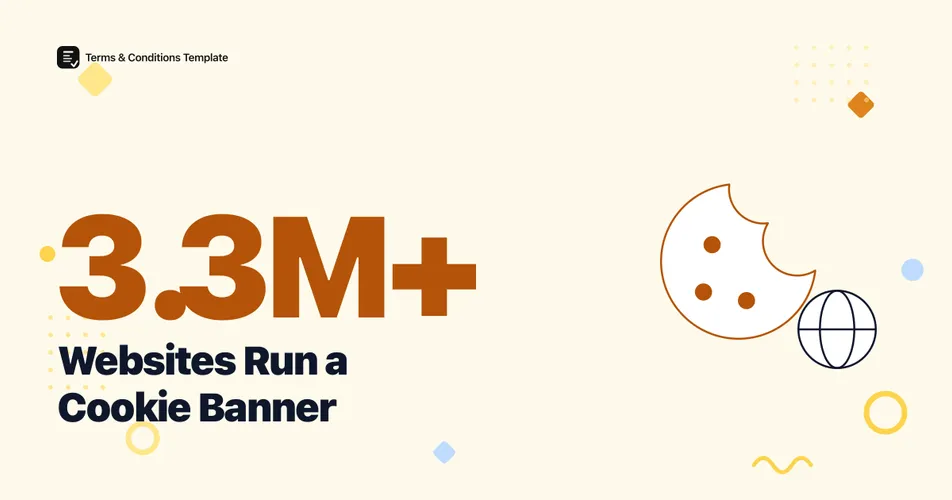
Over 3.3 million live websites, 5.74% of the web, run a dedicated cookie banner tool as of 2026, according to WebTechSurvey’s continuously updated crawl of 58.2 million indexed sites. That number looks small next to how common cookie banners feel to any web user, and the reason is the denominator: most of the web is small, low-traffic, or dormant, and never installs one. Among the sites people actually visit, the count looks completely different.
If you run a website that gets real traffic, from a store to a blog with analytics installed, the question is not whether banners are common but whether yours matches what the highest-traffic sites already do. Here is the full count, broken down by vendor, country, and site tier, with the sources that produced each number.
How many websites currently run a cookie banner?
Over 3.3 million live websites run a dedicated cookie banner tool, according to WebTechSurvey’s technology crawl, which indexes 58.2 million live websites and tags each one by the software it detects running on the page. That works out to 5.74% of the entire indexed web, a figure WebTechSurvey updates continuously rather than publishing on a fixed schedule, so treat it as a live snapshot taken in 2026 rather than a one-time historical count.
Figure 1: Share of WebTechSurvey’s 58.2 million indexed websites running a dedicated cookie-consent tool. Source: WebTechSurvey, 2026 crawl.
A site that runs a shopping cart, a login form, or an analytics platform, in other words most commercial and content sites with real traffic, almost always needs both a cookie and a banner to disclose it. Pairing a banner with a current cookie policy is the fastest way to close the gap between what your site’s code actually does and what it tells a visitor.
Why do cookie banner statistics range from 5% to 67%?
Because the underlying studies count entirely different populations. WebTechSurvey’s 5.74% figure covers its full crawled index of 58.2 million websites, the vast majority of which are small, low-traffic, or effectively dormant domains that never had a reason to install consent software. A CHI 2025 study by Nouwens et al., which scraped the top 10,000 most-visited websites in each of 31 countries with a GDPR or ePrivacy obligation, for 254,148 site observations total, found 67% of that much smaller and much more heavily trafficked sample show some kind of consent interface.
Figure 2: Why a single “percentage of websites with a banner” number does not exist. Source: WebTechSurvey; Nouwens et al., CHI 2025.
Neither number is wrong. They answer different questions: how common is a cookie banner across every live domain on the internet, versus how common is one among the sites that actually receive meaningful traffic. A journalist or founder asking “how many websites have a cookie banner” usually means the second question, and 67% is the more useful answer for anyone benchmarking against real competitors.
Which companies power the most cookie banners?
CookieYes leads WebTechSurvey’s cookie-compliance category by raw website count, with 631,689 live sites, 18.92% of the category. Complianz follows at 466,480 sites (13.97%), Cookie Notice at 445,136 sites (13.33%), Cookiebot at 246,846 sites (7.39%), and Osano at 237,556 sites (7.12%). Together the top five vendors account for well over half of every website WebTechSurvey has tagged with cookie-compliance software.
Figure 3: The five most-detected cookie banner vendors by raw website count. Source: WebTechSurvey, 2026 crawl.
This ranking looks different from vendor rankings built on the CHI 2025 top-10,000-per-country sample, where enterprise-focused platforms like Usercentrics and OneTrust score higher. The pattern makes sense once you separate the two datasets: WebTechSurvey’s full-web count skews toward the lower-cost, plugin-style tools that small and mid-size sites install by the millions, while a sample built from only the most-visited sites per country skews toward the enterprise platforms those larger organizations tend to buy.
Which countries host the most websites with a cookie banner?
The United States hosts the most cookie-banner websites in absolute terms, narrowly ahead of Germany, with France a distant third among the countries WebTechSurvey tracks individually.
| Country | Websites running a cookie banner tool | Share of the 3.3M+ total |
|---|---|---|
| United States | 661,945 | 19.8% |
| Germany | 655,542 | 19.6% |
| France | 314,271 | 9.4% |
Source: WebTechSurvey, 2026 crawl of its cookie-compliance category.
Germany’s near-tie with the US is notable given the size difference between the two countries’ web presences overall, and reflects how directly GDPR and Germany’s own stricter national guidance push site owners toward installing a banner tool rather than writing one from scratch.
How does banner prevalence compare across different datasets?
Lining up every dataset side by side shows the same story the flowchart above describes: prevalence climbs as the sample narrows to more heavily trafficked sites.
| Dataset scope | Banner or CMP prevalence | Source |
|---|---|---|
| Top 10,000 sites per country, 31 countries | 67% | CHI 2025, Nouwens et al. |
| Tracked EEA websites, 2024 | 40.29% | Longitudinal EEA study, 11,364 sites |
| Tracked EEA websites, 2018 | 11.60% | Longitudinal EEA study, 11,364 sites |
| All indexed websites | 5.74% | WebTechSurvey, 2026 |
Figure 4: The same underlying question, four different answers, depending on which websites get counted. Sources: CHI 2025; longitudinal EEA study; WebTechSurvey.
Cookies themselves are more common than dedicated banner software either way you slice it: W3Techs’ daily-updated survey puts cookie use at 41.6% of all websites as of July 2026, well above WebTechSurvey’s 5.74% dedicated-tool figure. That gap includes sites running a custom-built banner WebTechSurvey’s crawler does not detect as third-party software, alongside sites using cookies without any consent interface at all, a split covered in more depth in what percentage of websites use cookies.
How has cookie banner adoption grown since GDPR?
Adoption has climbed steadily among the sites regulators actually watch. Among 11,364 EEA websites tracked every September from 2018 through 2024, the share running a consent management platform rose from 11.60% to 40.29%, a longitudinal study of 30 EEA countries found, roughly 3.5 times its starting level in six years.
Figure 5: Cookie banner counting milestones, 2018 to 2026. Sources: Longitudinal EEA study; Nouwens et al.; WebTechSurvey.
A rising count of sites with a banner does not automatically mean a rising count of banners that actually work as intended. Once a visitor sees the banner, what they click, and whether the site honors that click, is a separate question covered in cookie consent statistics for 2026.
The Bottom Line
The honest answer to “how many websites have a cookie banner” depends entirely on which websites you count. Across the whole crawled web, it is a modest 3.3 million sites, 5.74%, because most domains are small and never needed one. Among the sites that actually carry meaningful traffic, the CHI 2025 study puts the figure at 67%, and CMP adoption among tracked EEA sites has grown roughly 3.5x since 2018. If your site earns real traffic and sets a cookie of any kind, the relevant benchmark is the 67% figure, not the 5.74% one, and the fastest way to close that gap is a banner paired with a current, accurate cookie policy that names what your site actually collects.
Frequently Asked Questions
How many websites have a cookie banner in 2026? Over 3.3 million live websites, about 5.74% of the web, run a dedicated cookie banner tool as of 2026, according to WebTechSurvey’s crawl of 58.2 million indexed sites. Among the most heavily trafficked sites specifically, the share is much higher: 67% of the 254,148 top websites scraped across 31 countries show some kind of consent interface, per a CHI 2025 study by Nouwens et al.
Why do cookie banner statistics range from 5% to 67%? Because the studies count different populations. WebTechSurvey’s 5.74% figure covers its entire crawled index of 58.2 million websites, most of which are small, low-traffic, or dormant. The CHI 2025 study’s 67% figure covers only the top 10,000 most-visited websites in each of 31 countries with a GDPR or ePrivacy obligation, a much smaller and much more heavily trafficked sample.
Which company provides the most cookie banners? CookieYes leads by raw website count with 631,689 live sites (18.92% of WebTechSurvey’s cookie-compliance category), ahead of Complianz at 466,480 sites (13.97%), Cookie Notice at 445,136 sites (13.33%), and Cookiebot at 246,846 sites (7.39%).
Has cookie banner adoption grown since GDPR took effect? Yes. Among 11,364 EEA websites tracked every September from 2018 to 2024, the share running a consent management platform rose from 11.60% to 40.29%, according to a longitudinal study covering 30 EEA countries.
Sources and References
- WebTechSurvey. (2026). “Cookie Compliance Usage Statistics.” Continuously updated crawl of 58.2 million indexed websites.
- Nouwens, Kristensen, et al.. (2025). “A Cross-Country Analysis of GDPR Cookie Banners and Flexible Methods for Scraping Them.” CHI 2025, ACM. Analysis of 254,148 websites across 31 countries.
- Longitudinal EEA cookie banner study. (2024 data). “A History of GDPR Cookie Banner Compliance.” 11,364 websites, 30 EEA countries, 2018 to 2024.
- W3Techs. (2026). “Usage Statistics of Cookies for Websites.” Daily-updated survey, data captured July 2026.
Note: All figures verified as of August 2026. WebTechSurvey’s crawl figures update continuously and are refreshed at least twice a year in this article.