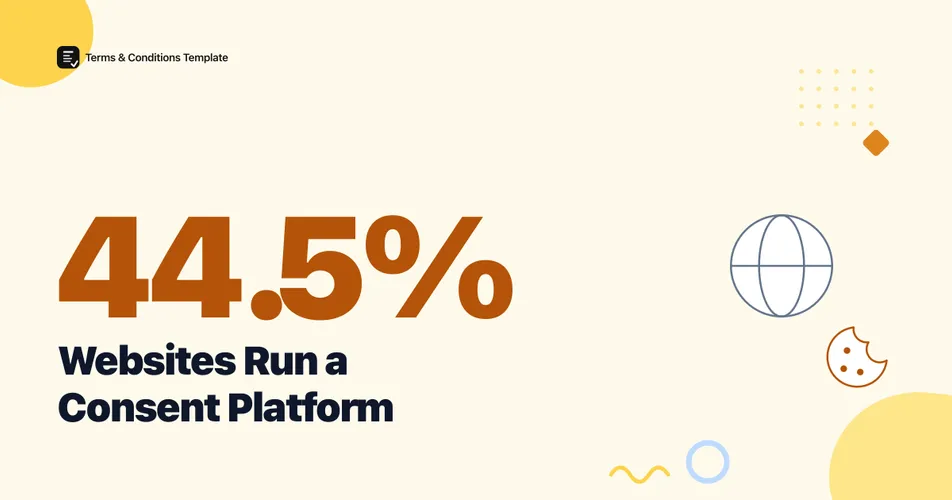
44.5% of all websites analyzed run a third-party consent management platform, according to a CHI 2025 study of 254,148 websites across 31 countries by Nouwens et al. Another 22.5% display a custom-built cookie banner instead of a CMP, and roughly a third show no consent interface at all. The CMP, once a niche compliance add-on, is now the default way a website asks a visitor for permission.
That single number hides a fast-moving market underneath it: which platforms dominate, how quickly adoption grew after GDPR enforcement began, and how the framework governing them is responding to a system that, by its own regulator’s numbers, still fails compliance audits at scale.
How many websites use a consent management platform?
44.5% of all websites analyzed run a CMP to display their cookie banner, the largest and most recent cross-country snapshot available. The figure comes from Nouwens et al.’s “A Cross-Country Analysis of GDPR Cookie Banners,” presented at CHI 2025 after scraping the top 10,000 websites in each of 31 countries with an ePrivacy or GDPR obligation, for 254,148 total site observations. The same dataset found 67% of websites show some form of consent interface at all, and that at least 67% of those interfaces are CMP-provided rather than custom-built, which is where the 44.5% figure comes from.
Figure 1: Share of analyzed websites by consent-interface type. Source: Nouwens et al., CHI 2025, 254,148 sites.
The custom-build option is shrinking in relative terms as CMPs get cheaper and easier to deploy, but it is far from gone. A site that builds its own banner still has to pass the same compliance bar as one running a CMP, and the study’s compliance numbers below suggest most sites, CMP or not, are not clearing that bar.
How has consent management platform adoption changed since GDPR?
CMP adoption among tracked EEA websites rose from 11.60% in 2018 to 40.29% in 2024, a 3.5x increase over six years. That comes from a longitudinal study of 11,364 websites across 30 EEA countries, tracked every September from 2018 through 2024, and it identified 18 distinct CMPs in the market: 12 comprehensive commercial platforms, 4 open-source options, and 2 browser-plugin CMPs. Overall cookie banner adoption, CMP or otherwise, grew more slowly over the same period, from 21.81% to 35.73%, meaning nearly all of the net growth in banners came from CMPs specifically rather than custom-built ones.
Figure 2: CMP adoption growth. Source: Longitudinal EEA cookie banner study, 11,364 sites, 2018 to 2024 data.
Country-level results vary sharply. By 2024, Denmark reached a 60.61% compliant-banner rate, with Austria at 44.44% and Finland at 44.23%. Over the full 2018 to 2024 window, Lithuania averaged the lowest compliance at 4.74%, followed by Poland at 5.89% and Bulgaria at 6.73%. A CMP alone does not guarantee compliance, but the countries with the highest adoption also tend to post the highest compliance rates.
Which consent management platforms have the largest market share?
Usercentrics, CookieYes, and OneTrust are the three most-detected CMPs, together powering 37.57% of all CMP-run banners in the CHI 2025 dataset. Usercentrics led at 17% of all CMPs detected, CookieYes followed at 12%, and OneTrust at 8%. The remaining share is split across a long tail of smaller comprehensive, open-source, and plugin-based CMPs.
Figure 3: CMP vendor market share. Source: Nouwens et al., CHI 2025.
Market-size research points the same direction: Mordor Intelligence’s industry analysis names OneTrust, TrustArc, Usercentrics (which now includes Cookiebot), Crownpeak, and Quantcast as the leading commercial vendors, and OneTrust separately reports it is used by over half of the Fortune 500. Whichever platform a site chooses, the CMP only handles the banner, not the disclosures a compliant cookie policy still has to make.
How big is the consent management platform market in 2026?
The consent management platform market is valued at USD 1.07 billion in 2026, projected to reach USD 2.34 billion by 2031, a 17.05% compound annual growth rate, according to Mordor Intelligence’s industry report (updated January 2026). Grand View Research puts the figure at a broadly similar USD 1.2 billion for 2026, reaching USD 2.8 billion by 2033. North America holds the largest single regional share at 36.20% of 2025 revenue, while Asia-Pacific is the fastest-growing region at a 17.4% CAGR.
| Metric | 2026 value | Projected value | Source |
|---|---|---|---|
| Market size (Mordor Intelligence) | USD 1.07 billion | USD 2.34 billion by 2031 | Mordor Intelligence, Jan 2026 |
| Market size (Grand View Research) | USD 1.2 billion | USD 2.8 billion by 2033 | Grand View Research |
| Websites running any CMP | 44.5% of sites analyzed | n/a | CHI 2025, 254,148 sites |
| EEA CMP adoption | 40.29% (2024) | up from 11.60% in 2018 | Longitudinal EEA study |
Software deployments account for 66.80% of 2025 revenue, cloud deployment for 64.10%, and large enterprises still hold the biggest customer segment at 47.10%, though small and mid-size businesses are the fastest-growing buyer group at an 18.2% CAGR. That last figure matters for smaller site owners: a market growing fastest among SMBs means CMP pricing and setup complexity are both trending down, not up.
How many vendors and CMPs are registered under the industry framework?
953 vendors and 181 CMPs were registered under IAB Europe’s Transparency and Consent Framework (TCF) as of December 31, 2025, up 7.7% and 2.3% respectively from 885 vendors and 177 CMPs a year earlier. Of the 181 registered CMPs, 59% are commercial providers and 41% are private, in-house CMPs built by a single publisher or ad-tech company for its own use. The framework added 154 new vendors and 19 new CMPs during 2025 alone.
Figure 4: How a site’s banner choice maps onto TCF’s CMP registry. Source: IAB Europe 2025 TCF Compliance Report.
Registration is not the same as compliance. IAB Europe’s own 2025 compliance report, covered by PPC Land, found CMP enforcement procedures rose from 40 in 2024 to 51 in 2025, a 27.5% increase, and recorded the framework’s first-ever temporary CMP suspension. Vendor-level enforcement grew faster still, from 269 procedures in 2024 to 587 in 2025, a 118.2% jump, alongside 41 vendor suspensions, up from 23 the year before.
What is driving consolidation in the CMP market?
The CMP market is consolidating around a smaller number of larger vendors. Didomi acquired rival CMP Sourcepoint in July 2025, months after acquiring server-side tracking company Addingwell in April 2025, according to a joint press release from both companies. That combines two previously separate consent platforms into one vendor’s product line, a pattern likely to continue given a market growing at a double-digit CAGR with a long tail of 181 registered CMPs competing for the same publisher budgets.
Figure 5: Key adoption, enforcement, and consolidation milestones. Sources: Longitudinal EEA study, IAB Europe, PR Newswire, Mordor Intelligence.
Consolidation tends to raise switching costs for the sites that depend on a CMP for legal compliance, not just banner styling. If your consent platform changes hands or shuts down a feature, the fallback that never disappears is your own published cookie policy, which is why pairing any CMP with a cookie policy generator is worth doing regardless of which vendor you use. For a wider look at how these platforms perform on compliance audits specifically, see our breakdown of the 2025 TCF Compliance Report.
The Bottom Line
Just under half of all websites now run a third-party consent management platform, and that share has grown roughly 3.5x among EEA sites since 2018. The market is expanding fast (double-digit CAGR, over 180 registered CMPs) and consolidating at the same time, as larger vendors buy up smaller rivals. None of that growth guarantees compliance: registration under IAB Europe’s framework and passing a compliance audit are two different things, and enforcement activity against both vendors and CMPs more than doubled in 2025. If you run a website, the safest baseline is a CMP that actually offers a working reject and withdrawal option, backed by a current, published cookie policy that matches what the CMP collects consent for.
Frequently Asked Questions
What percentage of websites use a consent management platform? 44.5% of all websites analyzed run a third-party consent management platform, according to a CHI 2025 study of 254,148 websites across 31 countries by Nouwens et al. A further 22.5% show a custom-built banner instead of a CMP, and 33% show no consent interface at all.
Has consent management platform adoption grown over time? Yes. Among 11,364 EEA websites tracked from 2018 to 2024, the share running a CMP rose from 11.60% (1,318 sites) to 40.29% (4,578 sites), a longitudinal study covering 30 EEA countries found.
Which consent management platforms have the biggest market share? Usercentrics, CookieYes, and OneTrust are the three largest CMPs by detected usage, together powering 37.57% of all CMP-run banners in the CHI 2025 dataset: Usercentrics at 17%, CookieYes at 12%, and OneTrust at 8%.
How big is the consent management platform market in 2026? Mordor Intelligence values the consent management platform market at USD 1.07 billion in 2026, growing to USD 2.34 billion by 2031 at a 17.05% CAGR. North America holds the largest 2025 regional share at 36.20%.
Sources and References
- Nouwens, Kristensen, et al.. (2025). “A Cross-Country Analysis of GDPR Cookie Banners and Flexible Methods for Scraping Them.” CHI 2025, ACM. Analysis of 254,148 websites across 31 countries.
- Longitudinal EEA cookie banner study. (2024 data). “A History of GDPR Cookie Banner Compliance.” 11,364 websites, 30 EEA countries, 2018 to 2024.
- IAB Europe. Transparency and Consent Framework, official framework page and version history.
- PPC Land. (2026). “TCF Enforcement More Than Doubled in 2025, IAB Europe Report Shows.” Reporting on IAB Europe’s 2025 TCF Compliance Report, published March 2026.
- Mordor Intelligence. “Consent Management Market Size and Share Analysis.” Updated January 13, 2026.
- Grand View Research. “Consent Management Market Size, Share Report, 2026-2033.”
- PR Newswire. (2025). “Didomi and Sourcepoint Join Forces to Build the Future of Privacy Technology.” July 8, 2025.
- OneTrust. Company overview and self-reported customer statistics.
Note: All figures verified as of August 2026. CMP adoption and market size figures are refreshed at least twice a year. The EEA longitudinal study’s country-level compliance figures mix single-year (2024) and multi-year-average metrics, which are labeled separately in-text to avoid conflating the two.