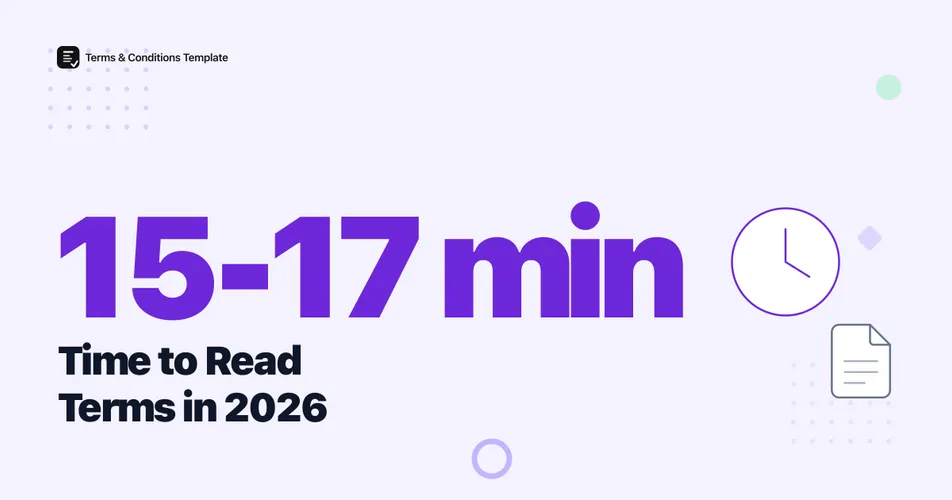
Reading a typical terms of service document takes 15 to 17 minutes at a normal adult reading speed of 250 to 280 words per minute, according to a peer-reviewed 2020 study by Jonathan Obar and Anne Oeldorf-Hirsch (n=543). In the same controlled experiment, participants who opened the document spent an average of just 51 seconds on it before clicking through.
That gap between the time a document requires and the time it actually gets is the subject of this article. Below is what the current data says about terms and conditions reading time, broken down by industry, by company, and against how fast an adult actually reads.
How long does it take to read the average terms of service?
About 15 to 17 minutes, if a reader goes through the whole document at a normal pace. That figure comes from Obar and Oeldorf-Hirsch’s 2020 study, published in Information, Communication & Society, which had 543 participants join a fictitious social network and tracked how long they spent on the terms of service before clicking through. The 250 to 280 words-per-minute range the researchers used to calculate expected reading time is itself an estimate, and other studies land on different numbers for how fast people actually read.
Figure 1: The reading-speed assumption a source uses changes its reading-time estimate. Reboot Online’s implied pace is calculated from its own published word counts and reading times. Sources: Obar & Oeldorf-Hirsch (2020), Brysbaert (2019), Reboot Online (2021).
Reboot Online’s implied pace for legal text, calculated from its own published word counts and reading times, comes out to about 129 words per minute, well below the general non-fiction baseline. Denser language and legal terminology slow reading, which is part of why a terms of service document can take twice as long to read as a general-audience article of the same length.
| Measure | Time | Source |
|---|---|---|
| Actual time spent reading a typical terms of service document | 51 seconds | Obar & Oeldorf-Hirsch, 2020 |
| Expected reading time for that same document | 15 to 17 minutes | Obar & Oeldorf-Hirsch, 2020 |
| Longest industry average (dating sites) | 58 minutes | Reboot Online, 2021 |
| Shortest industry average (home & car insurance) | 13 minutes | Reboot Online, 2021 |
For the acceptance-rate data behind why so few readers ever reach the 15-minute mark, see our terms and conditions reading statistics. The reading-speed assumption behind a time estimate matters almost as much as the document’s length.
Which industries have the longest terms and conditions to read?
Dating sites, by a wide margin. Reboot Online’s 2021 study of 56 websites across 7 industries found dating-site terms and conditions average 7,569 words, a 58-minute read at the pace the study used. Fashion retailers and social networking platforms are not far behind, both averaging well over half an hour. Home and car insurance sites sit at the other end, averaging 1,682 words and a 13-minute read.
Figure 2: Average terms and conditions reading time by industry, sorted longest to shortest. Source: Reboot Online, 2021, 56 sites across 7 industries.
| Industry | Avg. word count | Avg. reading time | Avg. reading age |
|---|---|---|---|
| Dating | 7,569 | 58 minutes | 18-19 |
| Fashion | 5,036 | 39 minutes | 17-18 |
| Social networking | 4,754 | 37 minutes | 18-19 |
| Job websites | 4,423 | 34 minutes | 19-20 |
| Children’s education | 2,558 | 20 minutes | 17-18 |
| Banking | 2,368 | 18 minutes | 19-20 |
| Home & car insurance | 1,682 | 13 minutes | 19-20 |
Every industry on this list writes for a legal audience first and a customer second, and reading time is one of the more visible symptoms of that priority.
How long does it take to read terms of service from major tech companies?
Individual companies show even more spread than the industry averages above. Visual Capitalist’s “I Agree” project measured terms of service word counts for several major platforms and calculated reading time at a 240-words-per-minute pace. Microsoft’s terms of service came out to 15,260 words, a 63.5-minute read, more than six times longer than Instagram’s 2,451-word document.
| Company | Word count | Reading time |
|---|---|---|
| Microsoft | 15,260 | 63.5 minutes |
| Spotify | 8,600 | 35.8 minutes |
| TikTok | 7,459 | 31.4 minutes |
| Netflix | 2,628 | 11 minutes |
| 2,451 | 9.7 minutes |
Warning
These word counts reflect a 2020 snapshot of each company’s terms of service. Companies revise legal terms regularly, sometimes more than once a year, so a current count for any single company could be meaningfully different today. Treat the company-level figures as illustrative of the range rather than a live measurement.
Figure 3: Share of the combined word count across five major platforms’ terms of service. Source: Visual Capitalist’s “I Agree” project, 2020 data.
Microsoft alone accounts for more than 40% of the combined word count across these five companies’ terms of service, which says as much about how legal teams scale documentation with company size as it does about any single product.
How fast do people actually read, and does that change the numbers?
Slower than most reading-time calculators assume, once you account for legal language. Marc Brysbaert’s 2019 meta-analysis, reviewing 190 studies and 18,573 participants and published in the Journal of Memory and Language, found adults read English non-fiction text at an average of 238 words per minute in silent reading. That is close to the 240-words-per-minute pace Visual Capitalist’s project used for the company comparisons above, but well above the roughly 129 words per minute implied by Reboot Online’s own published word counts and times.
Apply Brysbaert’s faster, general-non-fiction rate to Reboot Online’s 7,569-word dating-industry average and the read drops to about 32 minutes, nearly half the 58 minutes Reboot Online itself reported. The gap is a reminder that a reading-time estimate says as much about the assumed pace as it does about the document itself.
Whichever pace you use, every credible estimate lands well above the seconds most people actually spend.
What would it cost to read everything you agree to in a year?
About 244 hours, or close to 76 full eight-hour workdays, according to Aleecia McDonald and Lorrie Cranor’s 2008 Carnegie Mellon study, which measured the word count of privacy policies on the 75 most popular US websites and modeled the time cost of reading every one an average internet user encountered in a year. The researchers valued the aggregate opportunity cost to US internet users at roughly 781 billion dollars.
Figure 4: Key milestones in terms and conditions reading-time research. Sources: McDonald & Cranor (2008), Brysbaert (2019), Obar & Oeldorf-Hirsch (2020), Reboot Online (2021).
The 2008 study measured privacy policies rather than terms and conditions specifically, but the two documents are typically similar in length and legal density, and the study predates the current volume of apps, browser extensions, and connected accounts most people now maintain. The 244-hour figure is better read as a conservative historical floor than a current number. No individual is spending 244 hours a year on legal text, which is exactly why so much of it goes unread.
Does document length actually decide whether people read it?
Not as much as you might expect. Deloitte’s Global Mobile Consumer Survey found 91% of US consumers accept terms and conditions without reading them at all, a rate that holds up whether the underlying document is a 13-minute insurance policy or a 58-minute dating-site agreement. Pew Research Center’s 2019 survey of 4,272 US adults found only 9% say they always read a privacy policy or terms and conditions before agreeing, regardless of length. For the full breakdown of who reads terms and conditions and what changes that rate, see our terms and conditions reading rate data.
Figure 5: Regardless of expected reading time, observed reading time barely moves. Buckets built from the word counts above; the 51-second figure is from Obar & Oeldorf-Hirsch, 2020.
The practical takeaway for anyone publishing terms and conditions is to assume almost nobody will read past the first screen, regardless of how long or short the full document runs. Putting the material terms, refund rights, and liability limits in plain language near the top means the small share of people who do open the document actually see what matters. A terms and conditions generator that structures a document this way is a faster starting point than drafting from a length-first template.
Length changes how long a document takes to read. It does not change whether anyone reads it.
The Bottom Line
The number that matters most here is not any single industry average or company word count, it is the 18-to-1 gap between 15 to 17 minutes and 51 seconds. Every dataset in this article, from Reboot Online’s 58-minute dating-industry average to Microsoft’s 63.5-minute document, describes a reading time that almost nobody spends. If you publish terms and conditions, treat that gap as the design brief: the length of the document matters less than what a reader encounters in the first minute of it. Put the terms that actually affect a customer, cancellation, refunds, liability, data use, near the top in plain language, and the value of the document does not depend on convincing more people to read all 15 minutes of it.
Frequently Asked Questions
How long does it take to read the average terms of service? About 15 to 17 minutes at a normal adult reading speed of 250 to 280 words per minute, according to a peer-reviewed 2020 study by Obar and Oeldorf-Hirsch (n=543). The same study found people actually spend an average of just 51 seconds on it before agreeing.
Which industries have the longest terms and conditions? Dating sites have the longest terms and conditions of any industry tested, averaging 7,569 words and a 58-minute read, according to Reboot Online’s 2021 study of 56 websites across 7 industries. Home and car insurance sites have the shortest, averaging 1,682 words and 13 minutes.
How many words per minute do people actually read? Adults read non-fiction text at an average of 238 words per minute, according to a 2019 peer-reviewed meta-analysis of 190 studies and 18,573 participants by Marc Brysbaert, published in the Journal of Memory and Language.
How long would it take to read every policy you agree to in a year? About 244 hours, or roughly 76 full workdays, according to a 2008 Carnegie Mellon study by Aleecia McDonald and Lorrie Cranor that measured the word count of the privacy policies on the 75 most popular US websites.
Sources and References
- Obar, J. A., & Oeldorf-Hirsch, A. (2020). “The Biggest Lie on the Internet: Ignoring the Privacy Policies and Terms of Service Policies of Social Networking Services.” Information, Communication & Society, 23(1). Experimental survey, n=543.
- Reboot Online. (2021). “The Industries with the Longest Terms and Conditions.” Word count and reading-time analysis of 56 websites across 7 industries.
- Visual Capitalist. (2021). “Visualizing the Length of the Fine Print, for 14 Popular Apps.” Word count and reading-time analysis, 2020 data, 240 words-per-minute assumption.
- Brysbaert, M. (2019). “How Many Words Do We Read Per Minute? A Review and Meta-Analysis of Reading Rate.” Journal of Memory and Language, 109. Meta-analysis of 190 studies, 18,573 participants.
- McDonald, A. M., & Cranor, L. F. (2008). “The Cost of Reading Privacy Policies.” A Journal of Law and Policy for the Information Society, 4(3), Carnegie Mellon University.
- Deloitte. (2017). “Global Mobile Consumer Survey, US Edition.” US cut of 2,000 consumers, part of a 51,000-respondent global survey.
- Pew Research Center. (2019). “Americans’ Attitudes and Experiences with Privacy Policies and Laws.” American Trends Panel survey, n=4,272 US adults, fielded June 3-17, 2019.
Note: All figures verified as of August 2026. Company-level word counts in the Visual Capitalist section reflect a 2020 snapshot and change whenever a company revises its terms; reading-time figures are refreshed at least twice a year as newer data becomes available.