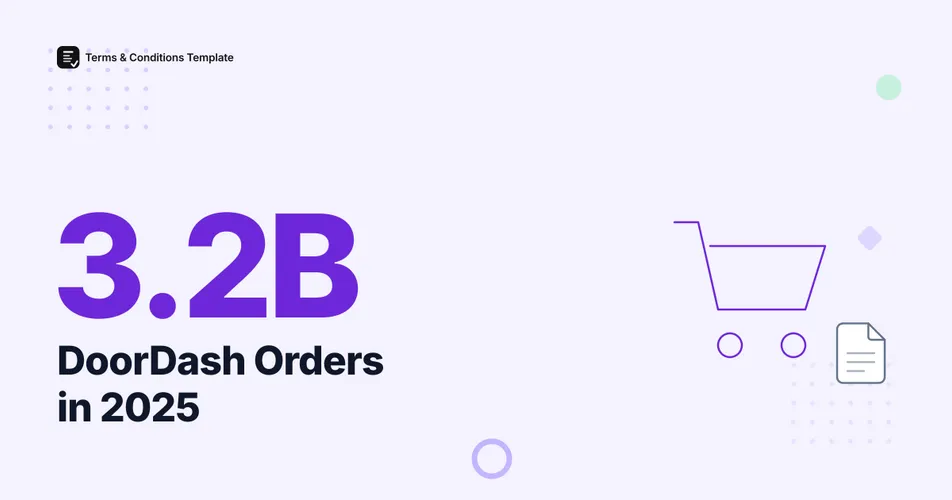
DoorDash completed 3.172 billion orders in 2025, according to its Form 10-K filed with the SEC in February 2026, and $102.018 billion of Marketplace GOV passed through its apps. It is the most useful public example of a three-sided marketplace: shoppers, merchants and independent couriers, all bound by separate agreements. Every figure here comes from the filing and was checked in November 2026.
If you run a marketplace or a gig platform, DoorDash shows both the upside and the legal exposure that come with it.
How many orders does DoorDash complete?
3.172 billion in 2025. DoorDash defines Total Orders as all orders completed through its Marketplaces and Commerce Platform. The company says growth came mainly from more consumers, partly through its acquisition of Deliveroo, and from higher average engagement.
| Measure | 2023 | 2024 | 2025 |
|---|---|---|---|
| Total Orders | 2.161 billion | 2.583 billion | 3.172 billion |
| Orders growth | 24% | 20% | 23% |
| Marketplace GOV | $66.771 billion | $80.231 billion | $102.018 billion |
| Revenue | $8.635 billion | $10.722 billion | $13.717 billion |
Figure 1: DoorDash Total Orders in billions, 2023 to 2025. Source: DoorDash Form 10-K for fiscal 2025, key business metrics.
Orders rose 46.8% in two years, from 2.161 billion to 3.172 billion (our calculation).
DoorDash adds about a billion orders every two years, and it still counts its growth in percentages above 20%.
How much money moves through DoorDash?
$102.018 billion in Marketplace GOV in 2025. DoorDash defines Marketplace GOV as the total dollar value of orders completed on its Marketplaces, including taxes, tips and any applicable consumer fees such as DashPass membership fees. It excludes orders fulfilled through the Commerce Platform. Marketplace GOV grew 27% in 2025, driven mainly by order growth.
Figure 2: DoorDash Marketplace GOV in billions of dollars, 2023 to 2025. Source: DoorDash Form 10-K for fiscal 2025.
DoorDash keeps a slice. It defines Net Revenue Margin as revenue as a percentage of Marketplace GOV, and reports 13.4% in 2025, the same as 2024 and up from 12.9% in 2023. That ratio is DoorDash’s own definition, and revenue in it includes revenue from outside the Marketplaces.
For comparison, Airbnb kept about 13.4% of gross booking value as revenue in 2025 on our calculation, see our Airbnb numbers. The two businesses define their bases differently, so treat the match as a coincidence, not a benchmark.
A marketplace earns a low double-digit share of what flows through it. Your fee terms decide whether you do.
Is DoorDash profitable?
Yes, and increasingly so. Net income attributable to DoorDash common stockholders was $935 million in 2025, up from $123 million in 2024 and a loss of $558 million in 2023. GAAP gross profit rose from $3.860 billion to $4.979 billion to $6.686 billion over the same three years, which is 5.8%, 6.2% and 6.6% of Marketplace GOV.
Figure 3: Year over year growth in revenue, Marketplace GOV and Total Orders in 2025. Source: DoorDash Form 10-K for fiscal 2025.
Revenue and Marketplace GOV grew faster than orders, 28% and 27% against 23%. The 10-K attributes the GOV increase mainly to order growth and does not give a fuller breakdown, so we do not read more into the gap.
Growth with a thin margin is hard to sustain. DoorDash got from a loss to a profit by adding $2.8 billion of gross profit over two years.
The profit is recent, and it came from volume, not from a higher take.
Who uses DoorDash?
Over 56 million people a month. In December 2025 DoorDash’s Marketplaces served over 56 million monthly active users, according to the 10-K, and as of 31 December 2025 over 35 million people held DashPass, Wolt+ or Deliveroo Plus memberships. Those programs aim to cut the delivery and service fees DoorDash charges, while adding membership benefits.
DoorDash completed its acquisition of Deliveroo plc on 2 October 2025. The 10-K says the acquisition-related costs for 2025 were $58 million, and that the deal strengthens its position in local commerce for consumers, merchants and Dashers. The filing says the deal was accounted for under the acquisition method, so Deliveroo’s results count from that date.
Membership is a contract too. If you sell a subscription alongside a marketplace, state the price, the renewal date and how to cancel. Our data on subscription cancellation shows why that clause draws so much regulator attention.
Over 35 million memberships is a large base of people on recurring-fee terms.
What legal risks does DoorDash name about Dashers and terms?
Classification, arbitration and pay rules. The 10-K says Dashers generally means the independent contractors using its Marketplaces, and that DoorDash is subject to claims, lawsuits, arbitration proceedings, administrative actions and government investigations challenging that classification. Some of those claims are brought in arbitration, or compelled to arbitration under its independent contractor agreements. It says it maintains Dashers are properly classified, but warns they could be reclassified as employees if the law or its interpretation changes.
Figure 4: How a classification dispute can move under an arbitration clause, as the 10-K describes it. Source: DoorDash Form 10-K for fiscal 2025, risk factors.
Pay rules affect the fee you see. The filing says some jurisdictions have set minimum earnings standards for delivery workers, that these have caused DoorDash to raise fees charged to consumers and merchants, and that a New York City rule setting minimum earnings for certain food delivery workers took effect in December 2023. It lists arbitration agreements and class action waivers, terms of service, and website accessibility among the laws and rules it is subject to.
Figure 5: Dates drawn from DoorDash’s Form 10-K for fiscal 2025.
This is the company’s own risk disclosure, not a legal finding. But the pattern is plain: each side of the marketplace has its own agreement, and each agreement has a dispute clause. Our guide to governing law and dispute resolution clauses explains the options, and our data on mass arbitration shows what can happen when many claims land at once.
Every side of a marketplace signs something. The dispute clause is the part that gets tested.
The Bottom Line
DoorDash completed 3.172 billion orders and moved $102.018 billion of Marketplace GOV in 2025, keeping 13.4% as $13.717 billion in revenue. Net income reached $935 million, up from $123 million, in a business that served over 56 million monthly active users.
For you the lesson is structural. A marketplace has several contracts, not one: the shopper’s terms, the merchant’s agreement and the contractor’s agreement. Each one needs its own fee, cancellation and dispute clauses, and the contractor agreement carries a classification risk that DoorDash’s own filing flags. If you are building one, set up your core terms with a terms and conditions generator, then take legal advice on contractor and arbitration language for your markets. This article is data, not legal advice.
Frequently Asked Questions
How many orders did DoorDash complete in 2025? 3.172 billion, up 23% from 2.583 billion in 2024, according to DoorDash’s Form 10-K. The figure covers all orders completed through its Marketplaces and Commerce Platform, and the company says Deliveroo helped drive growth.
How much revenue did DoorDash make in 2025? $13.717 billion, up 28% from $10.722 billion in 2024. Marketplace GOV, the total dollar value of Marketplace orders including taxes, tips and consumer fees, was $102.018 billion, and the Net Revenue Margin was 13.4%.
Was DoorDash profitable in 2025? Yes. Net income attributable to DoorDash common stockholders was $935 million in 2025, up from $123 million in 2024 and a loss of $558 million in 2023.
Does DoorDash treat Dashers as employees? No. DoorDash’s 10-K says Dashers are generally independent contractors, and that the company faces claims, lawsuits and arbitration proceedings challenging that classification. It maintains they are properly classified but says they could be reclassified if the law changes.
Sources and References
- DoorDash, Inc.. (2026). Annual Report on Form 10-K for the fiscal year ended December 31, 2025, filed 18 February 2026. Source of all order, GOV, revenue, margin, profit, user, membership, acquisition, classification, arbitration and minimum earnings figures and statements in this article.
- U.S. Securities and Exchange Commission. EDGAR filing index for DoorDash, Inc., used to confirm the filing date and fiscal period.
- Airbnb, Inc.. (2026). Annual Report on Form 10-K for fiscal 2025, the source of the revenue and gross booking value used for the 13.4% comparison.
Note: All figures verified as of November 2026 against DoorDash’s fiscal 2025 Form 10-K. Two-year order growth, gross profit gain and the membership share are our own calculations. The 10-K’s Net Revenue Margin is DoorDash’s own definition.