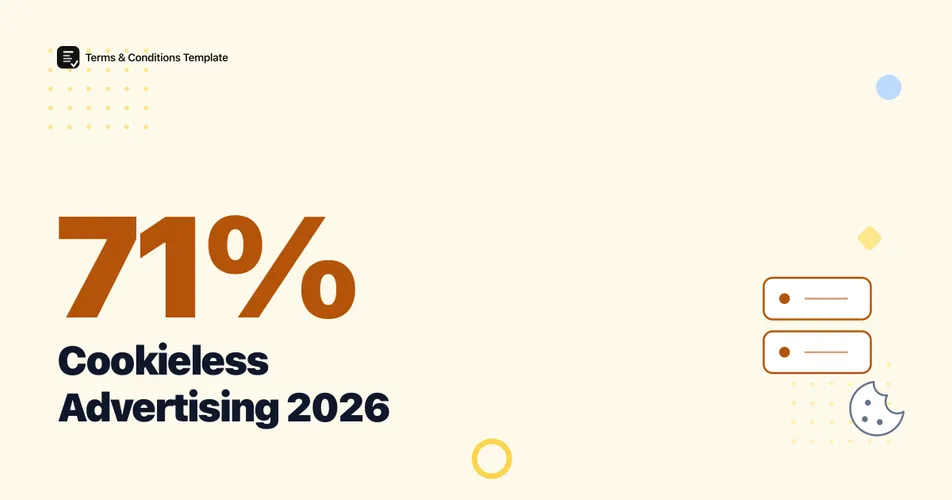
71% of brands, agencies, and publishers are now growing or building first-party data programs, nearly double the 41% share recorded just two years earlier, according to the IAB’s 2024 State of Data report of more than 500 advertising and data professionals. That shift is happening even though Chrome never actually deprecated third-party cookies: Google reversed the plan in 2024 and confirmed in April 2025 that cookies stay on by default with a user opt-out. Cookieless advertising in 2026 turns out to be less about one deprecation deadline and more about which measurement infrastructure survives the years of back-and-forth around it.
Are third-party cookies actually gone in 2026?
No, and this is the single most misunderstood fact in the cookieless advertising conversation. Google spent from 2020 to 2024 promising a full phase-out, then reversed course. In April 2025 the company confirmed Chrome would keep third-party cookies on by default, offering users a browser-wide opt-out instead of forcing deprecation on publishers and ad tech vendors. Chrome still runs the majority of the browser market, so most web traffic still carries third-party cookies unless a person actively turns them off.
Figure 1: Third-party cookie status by default browser setting. Source: eMarketer analysis, April 2025.
Safari and Firefox are the exception, not Chrome. Between the two, over a third (34.9%) of US browsers already turn off third-party cookies by default, per eMarketer analyst Evelyn Mitchell-Wolf. Brave blocks them too, though it holds a smaller share of the browser market. The practical result is a split web: publishers and advertisers who depend entirely on third-party cookies lose reach on privacy-forward browsers today, while Chrome buys the rest of the industry more runway than the original 2020 announcement implied. See our third-party cookie phase-out numbers for the full browser-by-browser breakdown.
Treat “cookies are dead” as a myth and “cookies are permanent” as an equally bad assumption. Plan for a browser landscape that stays fragmented rather than one that resolves cleanly in either direction.
What happened to Google’s Privacy Sandbox?
Google’s from-scratch replacement for third-party cookies did not survive the reversal on cookies themselves. On October 17, 2025, Google’s Privacy Sandbox VP announced the retirement of 10 Privacy Sandbox technologies, including Topics, Protected Audience, Attribution Reporting, Related Website Sets, and Private Aggregation, across both Chrome and Android. Google’s own explanation cited “ecosystem feedback about their expected value” and “low levels of adoption” after six years of development. One of the retired features, IP Protection, had only just begun rolling out in Chrome’s Incognito mode months earlier.
Figure 2: Six years of cookie policy reversals in one timeline. Sources: Google Privacy Sandbox blog posts, 2019-2025.
Privacy Sandbox was meant to be the durable, privacy-safe replacement for cookie-based targeting and measurement. Its retirement means there is no single Google-built successor: the industry is left to assemble its own mix of first-party data, contextual signals, and server-side infrastructure instead of waiting on one standard.
How fast is first-party data adoption growing?
Fast, and accelerating. The IAB’s 2024 State of Data report found that 71% of brands, agencies, and publishers are currently growing or planning to grow their first-party datasets, nearly double the 41% share the same survey recorded two years earlier. Separately, 62% of brand marketers told Econsultancy in October 2024 that first-party data would become more important to their business over the following two years.
Figure 3: Growth in first-party data investment over two years. Source: IAB State of Data 2024, 500+ respondents.
The same IAB survey found 95% of decision-makers expect continued signal loss or new privacy legislation to keep affecting measurement, and 55% specifically expect attribution to get harder. First-party data is the response to that expectation, not a reaction to a cookie deadline that, so far, has not actually arrived for the majority of the web.
Is contextual advertising actually growing?
Yes, though the exact size depends heavily on which research firm you ask. The Business Research Company valued the global contextual advertising market at $233.89 billion in 2025, growing to $258.32 billion in 2026, a 10.4% year-over-year increase, with an extended forecast of $379.84 billion by 2030. Grand View Research, using a different methodology, projects the market will reach $468.17 billion by 2030 at a 13.3% compound annual growth rate. Both firms agree on the direction; neither agrees on the magnitude, which is common in ad tech market sizing and worth flagging rather than smoothing over.
Figure 4: A simple test for how exposed your targeting stack is to further cookie changes. Source: synthesized from the IAB and eMarketer findings above.
Contextual advertising’s appeal is structural: it targets the page, not the person, so it does not depend on any cookie, device ID, or opt-in status at all. That is also why it keeps showing up as a hedge in every cookieless advertising playbook regardless of what happens next to Chrome. If you publish content and want to keep your own ad and tracking disclosures current while your stack shifts, a cookie policy generator is the fastest way to keep that document matched to what your site actually collects.
Are server-side tracking and data clean rooms replacing cookies?
Partially, and unevenly. 66% of US data and advertising professionals had adopted a data clean room by February 2024, according to IAB and BWG Strategy research, up sharply as brands look for ways to match first-party data with partner data without exposing raw records to either side. That is the clearest quantified signal available on cookieless measurement infrastructure, and it tracks with the broader decline in how much ad tracking still reaches an opted-out user; see our ad tracking reach and decline numbers for the methods still in use today.
Warning
Precise, disclosed-methodology figures for “what percentage of advertisers run server-side tracking” are hard to find in 2026. Several vendor blogs cite adoption jumping from roughly 20% to 70% within two to three years, but none of the versions we checked disclosed a sample size or survey method, so we are not repeating those numbers as fact. Treat server-side tagging adoption as directionally rising, anchored to the 66% clean room figure above, rather than as a settled percentage.
Figure 5: Where the main cookieless methods sit on privacy protection versus signal accuracy. Source: synthesized from the data cited in this article.
How do the main cookieless advertising methods compare?
| Method | What it targets | Adoption signal | Privacy tradeoff |
|---|---|---|---|
| First-party data | Your own opted-in audience | 71% growing it, up from 41% in 2022 (IAB) | Strong: user-permissioned |
| Third-party cookies | Cross-site browsing history | 34.9% of US browsers block by default | Weak: no active consent |
| Contextual advertising | Page content, not the person | $258.32B global market for 2026 (TBRC) | Strong: no personal data used |
| Data clean rooms | Matched first- and third-party data | 66% of US data/ad pros have adopted one | Strong: no raw records shared |
Sources: IAB State of Data 2024; eMarketer, April 2025; The Business Research Company, January 2026.
The Bottom Line
The headline number for 2026 is not a deprecation date, it is the 71% of brands now building first-party data programs, nearly double 2022’s share. That shift happened while Google was reversing its cookie deprecation plan twice and eventually retiring its own replacement technology, Privacy Sandbox, entirely. The practical takeaway for a site owner is to stop waiting on Chrome. Build a first-party data source, keep your cookie and tracking disclosures current, and treat contextual advertising and clean rooms as complements rather than a full replacement for owned data.
Frequently Asked Questions
Are third-party cookies gone in 2026? No. Google confirmed in April 2025 that Chrome will keep third-party cookies on by default with a user opt-out, reversing years of deprecation plans. Only Safari and Firefox, about 34.9% of US browsers combined, block third-party cookies by default (eMarketer, April 2025).
What happened to Google’s Privacy Sandbox? Google retired 10 Privacy Sandbox APIs, including Topics, Protected Audience, and Attribution Reporting, on October 17, 2025, citing low levels of adoption after six years of development.
How many advertisers are shifting to first-party data? 71% of brands, agencies, and publishers are currently growing or planning to grow first-party data, nearly double the 41% share recorded two years earlier, according to IAB’s 2024 State of Data report of over 500 respondents.
Is contextual advertising actually growing? Yes. The Business Research Company put the global contextual advertising market at $233.89 billion in 2025, growing to $258.32 billion in 2026, a 10.4% year-over-year increase, though estimates vary widely by research firm.
Sources and References
- eMarketer. (2025). “Third-Party Cookies Are Here to Stay as Google Pivots.” Analysis by Evelyn Mitchell-Wolf, published April 23, 2025.
- Google Privacy Sandbox. (2025). “Update on Plans for Privacy Sandbox Technologies.” Official announcement, October 17, 2025.
- Google Privacy Sandbox. (2025). “Update on the Plan for Phase-Out of Third-Party Cookies on Chrome.” Official announcement, April 2025.
- IAB. (2024). “Digital Industry Moves Aggressively to Privacy-by-Design.” State of Data 2024 report with BWG Strategy, 500+ respondents, published March 14, 2024.
- eMarketer. (2026). “FAQ on Identity Resolution: Navigating Privacy, Cookies, and Cross-Channel Fragmentation in 2026.” Cites Econsultancy (October 2024) and IAB/BWG Strategy data clean room figures (February 2024).
- The Business Research Company. (2026). “Contextual Advertising Global Market Report.” Published January 2026.
Note: All figures verified as of October 2026. Cookie policy, Privacy Sandbox status, and cookieless adoption rates continue to shift, so headline figures here are refreshed at least twice a year. Market-sizing figures vary by research firm and are flagged in-text rather than presented as a single settled number.