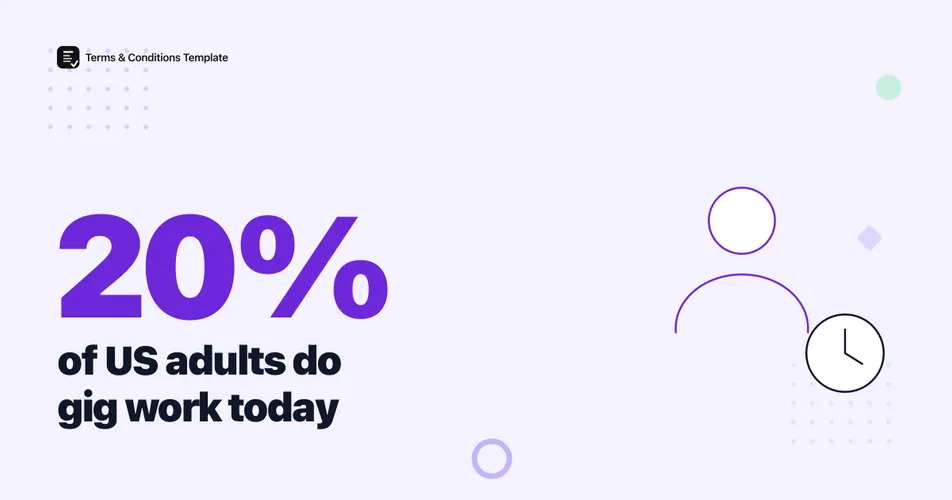
20% of US adults performed some kind of gig work in the month before being surveyed in October 2024, according to the Federal Reserve’s Survey of Household Economics and Decisionmaking (SHED), based on a nationally representative sample of 12,295 adults and published in May 2025. That is up from 16% in 2021, the last year the Fed asked the same question. Most of that growth is not full-time platform driving: it is people selling items, renting out property, and doing short freelance tasks alongside a primary job.
If you run a business that hires gig workers, lists them on a marketplace, or sells products through a side-gig storefront, the numbers below cover who is doing this work, how much of it is a primary income source, how the broader independent workforce compares, and what a business needs in writing once a working relationship is paid and ongoing.
How many Americans do gig work today?
One in five US adults, 20%, performed at least one type of gig activity in the month before the Federal Reserve’s October 2024 survey, up from 16% in 2021. The Fed defines gig activities broadly: selling goods, renting out property short-term, and doing short-term tasks or freelance work, whether or not a digital platform is involved.
That four-point rise over three years is measured the same way both times, by the same survey, which makes it one of the few apples-to-apples gig work trend lines available from a government source rather than a single company’s user base.
Figure 1: Gig work participation, US adults, prior-month basis. Source: Federal Reserve Survey of Household Economics and Decisionmaking (SHED), 2021 and 2024 reports.
The trend points one direction, growth, but the size of that growth is modest next to how the term “gig economy” gets used in headlines. A five-point swing over three years is real, not a doubling.
What kind of gig work are people actually doing?
Selling items is the single largest category: 13% of adults sold something in the prior month, more than double the 6% who did other freelance or gig work, and well above the 2% who offered a short-term rental. These categories overlap, since the Fed’s survey lets one person report more than one activity type.
Figure 2: Gig activity types among US adults, prior-month basis, 2024 (categories overlap). Source: Federal Reserve SHED, 2024 report.
| Activity type | Share of US adults, 2024 |
|---|---|
| Any gig activity (overall) | 20% |
| Selling items (any) | 13% |
| Short-term tasks (any) | 9% |
| Platform-based tasks (app or website) | 4% |
| Short-term rentals | 2% |
Source: Federal Reserve SHED, 2024 report.
Only 4% of adults did a platform-based task, the category closest to the popular image of “gig work” as app-dispatched driving or delivery. The much larger share, selling items and informal short-term tasks, rarely shows up in coverage built around a single rideshare or delivery app.
Who is doing gig work, and is it their main source of income?
Gig work skews young and skews supplemental rather than primary. Adults aged 18 to 29 do gig work at more than double the rate of adults 60 and older, 26% versus 12%, and only 21% of gig workers consider it their main job.
Figure 3: Share of gig workers who consider the work their main job. Source: Federal Reserve SHED, 2024 report.
| Group | Share doing gig work, 2024 |
|---|---|
| Students | 30% |
| Age 18 to 29 | 26% |
| Parents of young children | 26% |
| Hispanic adults | 24% |
| Male | 21% |
| Female | 19% |
| Age 60 and older | 12% |
Source: Federal Reserve SHED, 2024 report.
Money need is common but not universal among gig workers: 31% say they need the income to cover basic expenses, and the Fed’s data shows gig workers reporting lower overall financial well-being than non-gig workers on the same survey. Most gig workers also keep the time commitment small, with 70% spending under 5 hours a week and 96% under 35 hours.
How big is the broader independent and freelance workforce?
Gig work, as the Fed defines it, is a narrower slice of a much larger independent workforce. MBO Partners’ 2025 State of Independence report, fielded in April 2025 and now in its 15th consecutive year, counts 72.9 million Americans doing independent work of any kind in 2025, and 42% of them used a digital platform to find that work. MBO Partners sells services and research to businesses that manage independent talent, so its interest is in a growing independent workforce; the report does not disclose a sample size on its public pages, which is worth stating plainly rather than passing over.
| Source | Population measured | Headline figure | Year |
|---|---|---|---|
| Federal Reserve SHED | US adults, gig activity in the prior month | 20% | 2024 |
| MBO Partners | US independent workers, any type | 72.9 million | 2025 |
| Pew Research Center | US adults who ever earned money via an online gig platform | 16% (lifetime, not monthly) | 2021 |
Different definitions produce very different-looking numbers from the same underlying shift toward independent income. Within MBO’s broader independent-worker count, income is concentrated at the top: 5.6 million independent workers earned $100,000 or more in 2025, up 19% from 4.7 million in 2024, and Generation Z now makes up 28% of the independent workforce.
That top-heavy earnings pattern matches what shows up in adjacent parts of the independent-income economy. Our creator economy statistics for 2026 and creator earnings statistics for 2026 posts cover the same concentration on the content-creation side, where more than half of creators earn under $15,000 a year even as platform-level payouts keep growing. Platform-specific gig income, such as what individual livestreamers earn on Twitch, follows a similar pattern of a large base earning little and a small top tier earning most of the money, though a dedicated breakdown of that platform is outside the scope of this post.
What legal and tax obligations come with hiring gig workers?
Paying someone as an independent contractor rather than an employee comes with a specific tax filing trigger: any business that pays a contractor $600 or more in a calendar year must file IRS Form 1099-NEC for that worker. That threshold is a useful practical marker for when a business needs a written agreement in place, not just an informal understanding.
Figure 4: The filing and documentation trigger for gig and contract worker payments. Source: IRS Form 1099-NEC filing guidance; worker-control test drawn from common IRS and Department of Labor classification criteria.
A written agreement matters more as the dollar amount and the number of workers grow, since a platform, marketplace, or business relying on gig labor is also a business publishing terms to the public. If your site lists contractors, freelancers, or gig workers, or simply sells to customers alongside running a gig-supported operation, you need terms and conditions that state payment terms, dispute resolution, and how either side can end the relationship, distinct from the consumer-facing policy that governs a storefront.
The Bottom Line
Gig work grew from 16% to 20% of US adults between 2021 and 2024, a real but modest shift, and it remains supplemental income for most people who do it: only 21% call it their main job. The bigger number sits one layer out, in the 72.9 million Americans MBO Partners counts as independent workers of any kind in 2025, where 42% now rely on a digital platform to find work and income keeps concentrating at the top end. Businesses on either side of this relationship, whether hiring gig talent or running a platform that lists it, cross a documentation line once a single worker is paid $600 or more in a year, and a written agreement at that point protects both sides more than an informal arrangement does.
Frequently Asked Questions
What percentage of Americans do gig work? 20% of US adults performed some type of gig work in the month before being surveyed in October 2024, according to the Federal Reserve’s Survey of Household Economics and Decisionmaking (SHED, n=12,295). That is up from 16% in 2021, the last year the Fed asked the same question.
Is gig work most people’s main job? No. Only 21% of people who do gig work consider it their main job, per the Federal Reserve’s 2024 SHED data. 51% of gig workers hold separate primary employment, and most spend under 5 hours a week on gig activities (70%, per the same survey).
How many people work independently overall, not just through gig platforms? 72.9 million Americans did independent work in 2025, and 42% of them used a digital platform to find that work, according to MBO Partners’ 2025 State of Independence report, its 15th consecutive year of fielding this survey.
Do businesses need a written agreement with gig workers? Any business that pays a contractor $600 or more in a calendar year must file IRS Form 1099-NEC for that worker, and a written independent contractor agreement documenting payment terms and scope of work is standard practice at that threshold, separate from an employee’s terms of employment.
Sources and References
- Federal Reserve Board. (2025). “Economic Well-Being of U.S. Households in 2024: Employment and Gig Work.” Survey of Household Economics and Decisionmaking (SHED), n=12,295, fielded October 18-31, 2024.
- Federal Reserve Board. (2022). “Economic Well-Being of U.S. Households in 2021: Employment.” Baseline gig work participation figure for the 2021 comparison year.
- MBO Partners. (2025). “State of Independence in America,” 15th annual report. Survey fielded April 2025; sample size not disclosed on public report pages.
- Pew Research Center. (2021). “The State of Gig Work in 2021.” American Trends Panel survey, n=10,348 US adults, fielded August 23-29, 2021.
- Internal Revenue Service. “About Form 1099-NEC, Nonemployee Compensation.” Official IRS filing guidance.
Note: All figures verified as of September 2026. The Federal Reserve’s gig work chapter is not published every year, so the 2021-to-2024 comparison uses the two most recent years the question was asked; figures are refreshed at least twice a year or whenever a newer SHED report adds a gig work chapter.