
On July 15, 2026, the Federal Trade Commission finalized its order against Vanilla Chip LLC, the company doing business as TruHeight, and its two principals, Eden Stelmach and Justin Rapoport. The order closes out a case the FTC first brought in April 2026 over supplements marketed to children and teenagers as able to boost height growth, and it settles allegations that the company backed those claims with fabricated reviews and bot-run social media profiles instead of science.
The headline number is a $4 million judgment, but TruHeight will only actually pay $750,000 of it. The Commission suspended the rest after the defendants showed they could not pay the full amount, a common outcome in FTC settlements against smaller companies. The more durable part of the order is not the dollar figure at all: it is a permanent set of restrictions on how TruHeight can make health claims and use consumer reviews going forward, and the reasoning behind those restrictions applies to any business making claims about what its product does for the body.
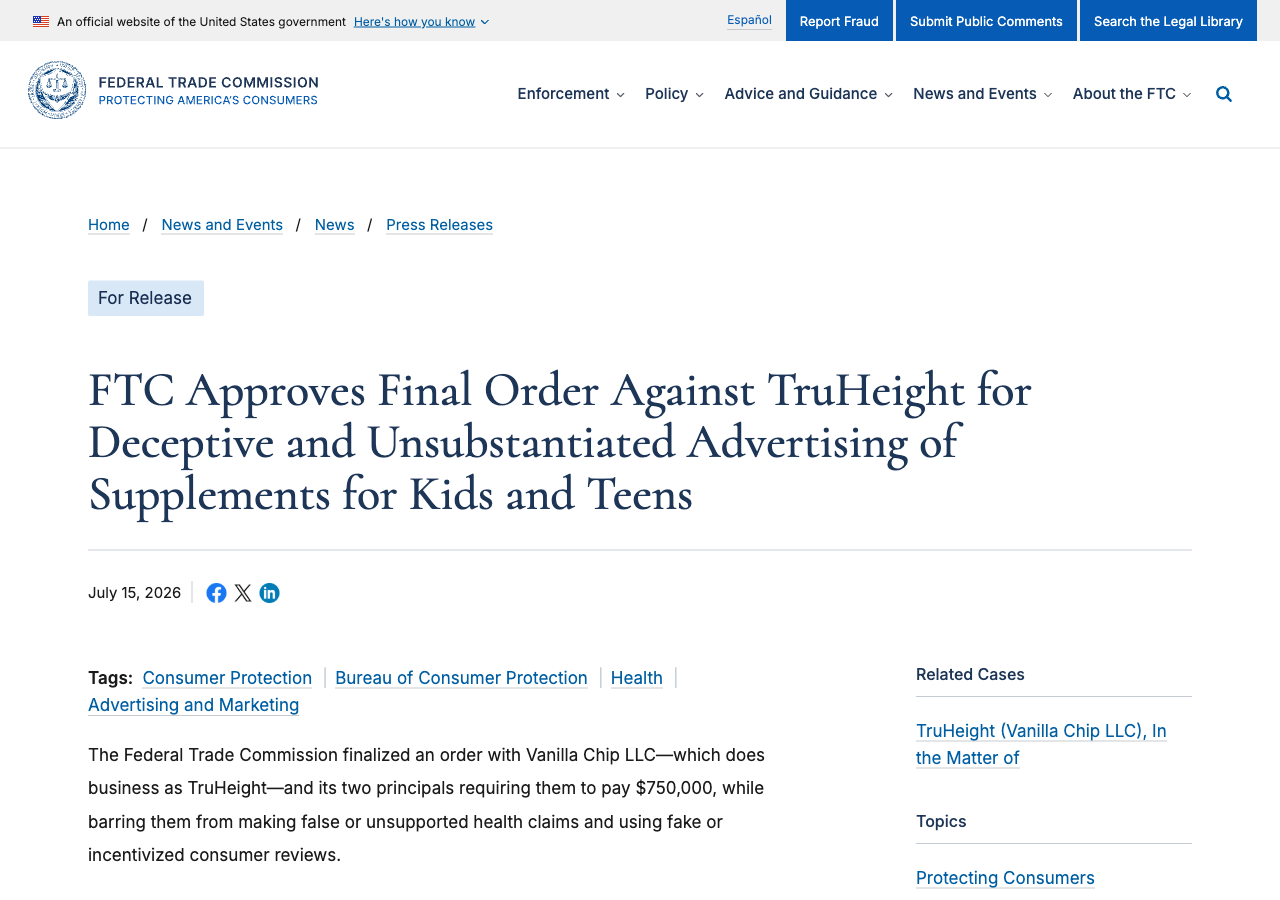
Source: Federal Trade Commission, “FTC Approves Final Order Against TruHeight for Deceptive and Unsubstantiated Advertising of Supplements for Kids and Teens”, captured August 2026.
What the FTC Actually Alleged
The FTC’s original complaint, filed in April 2026, said TruHeight advertised a range of supplements as capable of increasing height in children and teenagers without the scientific backing to support that. According to the Commission, the company lacked competent and reliable scientific evidence for its growth claims, the kind of evidence a claim like that would need to be more than marketing copy.
The reviews piece of the case is just as significant as the claims piece. The FTC alleged TruHeight and its principals relied on reviews written by their own employees and vendors, and on reviews from consumers who received a free product or a discount in exchange for a five-star write-up. The complaint also said the company used fake social media profiles, run by bots, made to look like real customers.
Figure: TruHeight’s final order suspends most of a $4 million judgment down to a $750,000 payment, based on the defendants’ documented inability to pay the full amount.
What the Order Actually Requires Going Forward
The FTC’s final order, approved by a 2-0 Commission vote, is permanent. It does not expire when the $750,000 is paid. Four restrictions sit at the center of it:
| Restriction | What it bars |
|---|---|
| Height and growth claims | Making false or unsubstantiated claims that a product affects height or growth |
| Health, performance, and safety claims | Any claim about health benefits, performance, efficacy, safety, or side effects, unless the claim is not misleading and supported by competent and reliable scientific evidence |
| Reviewer identity and experience | Misrepresenting that a reviewer exists, used the product, or had the experience described |
| Paid or incentivized reviews | Buying consumer reviews conditioned on a particular sentiment, positive or negative |
Two of those restrictions are about the claims themselves. The other two are about how the company backed those claims up with manufactured social proof. The FTC treated the fabricated reviews and bot profiles as part of the same deception as the unsupported health claims, not a separate issue.
The reviews restrictions in TruHeight’s order sit alongside a rule the FTC already has on the books for every business, not just this one. The Commission’s Rule on the Use of Consumer Reviews and Testimonials took effect in October 2024 and separately bans buying reviews conditioned on sentiment, employee or vendor reviews that hide the relationship, and fake indicators of social media influence, the exact practices the TruHeight complaint described.
What This Means If You Publish Health-Related Content
A disclaimer did not save TruHeight, and it would not have. No amount of “results not typical” or “consult your doctor” language cures a claim that is not backed by competent and reliable scientific evidence in the first place. A disclaimer discloses uncertainty around a claim; it does not manufacture substantiation for one that has none. That distinction is the practical lesson here for anyone running a site that touches health, wellness, fitness, or supplements.
If your business makes any claim about what a product does to the body, whether that is height, weight, energy, sleep, skin, or anything else, the FTC’s standard for backing that claim up has not changed because of this order, but the order is a reminder of how it gets enforced: a claim about a health outcome needs evidence before it goes live, not a disclaimer to soften it afterward. A medical disclaimer’s real job is to tell readers the content is informational, that reading it does not create a doctor-patient relationship, and that they should consult a licensed professional before acting on it, not to serve as legal cover for an unsupported product claim.
The reviews side matters just as much for any site that displays testimonials, star ratings, or user-submitted reviews next to a health or wellness product. Incentivizing a review, letting an employee post one without disclosing the relationship, or generating fake social proof all carry direct FTC exposure now, independent of whatever the underlying product claim says.
Bottom Line
TruHeight’s final order is not a new rule. It is an application of the same substantiation standard the FTC has always used, made concrete with a $4 million judgment, a $750,000 actual payment, and a permanent set of restrictions. If your site publishes health or wellness content and your disclaimer has not been reviewed recently, or if you are not certain your product claims and your review practices would hold up to the same scrutiny TruHeight faced, our Medical Disclaimer Generator can help you put a clear, specific disclaimer in place. It cannot substantiate a claim you cannot back up, but it can make sure your site is saying exactly what it should about the limits of the content you publish.
The information in this article is for informational purposes only and should not be construed as legal advice on any matter, and does not create an attorney-client relationship.