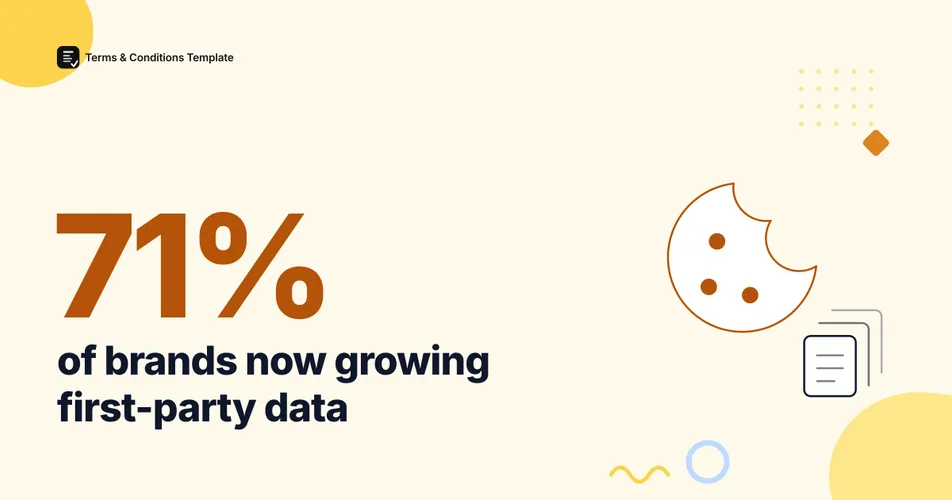
71% of brands, agencies, and publishers are now growing or planning to grow their first-party datasets, nearly double the 41% share measured two years earlier, according to the IAB’s State of Data 2024 survey of more than 500 advertising and data decision-makers. As third-party tracking keeps losing reliability, first-party cookies and the data collected through them have become the default foundation for how sites recognize returning visitors and personalize what they see.
The shift shows up in both strategy and in what actually runs on websites. Below is the current 2026 data on how much first-party cookie use has grown, how first-party and third-party cookies compare on a typical page, and what the growth curve looks like when measured over several years.
How many brands are actually growing first-party data collection?
71% of brands, agencies, and publishers report they are currently growing, or actively planning to grow, their first-party datasets. That is according to the IAB’s State of Data 2024 report, based on interviews conducted from November 2023 to February 2024 with over 500 advertising and data decision-makers at brands, agencies, and publishers, run in partnership with BWG Strategy. Two years earlier, only 41% of the same population reported the same intent.
Figure 1: Share of brands, agencies, and publishers growing or planning to grow first-party datasets. Source: IAB State of Data 2024, 500+ decision-makers.
That near-doubling did not happen because first-party data suddenly became more effective. It happened because the alternative, third-party tracking, kept getting less reliable. 95% of decision-makers in the same survey expect continued signal loss or new privacy legislation to keep affecting how they collect and use data going forward.
What share of website cookies are actually first-party?
On the top one million websites, 41% of cookies set on desktop pages and 40% on mobile pages are first-party, according to the HTTP Archive’s 2025 Web Almanac, based on a crawl completed in July 2025. The remaining 59% on desktop and 60% on mobile are third-party. The overall split has stayed roughly flat compared to the year before, even as the strategic push toward first-party data intensified.
Figure 2: Share of cookies set by first-party versus third-party domains, desktop crawl. Source: HTTP Archive, 2025 Web Almanac.
The gap between strategic intent and technical reality is the story in this data. Most brands say they are prioritizing first-party collection, but the raw cookie count on the average page has not shifted much yet, since a page can add first-party cookies for new use cases without removing the third-party ones already embedded through ad tags and widgets.
Does growing first-party data actually pay off?
Brands with mature first-party data implementations see revenue uplifts of 1.5x to 2.9x compared to brands still relying mainly on other data sources, according to a joint study from Boston Consulting Group and Google. The size of the uplift tracks directly with how many first-party data sources a brand has connected: linking first-party data across channels can double the incremental revenue generated from a single campaign or outreach compared to using an isolated data source.
Figure 3: Revenue uplift by first-party data maturity level. Source: Boston Consulting Group and Google, Responsible Marketing with First-Party Data.
This is the business case underneath the IAB’s adoption numbers. A brand growing its first-party dataset is not doing so as a defensive move against cookie deprecation alone. The data shows a direct, measurable payoff once the first-party program reaches enough maturity to connect across channels.
How are sites technically implementing first-party cookies in 2026?
Most first-party cookies are still set without an explicit SameSite value: 66% on desktop and 62% on mobile carry no explicit setting at all, which browsers then treat according to their own default (typically Lax). Only 19% explicitly declare SameSite=Lax, 3% declare Strict, and 11% declare None, the setting needed for a cookie to work across sites, according to the HTTP Archive’s 2025 Web Almanac.
Figure 4: How first-party cookies declare their SameSite attribute. Source: HTTP Archive, 2025 Web Almanac.
Third-party cookies show almost the opposite pattern, with near-universal use of SameSite=None, since a cookie has to explicitly opt in to cross-site delivery to function as a third-party cookie at all. That divide is a useful, low-effort audit: any first-party cookie your site sets with SameSite=None is worth double-checking, since it is functioning more like a cross-site cookie than the first-party label implies. For a full breakdown of how the browsers themselves are treating cross-site tracking cookies right now, see our third-party cookie data for 2026.
How has first-party data priority changed since GDPR-era cookie rules first landed?
Figure 5: Timeline of first-party data research and measurement milestones. Sources: BCG/Google, IAB State of Data, HTTP Archive.
The growth curve is steep on the strategy side and comparatively flat on the raw technical-implementation side, which tells you the shift is still in its early, additive phase: brands are building new first-party collection on top of existing sites rather than stripping out third-party dependencies first.
First-party versus third-party cookies: the 2026 snapshot
| Metric | First-party | Third-party | Source |
|---|---|---|---|
| Share of cookies, desktop | 41% | 59% | HTTP Archive, 2025 |
| Share of cookies, mobile | 40% | 60% | HTTP Archive, 2025 |
| Median cookie lifetime | 365 days | 360 days | HTTP Archive, 2025 |
Explicit SameSite=None | 11% | Nearly 100% | HTTP Archive, 2025 |
A first-party cookie that behaves this closely to a third-party one on lifetime is worth documenting clearly, and not just technically fixing. Every category of cookie your site actually sets, first-party or third-party, session or 365-day, needs to be disclosed in plain language. A cookie policy generator that lists cookie categories and retention periods accurately keeps your disclosure matching what your site actually does as your first-party collection grows.
The Bottom Line
First-party data has gone from a defensive fallback to the default strategy: 71% of brands are actively growing it, up from 41% two years ago, and the brands doing it well are seeing real revenue uplift, not just compliance cover. The technical picture on the average page has not caught up to the strategic shift yet, with first-party cookies still making up under half of all cookies set. As that gap closes over the next few years, the sites keeping an accurate, current cookie policy alongside the growth will be the ones avoiding a compliance gap opening up right as their first-party program scales.
Frequently Asked Questions
How many brands are growing their first-party data collection? 71% of brands, agencies, and publishers are currently growing or planning to grow their first-party datasets, according to the IAB’s State of Data 2024 survey of over 500 advertising and data decision-makers, nearly double the 41% rate measured two years earlier.
What share of website cookies are first-party versus third-party? On the top one million websites, 41% of cookies on desktop and 40% on mobile are first-party, with the remainder third-party, according to the HTTP Archive’s 2025 Web Almanac cookies chapter, based on a July 2025 crawl.
Does first-party data actually improve marketing results? Yes. A joint Boston Consulting Group and Google study found that brands with mature first-party data implementations saw revenue uplifts of 1.5x to 2.9x compared to brands with limited first-party data use.
How long do first-party cookies typically last before expiring? The median first-party cookie expires after 365 days, almost identical to the 360-day median for third-party cookies, according to the HTTP Archive’s 2025 Web Almanac.
Sources and References
- IAB. (2024). “State of Data 2024.” Survey of 500+ decision-makers, conducted with BWG Strategy, November 2023 to February 2024.
- HTTP Archive. (2025). “Cookies.” 2025 Web Almanac, based on a crawl of the top one million websites, July 2025.
- Boston Consulting Group and Google. “Responsible Marketing with First-Party Data.”
Note: All figures verified as of November 2026. First-party data adoption and cookie composition figures are refreshed at least twice a year as new IAB and HTTP Archive reports are published.