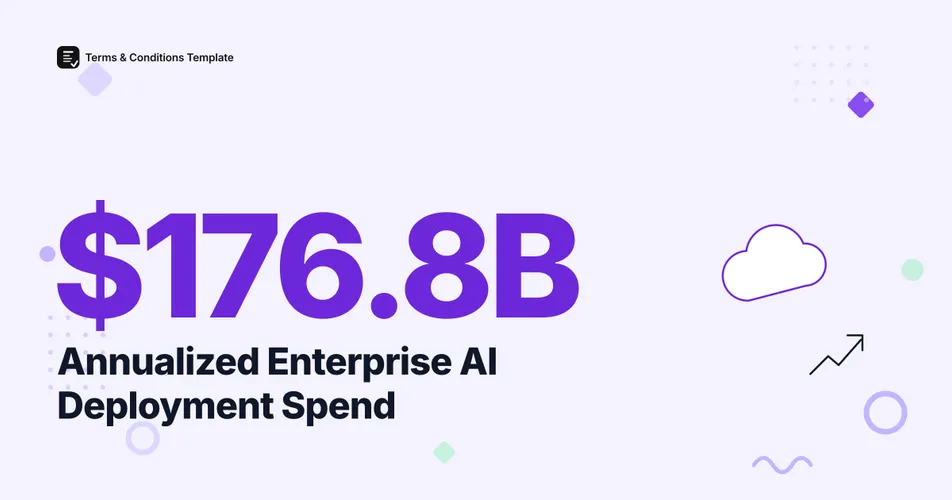
Enterprise spending on using AI reached an annualized $176.8 billion by September 2026, up 5.4x from $33 billion a year earlier, according to Menlo Ventures’ 2026 State of Enterprise AI report. Zylo’s 2026 SaaS Management Index found AI-native app spend up 108% year over year across all organizations, and 393% at companies with more than 10,000 employees. For SaaS buyers and vendors alike, AI is now a large line item in the software budget, not a checkbox feature.
If you build or buy SaaS, the numbers below show where the money is flowing, how much of it comes out of existing software budgets, and what that means for the contracts governing both.
How much are enterprises spending on deploying AI in 2026?
Enterprise AI deployment spending reached an annualized $176.8 billion by September 2026, up 5.4x from $33 billion in 2025, Menlo Ventures reports. Menlo’s series runs $1.7 billion in 2023, $8.5 billion in 2024 (5.0x) and $33 billion in 2025 (3.9x). Dollar figures are Menlo’s own estimates from a bottoms-up model, and its methodology says revenue is shown as an annualized run rate, so we read the 2026 figure as a run rate as of September rather than a completed calendar year. Menlo also reclassified prior years this time: its 2025 report put 2025 spend at $37 billion, and the new edition restates it as $33 billion after moving data-labeling vendors from deployment to development spending.
Figure 1: Enterprise generative AI deployment spending, 2023 to 2026 (2026 is an annualized run rate as of September), in billions of dollars. Prior years as restated in the 2026 edition. Source: Menlo Ventures, 2026: The State of Enterprise AI. The survey behind the report covered nearly 400 US enterprise decision-makers, fielded by Morning Consult, 8 to 26 September 2026.
The report separates two kinds of spending. Menlo estimates $102.5 billion went to building models in 2026 (up 5.3x), against $176.8 billion on using them, about $1.70 of deployment spend for every $1 of development spend. Menlo is a venture investor with portfolio companies in the markets it sizes, which is worth keeping in mind when reading its estimates.
Where is the $176.8 billion actually going?
Infrastructure takes $99.5 billion and applications $77.3 billion, up from $19 billion a year earlier, per Menlo. Two markets dominate the applications layer: coding ($34.0 billion, up 7.7x) and enterprise chatbots ($25.0 billion, up 3.0x) together are 76% of app spend. Healthcare ranks a distant third at $3.7 billion, and is 37% of the $10.1 billion vertical AI market.
Figure 2: Breakdown of the $77.3 billion AI application market, in billions of dollars. “Everything else” is our calculation ($77.3 billion minus $34.0 billion minus $25.0 billion); Menlo’s own horizontal ($8.8 billion) and vertical ($10.1 billion) figures add to $18.9 billion, so its published segments do not sum exactly. Source: Menlo Ventures, 2026: The State of Enterprise AI.
Menlo also finds AI-native providers capture 77% of application-layer spend, and 96% of the coding market, while incumbents lead categories such as IT (91%), data science (88%) and HR (68%).
How fast is AI-native spend growing inside existing software budgets?
AI-native application spend rose 108% year over year across all organizations, and 393% at companies with more than 10,000 employees, according to Zylo’s 2026 SaaS Management Index, the eighth annual edition of a report built on analysis of more than 40 million SaaS licenses and $75 billion in spend under management. Zylo’s January 2026 release does not name the years being compared, so we describe them as the prior year and the latest year. Zylo also reports ChatGPT is now the most expensed application.
Figure 3: AI-native application spend, indexed to 100 in the prior year (our calculation: 100 plus Zylo’s 108% rise gives 208). Source: Zylo, 2026 SaaS Management Index, based on analysis of more than 40 million SaaS licenses and $75 billion in spend.
In the same Zylo index, a survey of 218 IT leaders found that 78% reported unexpected charges tied to consumption-based or AI pricing models in the last 12 months. Zylo also reports that business units now control 81% of SaaS spend while IT directly manages 15%, and that large enterprises add an average of 21 applications per month.
Is AI replacing SaaS budgets?
Mostly it is adding to them. Menlo found that new budgets funded 55% of incremental AI spend, compared with 22% from software budgets. Of that 22%, 13% stayed with incumbents converting SaaS licenses to AI, such as Microsoft Office to Copilot, and 9% ($12.6 billion) moved to AI-native vendors. Menlo estimates that shift is about a 2-point growth headwind for the $600 billion-plus application SaaS market, from +13% last year to +11% this year, and found limited evidence of enterprises replacing core systems such as Salesforce, Workday or NetSuite with AI.
Figure 4: Where incremental enterprise AI spend came from in 2026, as a share of incremental spend. The 13% and 9% are the two parts of the 22% from software budgets. Source: Menlo Ventures, 2026: The State of Enterprise AI.
Before an AI SaaS tool moves from pilot to procurement, the contract governing it deserves the same scrutiny as the tool itself, particularly around how the vendor uses your data to train its models.
Figure 5: An illustrative checklist for reviewing an AI SaaS vendor’s contract. It is our own simplification, not a published dataset.
If you sell an AI-powered SaaS product, the terms you publish need to answer these same questions for your own customers before they ask. A clear, current terms and conditions document that states how you use customer data to train models, and what your customers can opt out of, answers a question enterprise buyers may ask before they sign. Clear terms can also help you if a training-data dispute ever arises.
| Metric | 2026 figure | Source |
|---|---|---|
| Enterprise AI deployment spend (annualized, September) | $176.8B, from $33B in 2025 | Menlo Ventures, 2026 |
| AI application spend | $77.3B, up from $19B | Menlo Ventures, 2026 |
| Coding apps | $34.0B, 96% AI-native | Menlo Ventures, 2026 |
| Incremental AI spend from software budgets | 22% (9% to AI-native vendors) | Menlo Ventures, 2026 |
For the broader SaaS market, see SaaS statistics for 2026 for how AI adoption compares with overall SaaS growth, and SaaS growth rate data for 2026 for the category-wide trend line this sits inside.
How are SaaS pricing models changing?
Usage-based pricing appeared in 43% of the SaaS pricing models analyzed in Monetizely’s SaaS Pricing Benchmark Study in 2025, up 8 percentage points year over year, based on 103 SaaS companies and 47 pricing leaders surveyed. Hybrid pricing, combining a subscription base with usage-based components, reached 61% adoption, up from 49% the year before, while per-user pricing as the primary model declined from 64% to 57%. Monetizely is a pricing consultancy, and this is a 2025 study.
Monetizely’s study does not attribute these shifts to AI, so we do not either; it is a general SaaS benchmark. Any refund or cancellation policy written for a flat-fee product needs a second look once usage-based billing enters the picture, since “days remaining in the billing cycle” stops being a clean way to calculate a refund.
How much venture funding is flowing into AI startups?
Venture funding to AI reached $211 billion in 2025, up 85% from $114 billion in 2024, according to Crunchbase’s full-year 2025 report published on 7 January 2026. That total covers AI-related startups broadly, not only SaaS companies. Crunchbase also reports that five companies (OpenAI, Scale AI, Anthropic, Project Prometheus and xAI) each raised more than $5 billion and together raised $84 billion, or 20% of all venture funding in 2025. An earlier Crunchbase snapshot from December 2025 put the year-to-date total at $202.3 billion; the January figure supersedes it. It is a full-year 2025 figure, and we did not find a full-year 2026 total.
The funding, enterprise spend and app spend figures in this post come from different surveys with different samples, so they are not directly comparable.
The Bottom Line
The headline number is $176.8 billion, but the more useful one for SaaS vendors and buyers is 22%: the share of incremental AI spend that came out of software budgets, per Menlo, with only 9% moving to AI-native vendors. Zylo separately reports a 108% rise in AI-native application spend, a different measure from Menlo’s budget-source split that points the same way. If you sell AI-powered software, your contracts need to keep pace, particularly on data-training disclosure and opt-outs, the terms enterprise legal reviews tend to ask about. If you buy AI SaaS, treat the vendor’s terms and conditions as part of the evaluation, not paperwork you sign after the decision is already made.
Frequently Asked Questions
How much are enterprises spending on deploying AI in 2026? Enterprise AI deployment spending, the money spent on using AI rather than building models, reached an annualized $176.8 billion by September 2026, up 5.4x from $33 billion a year earlier, according to Menlo Ventures’ 2026 State of Enterprise AI report. Menlo’s figures are its own estimates, not audited totals.
Is AI replacing traditional SaaS budgets? Mostly no, according to Menlo’s 2026 survey of nearly 400 US enterprise decision-makers: new budgets funded 55% of incremental AI spend and software budgets funded 22%. Only 9% ($12.6 billion) of incremental spend moved to AI-native vendors, which Menlo estimates is about a 2-point headwind for the $600 billion-plus application SaaS market, cutting its growth from 13% to 11%.
Where is enterprise AI application spending going? Coding ($34.0 billion) and enterprise chatbots ($25.0 billion) account for 76% of the $77.3 billion AI application market in 2026, according to Menlo Ventures. Healthcare ranks third at $3.7 billion.
How are SaaS pricing models changing? Usage-based pricing appeared in 43% of the SaaS pricing models Monetizely analyzed in 2025, an 8 percentage point increase year over year, while hybrid subscription-plus-usage models reached 61%, per Monetizely’s 2025 SaaS Pricing Benchmark Study of 103 companies. The study is a general SaaS benchmark and does not attribute these shifts to AI.
Sources and References
- Menlo Ventures. (3 November 2026). “2026: The State of Enterprise AI.” Fourth annual report; survey of nearly 400 US enterprise decision-makers fielded by Morning Consult, 8 to 26 September 2026; market sizes are Menlo estimates shown as annualized run rate, with prior years restated. Supports the spend, application, coding, healthcare and budget-source figures. Menlo’s earlier 2025 edition (2025: The State of Generative AI in the Enterprise) is superseded and not used for any figure here except where noted in the text.
- Zylo. (29 January 2026). “2026 SaaS Management Index.” Eighth annual report: more than 40 million SaaS licenses and $75 billion in spend analyzed (the basis for the 108% and 393% figures), plus a survey of 218 IT leaders (the 78% unexpected-charges figure). The 81%, 15%, 21-application and ChatGPT findings are stated on the page without a named basis.
- Monetizely. (2025). “SaaS Pricing Benchmark Study 2025.” 103 SaaS companies analyzed, 47 pricing leaders surveyed.
- Crunchbase News (Gené Teare). (7 January 2026). “Global Venture Funding In 2025 Surged As Startup Deals And Valuations Set All-Time Records.”
Note: All figures verified as of November 2026 against the linked sources. Menlo’s $176.8 billion is deployment spend only (development spend of $102.5 billion is separate and not included in it). McKinsey’s State of AI figures were removed from this post because we could not open the current McKinsey edition. Calculations that are ours are labeled as such.