Most teams write their first SLA for a customer, then reuse the same document, mostly unchanged, when infrastructure asks the platform team for an uptime commitment, or when support asks engineering to commit to a response time on escalations. That reuse is the mistake. An internal SLA and a customer-facing SLA answer the same basic question, how fast will you respond and what happens if you don’t, but they are read by different audiences under different incentives, and the clauses that make a customer-facing SLA enforceable are often the wrong clauses for an agreement between two teams on the same payroll.
Same Shape, Different Stakes
Both documents share a structure: a commitment (uptime, response time, resolution time), how it’s measured, and a consequence for missing it. Where they diverge is what backs up that consequence, and how much the document needs to anticipate a dispute in the first place.
A customer-facing SLA is a contract, usually a schedule attached to the master Terms and Conditions or master services agreement, and it needs to survive a scenario where the customer is unhappy, believes the vendor missed the commitment, and wants money back. That means every term needs a definition precise enough to hold up if the two sides disagree: how uptime is measured, what counts as an outage, what the customer has to do to claim a credit, and a stated cap on what the vendor owes. Genuinely adversarial in the sense that the document has to work even when the parties aren’t cooperating with each other.
An internal SLA between two teams is closer to a working agreement than a contract. Nobody is suing the platform team for missing a response-time target on a P2 ticket from the support team, and no money changes hands when a target is missed. What the internal SLA needs to do is set a shared expectation two teams can plan capacity around, and give a manager a specific, agreed-on number to point to when a target starts slipping repeatedly. It fails not by getting litigated, but by getting ignored, which is a different failure mode with a different fix.
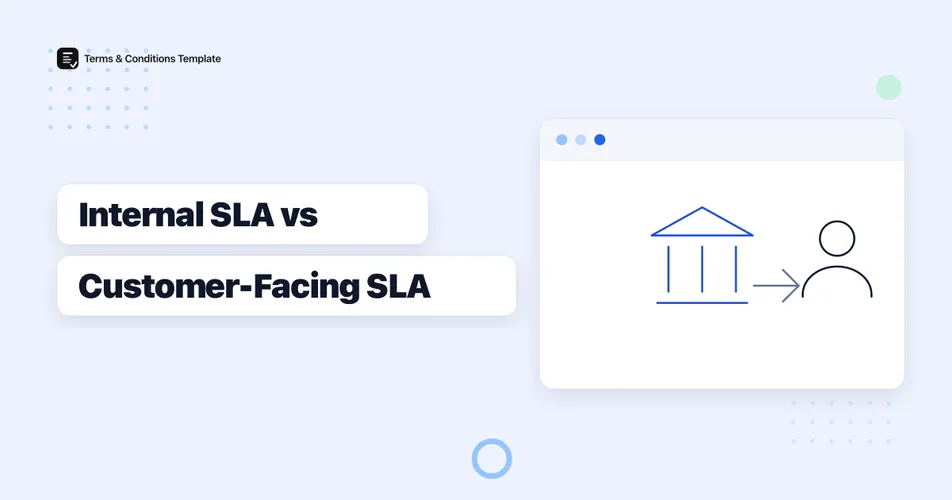
Internal SLA vs Customer-Facing SLA
| Internal SLA | Customer-Facing SLA | |
|---|---|---|
| Parties | Two internal teams | Vendor and customer |
| Legal status | Working agreement | Contract schedule in the T&Cs/MSA |
| Consequence for a miss | Escalation and capacity review | Service credit or termination |
| Measurement rigor | Good-faith, informal tracking | Defined, often verifiable |
| Exclusions list | Short or implied | Explicit: maintenance, force majeure |
| Who enforces it | Shared manager or escalation | Customer via credit or dispute |
| Renegotiation | Adjusted informally | Contract amendment or renewal |
Where the Credit Language Breaks If You Copy It
The clause that causes the most trouble when it’s copied wholesale from a customer SLA into an internal one is the service credit structure: tiered percentages of monthly fees, a customer-initiated claim window, a statement that credits are the sole and exclusive remedy. None of that has an equivalent inside a company. There are no fees for the platform team to credit back to the support team, no invoice for the credit to appear on, and no “sole and exclusive remedy” clause that means anything when both teams report up to the same VP.
Teams that keep the credit structure anyway usually end up with one of two outcomes. Either the credit language sits in the document unused, which trains everyone to skim past the enforcement section entirely because it’s understood to be decorative, or someone tries to make it literal by inventing an internal chargeback (platform’s budget gets dinged, support’s budget gets credited) that adds an accounting exercise nobody asked for to solve a problem that is really about priority and staffing, not money. The better move is to replace the credit tier table with an escalation path: what happens at each level when a target is missed, whose job it is to raise it, and how a repeated miss gets reviewed against the team’s staffing and roadmap.
Rewriting the Enforcement Section
The single biggest tell that an internal SLA was copy-pasted from a customer template is enforcement language that reads like it was written for a party with no reason to trust the other side. Vague, contract-flavored language (“Vendor’s failure to meet the Service Level shall entitle Customer to Service Credits as set forth in Section 4”) doesn’t fit a document two internal teams are going to reread quarterly, and it tends to get quietly ignored rather than followed, which defeats the point of writing it down at all.
Rewriting SLA enforcement language for an internal audience
- "Vendor's failure to meet the Service Level shall entitle Customer to Service Credits"
- "...as its sole and exclusive remedy"
- "...calculated per the tiered schedule in Section 4"
- "If Platform misses the P2 four-hour target three times in a rolling 30-day window..."
- "...Support's lead flags it to both managers for a capacity review"
The rewritten version keeps the same underlying mechanics, a measurable target and a defined trigger for what happens when it’s missed, but swaps a remedy that assumes distrust for a process that assumes both teams want the target hit and just need a structured way to notice when it isn’t. That’s also why internal SLAs tend to be shorter documents overall: the exclusions list that has to survive a customer’s lawyer reading it line by line can usually collapse into a sentence or two when the audience is a colleague who already understands why a planned deploy window doesn’t count as downtime.
Where the Two Documents Actually Connect
They aren’t unrelated. A customer-facing SLA promising 99.9% uptime and a four-hour response time on critical issues is only credible if the internal teams responsible for hitting those numbers have their own internal targets that are equal to or tighter than what’s been promised externally. A common structural mistake is setting the customer SLA first, in a sales negotiation, without checking whether the internal response-time target the support team is actually working against matches it. If support’s own internal goal is a same-business-day response and the customer contract promises four hours, that gap surfaces during the first real incident, not during drafting, which is a worse time to find it.
The workable order is internal-first: set the internal target the team can actually hit reliably, then build the customer-facing commitment with some margin under that number, not equal to it, so a bad week internally doesn’t automatically become a contract breach externally. If you haven’t drafted the customer-facing side yet, see our guide on how to write a Service Level Agreement for the uptime, exclusions, and credit-tier mechanics that belong in that version specifically. Both documents are usually schedules or exhibits rather than standalone contracts; our Terms and Conditions generator builds the master agreement a customer-facing SLA schedule attaches to, which is the document to have in place before the SLA language gets negotiated on top of it.
The Short Version
Write the internal SLA and the customer-facing SLA as two different documents serving two different jobs, even when the underlying targets are related. The customer-facing version needs contract-grade precision because it has to survive a dispute with someone who has no reason to give the vendor the benefit of the doubt. The internal version needs to be short, specific, and readable by the two teams who’ll actually reread it, with an escalation path instead of a credit schedule, because its job is to keep a shared number visible, not to price out a breach.