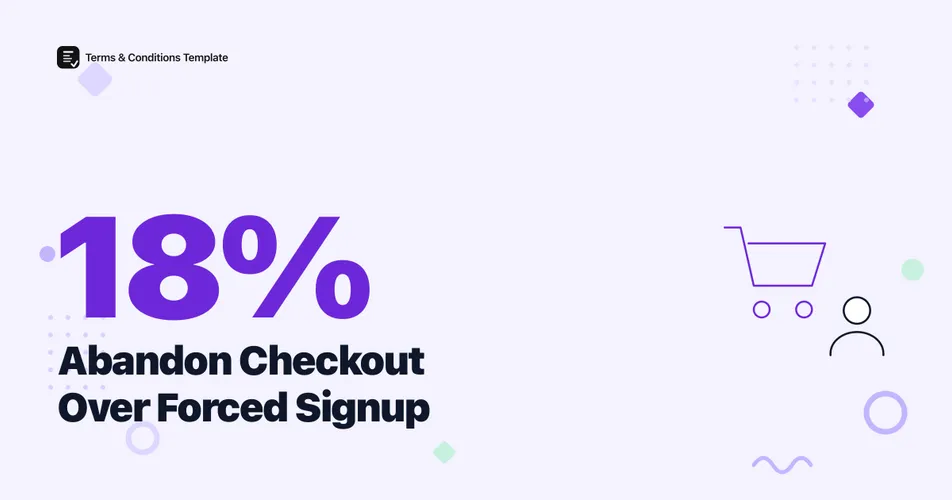
18% of shoppers who abandon an online checkout say they did so because the site required them to create an account, according to Baymard Institute’s cart abandonment reasons research, last updated in September 2025. That single friction point ties for the fourth-largest cited reason for quitting mid-checkout, trailing only extra costs, slow delivery, and payment-trust concerns. Guest checkout, letting a shopper complete an order without registering, is the direct fix.
How many shoppers abandon checkout specifically over forced account creation?
18% of shoppers cite forced account creation when asked why they abandoned a checkout, based on Baymard Institute’s ongoing compilation of cart abandonment survey data, last updated in September 2025. It sits close behind the top three reasons and just ahead of a checkout process that’s too long or complicated (17%) and a site that had errors or crashed (17%).
That 18% is not a fringe complaint. It is one of the few checkout-stage reasons a store can fix without touching pricing, shipping, or payment infrastructure at all: turning on guest checkout removes the friction entirely for shoppers who would otherwise register only to buy once.
Figure 1: Reasons shoppers give for abandoning a cart or checkout, ranked by share citing each one. These are independently reported reasons, not shares of a single total, so they do not sum to 100%. Source: Baymard Institute, cart abandonment reasons research, last updated September 2025.
Extra costs still dominate the list, but forced account creation is the largest reason on it that a store can eliminate with a single settings change rather than a pricing or logistics decision.
How bad is account and self-service UX across ecommerce sites right now?
Most sites still handle accounts poorly. Baymard Institute’s Accounts & Self-Service UX benchmark, updated in 2025 and drawing on a quantitative study of 1,026 US online shoppers, rates 73% of desktop ecommerce sites and 66% of mobile sites as poor to mediocre on this dimension. Across the full benchmark, 96% of sites get at least one crucial best practice wrong.
Only 27% of desktop sites clear a “good or better” bar on this scale, meaning the sites that handle guest access and account UX well are still the minority, not the norm. Common failures in the underlying 96% figure include hiding guest checkout below a required-registration form, not distinguishing a primary “continue as guest” path from secondary account options, and forcing a full password-and-profile setup just to complete a single purchase. None of those failures are about payment technology; they are about which path a shopper sees first.
The mobile number looks better only because mobile sites tend to strip account fields down out of necessity, not because mobile teams have solved guest checkout more deliberately than desktop teams have. Comparing the two side by side makes the gap concrete:
Figure 2: Share of benchmarked ecommerce sites rated poor to mediocre on Baymard’s Accounts & Self-Service UX scale. Source: Baymard Institute, Accounts & Self-Service UX benchmark, 2025 update.
Desktop actually scores worse than mobile here, which cuts against the assumption that account friction is a small-screen problem alone. A checkout that mishandles guest access is failing shoppers on both, just for different reasons: cramped forms on mobile, buried settings and unclear paths on desktop.
Registration is treated by most stores as a light-touch feature request when it is, per Baymard’s own data, one of the most commonly mishandled parts of the entire self-service experience.
What does a checkout that avoids forced-registration abandonment look like?
A checkout that avoids the 18% forced-registration abandonment reason has to pass a short, testable sequence rather than a vague “we support guest checkout” claim. Baymard’s own benchmarking treats guest access, optional post-purchase registration, and returning-guest recognition as three separate checks, not one box to tick.
Figure 3: A minimum three-question test a checkout should pass to avoid forced-registration abandonment. Source: synthesized from Baymard Institute’s Accounts & Self-Service benchmark criteria.
A checkout that fails the first question pushes shoppers straight into the 18% who cite forced account creation as their reason for leaving; one that passes all three has closed the gap almost entirely without any pricing or shipping change.
Has guest checkout adoption changed over time?
Removing forced registration from checkout is not a new idea, and the data trail behind it stretches back further than most of the stats above. UX researcher Jared Spool published a 2009 case study, later widely cited as the “$300 million button,” describing one anonymous retailer that replaced a forced-registration requirement with a visible guest checkout option and reported a substantial jump in completed orders. It is a single-retailer account rather than a benchmark, but the behavior pattern it identified still shows up in current, broader benchmark data.
Figure 4: Milestones in guest checkout and account-friction research and tooling. Sources: Jared Spool / UIE, 2009 (single-retailer case study); PYMNTS, 2020; PayPal Fastlane launch coverage, 2024; Baymard Institute, 2025 benchmarks.
Warning
The 2020 PYMNTS figure on guest-versus-account preference is the most complete direct measurement we could trace of that exact split, but it was collected during a pandemic-era shift in shopping behavior and no fresher large-sample study appears to be publicly available. Treat it as directional history, not a current baseline.
Sixteen years after the original case study, the underlying problem it identified, forcing registration before a shopper can pay, is still measurably costing stores checkout completions. What has changed is the tooling available to fix it, not whether the friction itself matters.
Which account-flow strategy balances friction against fixable risk?
Not every account strategy carries the same cost. Plotting the shopper friction each approach adds against how much of the 18% forced-registration abandonment risk it actually removes shows a clear ranking, from a pure guest-only flow that avoids the reason entirely to a hard account requirement that keeps all of it.
Figure 5: An editorial framework, not a measured metric. Horizontal placement reflects added shopper friction; vertical placement reflects how much of the 18% forced-registration abandonment reason each approach removes. Source: synthesized from the Baymard Institute data cited above.
Offering guest checkout as the visible default, with account creation as an optional step after payment, removes nearly all of the forced-registration abandonment reason while adding the least friction of any approach on the chart.
How does forced account creation compare with other fixable checkout reasons?
Forced account creation is not the largest checkout-stage reason, but it is one of the cheapest to fix relative to its size. Extra costs and slow delivery require pricing or logistics changes; forced account creation requires a settings and flow change a development team can usually ship in a sprint.
| Checkout-stage reason | Share citing it | Typical fix effort |
|---|---|---|
| Extra costs too high (shipping, tax, fees) | 40% | Pricing or fee-disclosure change |
| Slow delivery estimate | 20% | Logistics or carrier change |
| Didn’t trust the site with card information | 19% | Trust signals, security copy |
| Site required account creation | 18% | Checkout flow and settings change |
| Checkout too long or complicated | 17% | Form and step-count redesign |
| Website errors or crashes | 17% | Technical fix |
Source: Baymard Institute, cart abandonment reasons research, last updated September 2025.
Clear terms and a visible security statement at the point of payment help close part of the 19% trust gap in the same row; a T&C Generator produces that language without legal boilerplate a shopper skips past. Guest checkout availability and the trust signals sitting next to it in Figure 1 tend to move together in practice: a store that hides one usually buries the other too.
Shipping cost transparency is its own related friction point in this same cluster of checkout-stage reasons, worth a dedicated look at how upfront cost display affects abandonment separately from the account-creation issue covered here.
The Bottom Line
18% of shoppers who abandon checkout say a forced account requirement is why, and it is one of the few checkout-stage reasons a store can remove without touching price, shipping, or payment infrastructure. Most sites still get this wrong: 73% of desktop and 66% of mobile ecommerce sites rate poor to mediocre on Baymard’s Accounts & Self-Service UX benchmark, and 96% miss at least one crucial best practice. The fix has been documented since a widely cited 2009 case study and confirmed again by 2025 benchmark data: offer guest checkout as the visible default, make account creation optional and post-purchase, and pair it with clear terms at the point of payment. For the full picture of what happens before a shopper even reaches this stage, see our cart abandonment statistics for 2026, and for what happens once checkout has already started, see our checkout abandonment statistics for 2026.
Frequently Asked Questions
What percentage of shoppers abandon checkout because of forced account creation? 18% of shoppers who abandon checkout cite being forced to create an account as the reason, according to Baymard Institute’s cart abandonment reasons research, last updated September 2025. It ranks as the fourth most-cited checkout-stage reason, behind extra costs (40%), slow delivery (20%), and payment trust concerns (19%).
How common is poor guest checkout and account UX on ecommerce sites? 73% of desktop ecommerce sites and 66% of mobile sites rate poor to mediocre on Baymard Institute’s Accounts & Self-Service UX benchmark, and 96% of the sites benchmarked get at least one crucial best practice wrong, based on a 2025 update covering a quantitative study of 1,026 US online shoppers.
Do more shoppers prefer guest checkout or creating an account? The most complete direct measurement we could trace is from 2020: PYMNTS found that nearly three in four ecommerce shoppers who reached checkout chose to pay as a guest by manually entering card details rather than create an account. A fresher large-sample study measuring that exact split does not appear to be publicly available.
Is checkout abandonment worse on mobile, where account forms are harder to fill out? Yes. Mobile checkout abandonment runs at 77.06% versus 66.39% on desktop, per Dynamic Yield’s eCommerce Benchmarks dashboard, a snapshot dated July 2024. A forced account-creation form is a heavier tax on a small screen than on desktop.
Sources and References
- Baymard Institute. Cart abandonment reasons research, part of the 50 Cart Abandonment Rate Statistics compilation, last updated September 2025.
- Baymard Institute. “Accounts & Self-Service UX 2025: 5 Common Pitfalls & Best Practices.” Quantitative study of 1,026 US online shoppers; benchmark data updated August 2025.
- PYMNTS. “Guest Checkout, Still Popular, Gets a One-Click Boost” (2024), citing PYMNTS’ 2020 survey research on guest checkout preference and PayPal Fastlane guest-recognition data.
- Oberlo, citing Dynamic Yield eCommerce Benchmarks. Checkout abandonment rate by device. Snapshot dated July 2024.
- Jared Spool, Center Centre (UIE). “The $300 Million Button.” Published January 14, 2009. A single-retailer case study, not a benchmark; cited here as historical context only.
Note: All figures verified as of September 2026. Baymard’s cart abandonment reasons research and Accounts & Self-Service UX benchmark are both live, continuously updated sources; headline figures are refreshed at least twice a year.