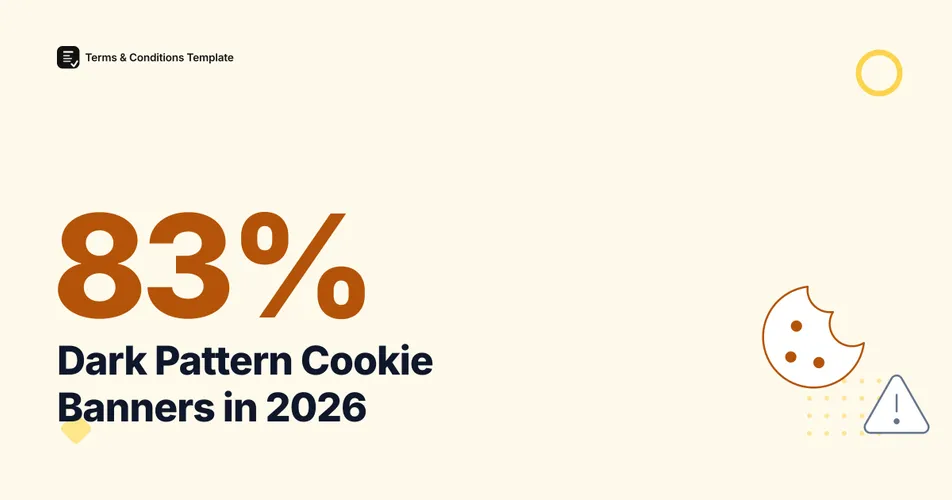
Most cookie banners still collect data before a visitor makes a choice. A 2025 study of 14,000 websites found that 83% of US sites and 44% of EU sites set tracking cookies before anyone clicks the banner, according to researchers Singh, Jin, and Kim. The “choice” a banner presents often arrives after the tracking has already started, which is the core mechanic behind most cookie banner dark patterns.
If you publish a website, the numbers below show exactly which manipulation techniques regulators are now fining companies over, and which ones remain legal but increasingly risky.
How common are dark patterns in cookie banners?
Dark patterns remain the default, not the exception. The 2025 preprint found tracking cookies fire before any interaction on 83% of the 7,000 US sites sampled and 44% of the 7,000 EU sites sampled, and 92% of those cookies are set to last longer than 12 months. This is a preprint and has not yet been peer-reviewed, so treat the exact percentages as strong directional signals rather than final numbers.
A separate, peer-reviewed study reaches a compatible conclusion through a different method. Nouwens et al.’s CHI 2025 paper analyzed 254,148 websites across 31 EU and ePrivacy countries and found only 15% of the top 10,000 sites run a banner that meets the minimum bar for compliance: Accept and Reject presented with equal prominence.
Figure 1: Share of sites that set tracking cookies before a visitor interacts with the banner. Source: Singh, Jin, Kim 2025 preprint, 14,000 sites. Preprint, treat as directional.
The gap between the US and EU figures tracks the gap in enforcement, not a gap in intent. Sites without a strong regulator watching set cookies first and ask permission, if at all, second.
Which dark pattern is most common?
A missing reject button is the single most common failure. Among the non-compliant banners in the CHI 2025 dataset, 56% offer no reject option at all, 30% lack granular purpose-by-purpose controls, and 24% make the reject option visually harder to find than accept, using smaller text, lower contrast, or extra clicks.
Figure 2: The three most common compliance failures. A single banner can exhibit more than one, so shares do not sum to 100%. Source: CHI 2025, Nouwens et al.
These three failures share a design logic: each one makes the compliant choice slower, smaller, or absent, while leaving the tracking choice one click away. A compliant cookie policy generator does not fix banner design on its own, but publishing accurate, current disclosure alongside a fixed banner is the other half of the compliance test regulators actually check.
What does a banner have to do to count as compliant?
Researchers use a short, mechanical test rather than a subjective one. A banner has to clear three checks in sequence before it counts as minimally compliant.
Figure 3: The three-step test researchers use to flag a dark pattern. Source: CHI 2025 compliance criteria.
Country-level results under this test vary sharply. Spain led the CHI 2025 dataset at 28% of sites compliant, while Slovenia sat at just 3%, showing that “same law, same deadline” still produces very different real-world banner design depending on the country’s enforcement track record.
Is enforcement actually changing banner design?
Yes, though slowly and unevenly. Across 11,364 EEA websites tracked from 2018 to 2024, the share offering both Accept and Reject with equal prominence rose from 2.94% to 30.66%, and consent management platform adoption rose from 11.60% to 40.29% over the same period. Enforcement accelerates the shift: after France’s CNIL acted against French cookie banners in December 2021, compliance rose 16.08 percentage points within three months and a further 21.69 points by September 2022.
Warning
Enforcement has become financially serious. In September 2025, CNIL fined Google 325 million euros and Shein 150 million euros, both decisions citing cookies placed without valid consent, with the Google decision also flagging advertisements shown in Gmail’s Promotions and Social tabs without consent. These are primary-source regulator decisions, the most reliable figures in this article. Rolling counts of “total 2025-2026 CNIL sanctions” circulate on industry blogs without a traceable primary source; we could not verify a specific aggregate figure and have excluded it rather than repeat an unconfirmed number.
Figure 4: Key milestones connecting banner design change to regulator action. Sources: EEA longitudinal study 2018-2024; CNIL decisions, September 2025.
Where does each banner design sit on risk versus compliance?
Plotting known banner types against two axes, reject-button prominence and pre-consent tracking risk, shows why some designs draw fines and others do not.
Figure 5: Illustrative placement of common banner types based on cited reject-button and pre-consent tracking figures above, not a single unified dataset. Sources: CHI 2025; EEA longitudinal study; Singh, Jin, Kim 2025 preprint.
The banners in the upper-left quadrant, low reject prominence paired with high tracking risk, are the exact designs both the CHI 2025 compliance test and the CNIL fines target.
Dark pattern types by share of non-compliant banners
| Dark pattern | Share of non-compliant banners | Source |
|---|---|---|
| No reject button at all | 56% | CHI 2025, n=254,148 sites |
| No granular purpose controls | 30% | CHI 2025, n=254,148 sites |
| Reject harder to find than accept | 24% | CHI 2025, n=254,148 sites |
| Pre-consent tracking cookies (US sites) | 83% | Singh, Jin, Kim 2025 preprint, n=14,000 |
| Pre-consent tracking cookies (EU sites) | 44% | Singh, Jin, Kim 2025 preprint, n=14,000 |
Are new, subtler dark patterns replacing the old ones?
Some are. Industry trackers monitoring 2025-2026 enforcement describe at least 7 newer “second-generation” techniques appearing as the crude no-reject-button design gets fined more often: barriers to withdrawing consent later, misleading toggle states, vendor lists long enough to cause fatigue, and confirmations that disappear before a user can verify their choice registered, among others.
Warning
The specific list and count of “second-generation” dark patterns comes from industry compliance blogs summarizing regulator guidance and enforcement trends, not from a single named academic study with a disclosed methodology. Treat this section as a directional trend description rather than a precise, citable count, and expect the exact list to keep changing as regulators publish new guidance.
This mirrors a pattern seen across cookie consent generally: as the cookie consent acceptance data shows, banner design keeps outrunning what any single compliance checklist captures, so the safest approach is a banner and a published cookie policy that are both current, not just compliant on the day they launched.
The Bottom Line
The clearest number in this dataset is not the accept rate, it is the 83% of US sites tracking before consent. Most cookie banners are not built to record a lawful choice; they are built to make the compliant choice slower or invisible while tracking starts anyway. Regulators are now fining that gap directly, with CNIL’s 325 million euro Google decision and 150 million euro Shein decision both landing in a single month. If your banner does not clear the three-step reject-button test above, fix the banner first, then publish or refresh your cookie policy to match what the banner actually does. For a deeper look at how consent mode and analytics tags interact with banner choices, see the Google Consent Mode adoption data, and for what visitors actually do once a compliant banner loads, see how long users spend deciding.
Frequently Asked Questions
What percentage of cookie banners use dark patterns? 83% of US websites and 44% of EU websites set tracking cookies before a visitor interacts with the consent banner at all, according to a 2025 preprint study of 14,000 sites. Only 15% of the top 10,000 EU websites run a minimally compliant banner, per a separate CHI 2025 study of 254,148 sites.
What is the most common cookie banner dark pattern? Missing a reject option entirely, found in 56% of non-compliant banners studied by the CHI 2025 researchers. A further 30% lack granular purpose controls, and 24% make the reject option visually harder to find than accept.
Are regulators fining companies for cookie banner dark patterns? Yes. France’s CNIL fined Google 325 million euros and Shein 150 million euros in September 2025, both decisions citing cookies placed without valid consent.
Are cookie banner dark patterns getting better or worse? Both. The share of EEA sites offering an equally prominent reject button rose from 2.94% in 2018 to 30.66% in 2024, but researchers have also documented at least 7 newer manipulation techniques, such as disappearing rejection confirmations, replacing the more obvious no-reject-button designs regulators targeted first.
Sources and References
- Singh, Jin, Kim. (2025 preprint). “Unveiling Evolving Dark Patterns in Cookie Consent Banners.” 14,000 sites, collected 2025. Not yet peer-reviewed.
- Nouwens, Kristensen, et al.. (2025). “A Cross-Country Analysis of GDPR Cookie Banners and Flexible Methods for Scraping Them.” CHI 2025, ACM. Analysis of 254,148 websites across 31 countries.
- Longitudinal EEA cookie banner study. (2024 data). “A History of GDPR Cookie Banner Compliance.” 11,364 websites, 30 EEA countries, 2018 to 2024.
- CNIL. (2025). “Cookie Regulation: CNIL Has Imposed Two Fines on Shein and Google.” Official regulator decision, 3 September 2025.
- Grossman, Smith, Borcea, Chen. (2025). “Using Salient Object Detection to Identify Manipulative Cookie Banners that Circumvent GDPR.” Computer-vision based dark-pattern detection study.
Note: All figures verified as of August 2026. Dark pattern taxonomies and enforcement activity change quickly; preprint and secondary-source figures are flagged in-text and headline figures are refreshed at least twice a year.