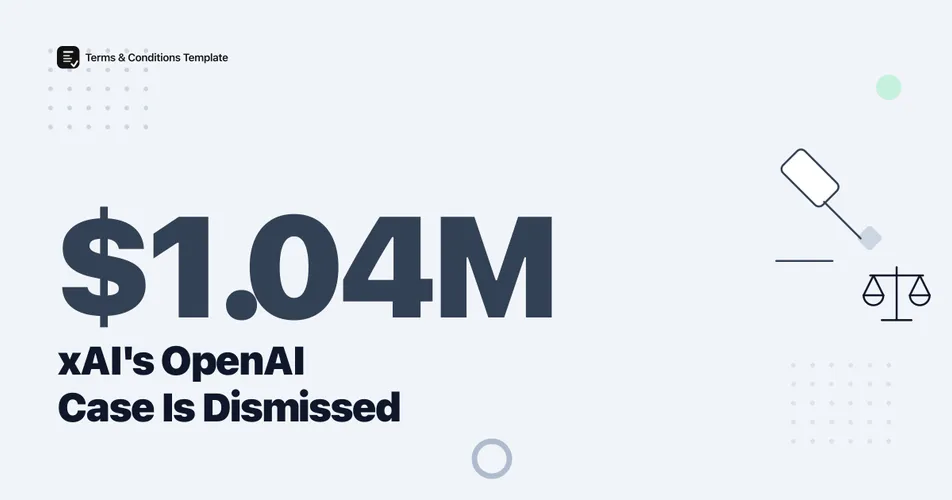
A federal judge in San Francisco dismissed xAI’s trade-secret lawsuit against OpenAI with prejudice on June 15, 2026, closing the door on the case at the district court level. xAI filed a notice of appeal to the Ninth Circuit on July 13, 2026, the same day OpenAI moved to make xAI pay more than a million dollars in attorney fees for having filed the suit at all. Neither development is really about Grok or ChatGPT. Both are about a much more ordinary question: what does a company actually have to prove when a departing employee crosses over to a rival, and what paperwork makes that provable.
xAI originally sued OpenAI in September 2025, alleging that OpenAI had misappropriated trade secrets related to its Grok chatbot through a wave of xAI engineers who left for OpenAI in the summer of 2025. U.S. District Judge Rita F. Lin dismissed the first version of the complaint in February 2026 but gave xAI a chance to amend it. The amended complaint narrowed to focus on one former xAI senior engineer, Xuechen Li, who gave a technical presentation during OpenAI’s recruiting process. Judge Lin dismissed that version too, this time without leave to amend, in a case captioned xAI Corp. v. OpenAI, Inc., No. 3:25-cv-08133-RFL (N.D. Cal.).
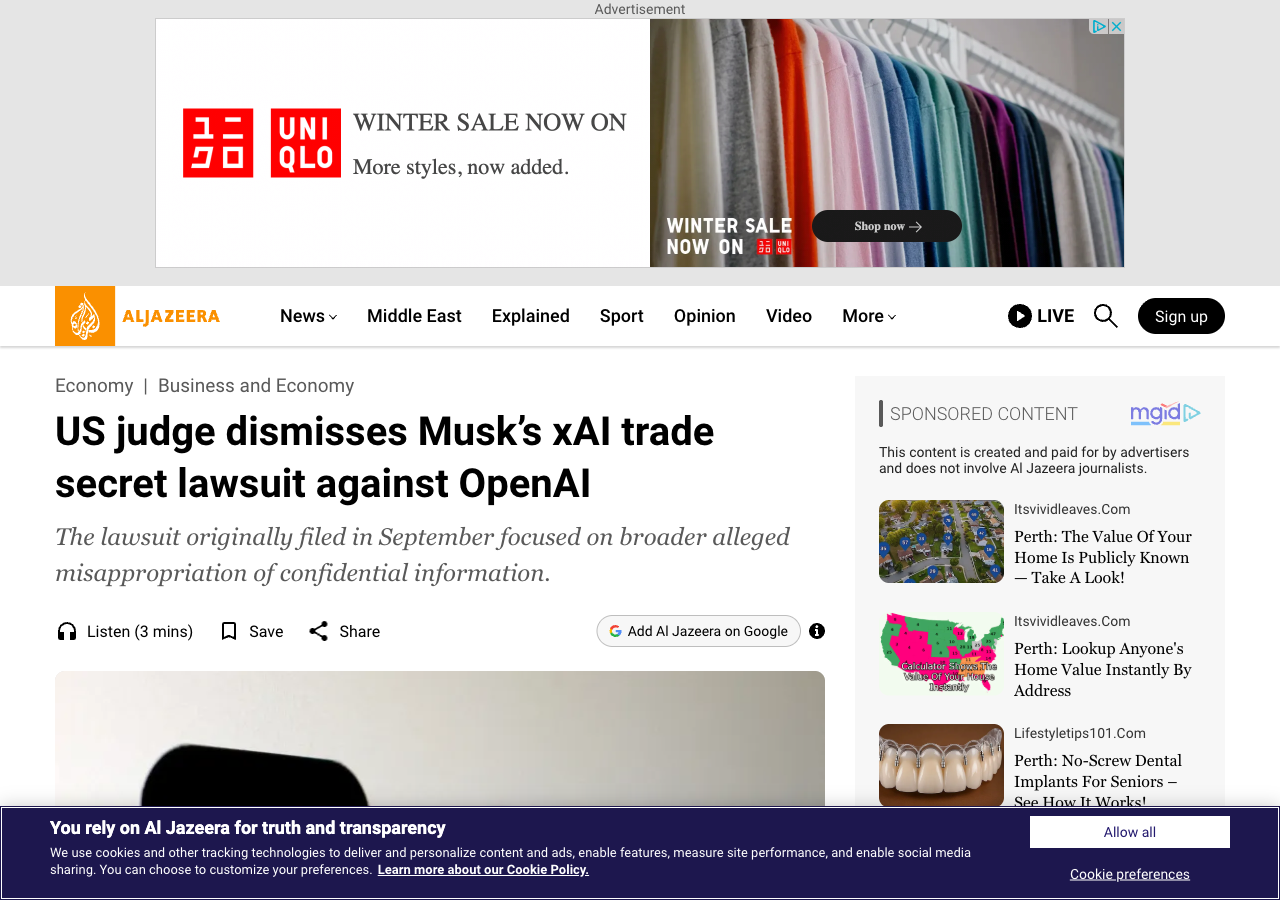
Source: Al Jazeera, captured August 4, 2026.
What the judge actually required, and what xAI could not show
The dismissal did not turn on whether Li said anything he should not have. Judge Lin’s opinion, as reported by Law360, treated that as beside the point. Under the federal Defend Trade Secrets Act and its California state-law counterpart, misappropriation requires active acquisition, disclosure, or use of a trade secret by the defendant, not passive receipt. Even accepting that Li disclosed protected information during his interview process, xAI’s complaint alleged only that OpenAI received it, not that OpenAI knew what it was getting or did anything with it. The court was blunt about where that standard would lead if relaxed: allowing a bare “you should have known” theory to proceed would expose every employer to liability any time it asks a job candidate about their prior work.
That is the whole case in one sentence: a trade-secret claim against a company that received information secondhand needs a paper trail showing the receiving company knew what it had, not just that a former employee of the plaintiff eventually said something useful. xAI’s lawsuit had circumstantial timing (eight employees left for OpenAI in one summer) and one specific interaction (Li’s presentation), but nothing connecting the two to actual, provable knowledge on OpenAI’s side.
Figure: On July 13, 2026, OpenAI moved for $1,041,859.90 in attorney fees against xAI under the Defend Trade Secrets Act’s fee-shifting provision and California’s parallel statute, arguing the suit was both legally baseless and filed in bad faith. Source: reporting on OpenAI’s fee motion, July 2026.
The appeal does not reset the clock
xAI’s Ninth Circuit appeal does not get a fresh look at the facts. The Ninth Circuit reviews a dismissal for legal error, meaning it asks whether Judge Lin applied the right standard to the allegations as written, not whether a jury might have believed xAI’s story. xAI’s opening brief is due August 24, 2026, and OpenAI’s answering brief is due September 23, 2026. Unless the appellate panel decides the district court applied the wrong legal test for misappropriation, the practical outcome will not change: a trade-secret claim built on “they must have known” rather than “here is what they knew and when” does not survive a motion to dismiss in this circuit.
The same day it filed that notice of appeal, OpenAI moved for $1,041,859.90 in attorney fees under the Defend Trade Secrets Act’s fee-shifting provision, 18 U.S.C. section 1836(b)(3)(D), and the parallel provision in the California Uniform Trade Secrets Act. That motion applies a two-part test for bad-faith trade secret claims: whether the claim was objectively specious on its face, and whether xAI acted in subjective bad faith in bringing it. Whatever the Ninth Circuit does with the underlying dismissal, the fee motion is a separate reminder that filing a trade-secret suit on thin evidence carries its own cost.
What this means if you use NDAs to protect confidential information
None of this changes what an NDA needs to contain. It changes what it needs to help you prove later, if it ever comes to that. A trade-secret claim against a third party, someone who received your confidential information secondhand rather than signing your agreement directly, lives or dies on evidence that the receiving party knew what it had. An NDA cannot bind a company that never signed it, but the process around your NDA can build exactly the record xAI was missing.
| What xAI’s case lacked | What a documented NDA process creates | |
|---|---|---|
| Definition of what is confidential | A vague claim about “Grok-related information” | A specific, written definition in the signed agreement |
| Evidence the other side knew | Only that Li disclosed something during an interview | Signed acknowledgment from every party who received the information |
| A timeline connecting disclosure to use | None; the complaint alleged timing, not causation | Dated access logs, version-controlled document sharing, and a signed agreement with an effective date |
| Offboarding paper trail | Not part of the public record in this case | An exit checklist confirming the departing party reaffirmed confidentiality obligations |
The lesson is not that your NDA needs more boilerplate. It is that the agreement is only half the job. The other half is the record you keep of who signed it, what specifically they agreed was confidential, and what happened when the relationship ended. A generic template that never gets a specific definition of confidential information filled in, or that never gets logged against who actually received sensitive material and when, leaves you in exactly xAI’s position: certain something crossed over, unable to prove who knew what and when they knew it.
Our NDA Generator walks through a specific definition of confidential information rather than a one-line catch-all, along with the acknowledgment and duration language that gives you a dated, signed record if a dispute like this one ever comes up. It will not make a weak factual case strong, but it removes the easiest way a court can throw out a claim before discovery even starts: a document too vague to show what was actually agreed to.
Bottom line
xAI’s suit against OpenAI failed not because a court decided nothing improper happened, but because xAI could not show OpenAI knowingly acquired or used what a departing engineer may have shared. That is a high bar for any plaintiff without a signed agreement and a documented process behind it. If your business shares confidential information with employees, contractors, or partners, the operative lesson from this case is not about AI companies specifically. It is that a specific, signed NDA with a clear record of who received what and when is the difference between a provable claim and a case that gets thrown out with prejudice.
The information in this article is for informational purposes only and should not be construed as legal advice on any matter, and does not create an attorney-client relationship.