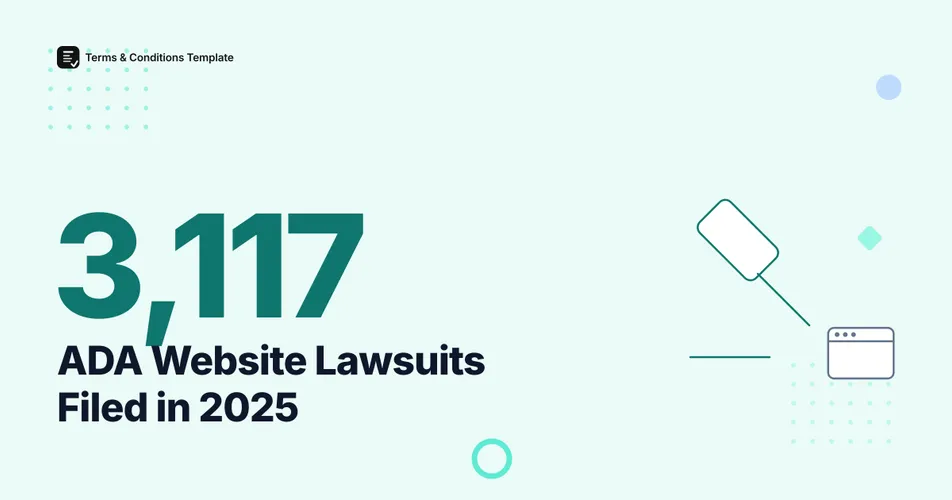
Plaintiffs filed 3,117 website accessibility lawsuits in US federal court in 2025, a 27% jump from 2,452 the year before, according to Seyfarth Shaw’s year-end count published in March 2026. Those cases made up 36% of all 8,667 federal ADA Title III filings. The data below runs through the 2025 filing year and sources checked in 2026.
If you run a small online business, you are the typical defendant. Here is who gets sued, where the cases land, and which dates matter this year.
How many website accessibility lawsuits were filed in 2025?
Federal courts saw 3,117 website accessibility lawsuits in 2025, according to Seyfarth Shaw’s ADA Title III tracker. That is 665 more than in 2024. The monthly range ran from a low of 219 filings in June to a high of 319 in July.
Trackers do not agree on one number, because they count different courts. UsableNet’s 2025 year-end report counted 5,114 digital accessibility lawsuits once New York and California state courts were included. Of those, 3,195 (62%) were federal and 1,919 (38%) were state cases. UsableNet’s report covers digital accessibility broadly, so its total is not the same measure as Seyfarth’s website-only federal count.
Figure 1: Where 2025 digital accessibility lawsuits were filed. Source: UsableNet 2025 Year-End Digital Accessibility Lawsuit Report.
Website suits are also a growing slice of the whole. They were 36% of 8,667 federal Title III filings in 2025, versus 28% of 8,800 in 2024.
Pick one tracker and name it when you cite a number. Seyfarth gives you the federal website count, and UsableNet gives you the wider total.
Which businesses get sued over website accessibility?
Online sellers get sued most. UsableNet found eCommerce made up 70% of 2025 digital accessibility lawsuits and food service made up another 21%. Healthcare and fitness and wellness each took 2%. Every other industry sat at 1% or less.
Figure 2: Share of 2025 lawsuits by industry. Source: UsableNet 2025 Year-End Digital Accessibility Lawsuit Report. The “all other” slice is the remainder to 100%.
Size does not protect you. Companies earning under $25 million a year were named in 64% of 2025 cases, while companies above that line made up 36%. Big names still get hit too: 36% of the top 500 eCommerce retailers received at least one lawsuit in 2025.
Figure 3: Top 500 eCommerce retailers sued at least once in 2025. Source: UsableNet.
Repeat targets are common. UsableNet counted 1,427 lawsuits against companies that had been sued before, which it put at 45% of federal filings. Fixing one page does not end your exposure.
If you sell online, read our small business website data to see how many of your peers have a site like yours.
Where are website accessibility lawsuits filed?
New York federal courts led in 2025 with 1,021 website accessibility lawsuits, according to Seyfarth Shaw. Florida came second with 961, Illinois third with 585, Minnesota fourth with 162, and Pennsylvania fifth with 137.
Figure 4: Top five federal court locations for website accessibility suits. Source: Seyfarth Shaw ADA Title III blog, March 2026.
Florida is the story. Its 961 filings were almost double its 470 in 2024.
California looks odd in this data. Seyfarth reports that California’s federal courts had only four new website accessibility lawsuits in 2025. That does not mean California is safe. UsableNet counts California state court cases separately from the federal filings Seyfarth tracks.
Your customers decide where you can be sued. Sell to shoppers in New York, Florida, or Illinois and you sit in the busiest courts.
Do accessibility widgets stop the lawsuits?
No. UsableNet’s 2025 year-end report said accessibility widgets “did not slow litigation in 2025.” It counted 95 lawsuits against sites that ran a widget in January and 114 in December.
We could not confirm a single published share for widget cases, so we do not quote one here. The point holds on the monthly data alone. A widget placed on top of a page does not fix the markup underneath it.
The real problems are found in the code. The 2026 WebAIM Million analysis of one million home pages, run in February 2026, found detectable WCAG 2 failures on 95.9% of them, with an average of 56.1 errors per page. WebAIM tallies this every year from automated checks, so treat it as a minimum count, since automated tools miss many issues.
Figure 5: Share of one million home pages with each failure: low contrast text, missing alt text, missing form labels, empty links, empty buttons, missing language. Source: WebAIM Million, February 2026 analysis.
Low contrast text alone shows up on 83.9% of home pages. Alt text, form labels, and link names are the fixes you can start on today.
Our guide on how to write an accessibility statement covers what to say once you have done that work, and the version for online stores fits the sellers who get sued most.
What do the 2026 accessibility deadlines change?
The US Department of Justice pushed back its Title II web rule in April 2026. State and local governments serving 50,000 or more people now have until April 26, 2027, and smaller entities and special districts have until April 26, 2028. The standard is still WCAG 2.1 Level AA.
Figure 6: Which accessibility date applies to which kind of site owner. Source: ADA.gov Title II web rule guidance, 2026.
The Title II rule covers governments, so a private business is not on that clock. Private businesses face the lawsuits counted above under Title III. The DOJ page we reviewed covers only the Title II rule, so check with counsel on what applies to you.
Figure 7: Key dates and filing counts. Sources: Seyfarth Shaw, WebAIM, ADA.gov.
A public notice about your accessibility effort is one piece of the picture. You can generate a disclaimer to state what your site does and where to send accessibility feedback, then fix the issues behind it. For the cost side of a rebuild, see our website cost data.
The deadline moves for governments. It does not move the lawsuits aimed at businesses.
Website accessibility lawsuit data at a glance
| Metric | Figure | Source and year |
|---|---|---|
| Federal website accessibility lawsuits | 3,117 | Seyfarth Shaw, 2025 |
| Change from 2024 | +27% (from 2,452) | Seyfarth Shaw, 2025 |
| All digital accessibility lawsuits, federal and state | 5,114 | UsableNet, 2025 |
| Share against eCommerce sites | 70% | UsableNet, 2025 |
| Defendants under $25M revenue | 64% | UsableNet, 2025 |
| Top 500 eCommerce retailers sued | 36% | UsableNet, 2025 |
| Home pages with WCAG 2 failures | 95.9% | WebAIM, February 2026 |
The Bottom Line
The hook number is 3,117: that is how many website accessibility lawsuits landed in US federal court in 2025, up 27% in a year. Add state courts and the count passes 5,000. The typical target is a small online seller, and nearly half of federal filings hit a company that had been sued before.
For you, that means three things. Fix the basics first: contrast, alt text, form labels, and link names. Skip the widget and treat it as a supplement at most. Then say plainly what your site supports and where visitors can report a problem. You can start that last step with the disclaimer generator, though it does not replace fixing your site or talking to a lawyer.
Frequently Asked Questions
How many website accessibility lawsuits were filed in 2025? Plaintiffs filed 3,117 website accessibility lawsuits in US federal court in 2025, a 27% increase from 2,452 in 2024, according to Seyfarth Shaw. UsableNet counted 5,114 digital accessibility lawsuits once New York and California state courts were included.
Which businesses get sued over website accessibility? Mostly small and mid-size online sellers. UsableNet’s 2025 report found eCommerce made up 70% of cases, food service 21%, and companies under $25 million in annual revenue were defendants in 64% of them.
Which states see the most website accessibility lawsuits? New York federal courts led with 1,021 website lawsuits in 2025, followed by Florida with 961 and Illinois with 585, per Seyfarth Shaw. Florida’s total was almost double its 470 filings in 2024.
Do accessibility overlay widgets stop lawsuits? No. UsableNet’s 2025 year-end report said accessibility widgets did not slow litigation, and it counted lawsuits against companies using widgets in both January (95) and December (114) of 2025.
Sources and References
- Seyfarth Shaw LLP: Federal Court Website Accessibility Lawsuit Filings Bounce Back in 2025 (2026). ADA Title III blog, March 2026, reprinted by Legal 500. Federal filing counts for 2024 and 2025, by state.
- UsableNet: 2025 Year-End Digital Accessibility Lawsuit Report (2026). Federal and state court totals, industry split, defendant revenue, repeat defendants, top 500 retailers, and widget findings. Sample size is the full count of cases UsableNet tracked.
- WebAIM: The WebAIM Million (2026). Automated analysis of one million home pages, conducted February 2026. A rolling page that is updated each year.
- ADA.gov: Title II Web Rule First Steps (2026). US Department of Justice guidance with the April 2026 interim final rule dates.
Note: All figures verified as of November 2026. Lawsuit counts and the WebAIM page change, so headline figures are refreshed at least twice a year.