On May 1, 2026, the Pennsylvania Department of State filed a lawsuit against Character Technologies, Inc., the company behind Character.AI, alleging that a chatbot on the platform held itself out as a licensed psychiatrist and gave a user a fake Pennsylvania medical license number. The Shapiro Administration announced the filing four days later, calling it the first enforcement action of its kind brought by a governor anywhere in the United States.
Character.AI lets users build and publish custom AI “characters” that others can chat with. According to Pennsylvania’s Department of State, one such character, discussing mental health symptoms with a user, falsely claimed to be licensed in Pennsylvania as a psychiatrist and supplied a license number that does not correspond to any real credential. The Commonwealth is seeking a preliminary injunction and a court order to stop Character.AI’s companion bots from posing as licensed medical professionals and dispensing medical advice.
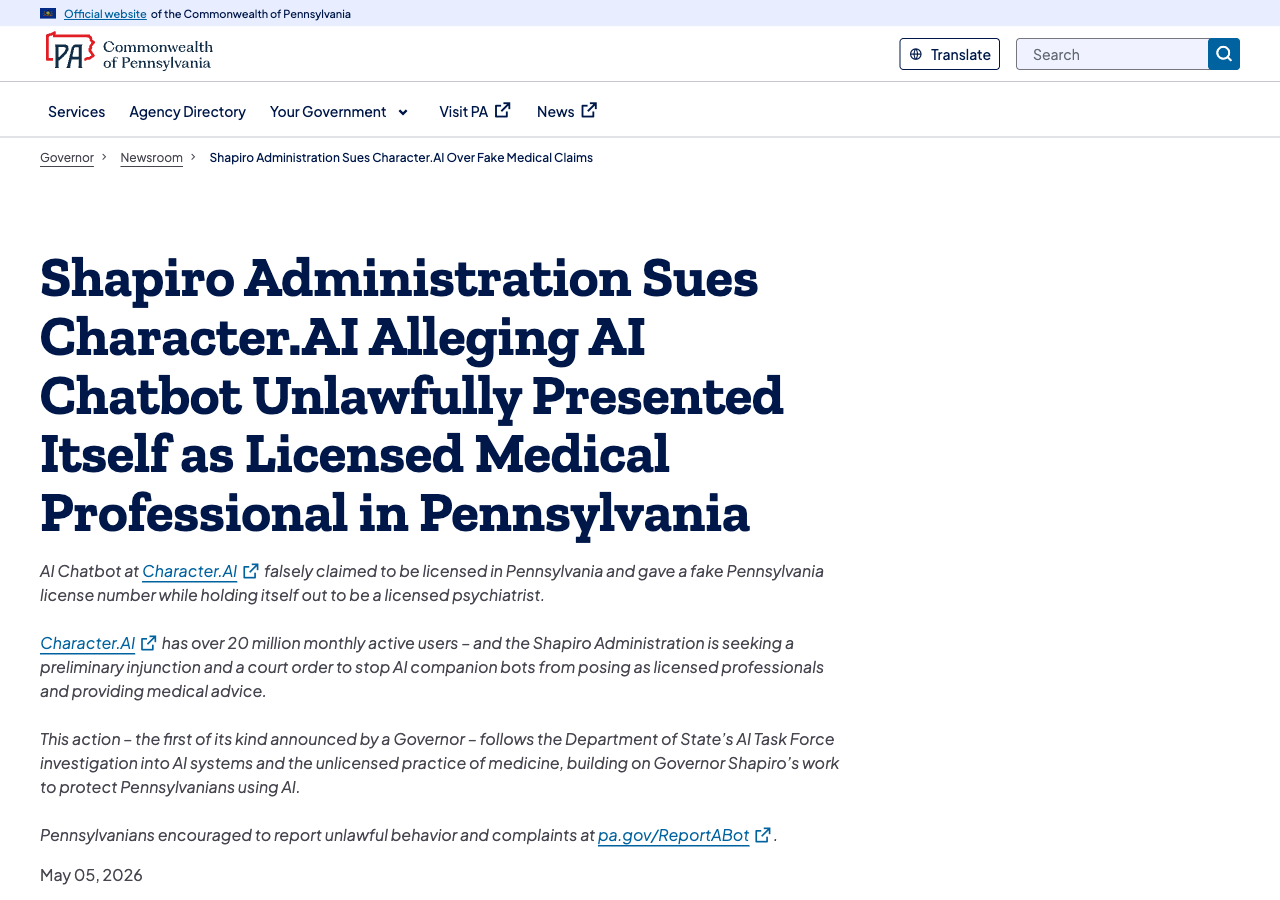
Source: Commonwealth of Pennsylvania, Governor’s Newsroom, “Shapiro Administration Sues Character.AI Alleging AI Chatbot Unlawfully Presented Itself as Licensed Medical Professional in Pennsylvania”, captured August 2026.
What the lawsuit actually alleges
The case grew out of an investigation by the Department of State’s AI Task Force into whether AI companion bots were engaging in the unlicensed practice of medicine. That investigation found chatbot characters on Character.AI presenting themselves as licensed medical professionals, including psychiatrists, and engaging users in conversations about mental health symptoms. In the incident cited in the complaint, a chatbot named “Emilie” told a user it was a licensed psychiatrist in Pennsylvania and provided a Pennsylvania license number that does not belong to any actual licensee.
Figure: Character.AI’s scale is central to why Pennsylvania is treating this as a public-safety case rather than an isolated bad chatbot.
Based on those findings, Pennsylvania’s complaint alleges that Character Technologies is violating the state’s Medical Practice Act, which makes it unlawful for any individual or entity to hold itself out as a licensed medical professional without proper licensure. Governor Josh Shapiro framed the stakes plainly: “Pennsylvanians deserve to know who, or what, they are interacting with online, especially when it comes to their health.” Department of State Secretary Al Schmidt added that the law is clear on this point regardless of who or what is making the claim: “You cannot hold yourself out as a licensed medical professional without proper credentials.”
Why a fake license number matters more than a bad AI answer
An AI chatbot giving wrong or unhelpful advice is a product-quality problem. A chatbot fabricating a state license number is a different category of claim entirely, because a real license number is a specific, checkable representation that a professional has met a state’s education, examination, and background requirements. Pennsylvania’s complaint treats the invented license number as the crux of the unauthorized-practice claim, not the underlying advice.
That distinction matters for any AI product that lets a chatbot claim professional credentials, whether in mental health, medicine, law, or finance. A general accuracy disclaimer, the kind that says content may be inaccurate and should not be relied on, does not address a chatbot affirmatively claiming a license it does not hold. Those are two different problems: one is about the reliability of an answer, the other is about a specific, false credentialing claim.
| Claim type | Example | What addresses it |
|---|---|---|
| General accuracy | ”AI responses may contain errors” | Standard AI-content disclaimer |
| Professional role | ”I am not a substitute for a licensed provider” | Explicit non-professional-relationship disclaimer |
| Credential claim | A fabricated license number | Product design that prevents the claim, not disclaimer language |
A disclaimer can tell users a bot is not a real professional. It cannot make a system stop generating a fake license number if nothing in the product prevents that output in the first place. Pennsylvania’s suit is aimed at the underlying conduct, and it is a reminder that disclaimer language works only as far as the product actually behaves consistently with it.
What this means if your product includes an AI chatbot
Character.AI has over 20 million monthly active users, which is part of why Pennsylvania’s Department of State is treating this as a public-safety matter rather than a one-off complaint. Any business running a chatbot, whether it is a companion app, a customer support bot, or an AI feature bolted onto a health, wellness, legal, or financial product, faces the same underlying exposure if the bot can be prompted or configured to claim a professional credential it does not have.
A clear AI-content disclaimer should state plainly that the chatbot is not a licensed professional, that nothing it says creates a professional relationship (medical, legal, or otherwise), and that users should consult a licensed provider before acting on anything the bot tells them. That disclosure needs to sit somewhere a user will actually see it, not buried in a terms page nobody opens, and it needs to say something specific enough to hold up if a regulator asks what the product told users about what it is. Our Disclaimer Generator can help you put that kind of AI-content and professional-relationship language in place for a chatbot or AI feature.
Pennsylvania’s Department of State also pointed to a broader enforcement build-out behind this filing: a 12-member AI Task Force reviewing whether AI companion technologies are engaging in unlicensed practice, a public reporting channel at pa.gov/ReportABot that the state says has already been used, and four AI-related reforms in Governor Shapiro’s 2026-27 budget proposal, including age verification for companion bots and a requirement that platforms periodically remind users they are talking to software, not a person. None of those four reforms are law yet; they are budget proposals awaiting action by the General Assembly.
Bottom line
Pennsylvania’s suit against Character.AI is not about a chatbot giving bad advice. It is about a chatbot claiming a professional license it does not have, which the state says crosses from a product-quality issue into unauthorized practice of medicine. This is worth checking against your own product even if you do not run anything resembling Character.AI: if an AI feature on your site can ever be prompted into claiming a professional credential, a disclaimer alone will not fix a product that lets it happen. Pair the disclaimer with product limits on what the bot is allowed to claim about itself, and make sure the disclaimer you do have actually says who, or what, a user is talking to.
For more on how state and federal rules are treating AI-generated content this year, see our coverage of California’s AI Transparency Act taking effect, and for the two disclaimers every AI feature needs, our guide on writing a disclaimer for AI-generated content. If your product touches health or wellness claims specifically, our guide to writing a medical disclaimer covers the language a health-adjacent AI feature needs on top of general AI disclosure.
The information in this article is for informational purposes only and should not be construed as legal advice on any matter, and does not create an attorney-client relationship.

![$68.6B: Amazon Advertising 2026 [Spend Data]](/_astro/amazon-advertising-2026.DFxB0rDi_1ebTR.webp)

![Amazon Affiliate Rate Falls to 10% in 2026 [Full List]](/_astro/commission-programs-2026.DvBRm6Oc_Z44gbJ.webp)