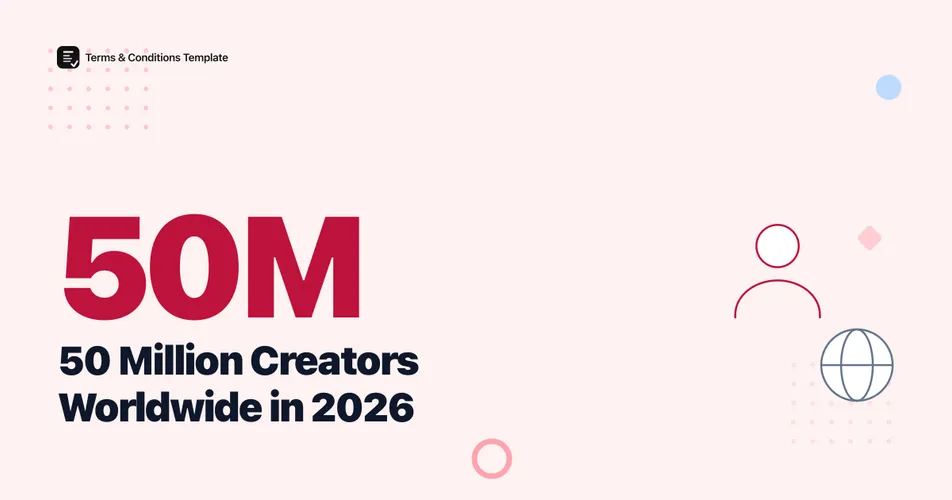
Goldman Sachs Research counts 50 million content creators worldwide, the most-cited figure for people who monetize content in some form, as of the bank’s 2023 baseline analysis. Linktree’s own 2023 Creator Report, drawn from its platform of 40 million-plus users, puts a broader definition of “creator” at 200 million people. Both numbers are correct. They are measuring different populations, and the gap between them is the actual story behind “how many content creators are there.”
If you run a website, hire creators, or create content yourself, which number matters depends on what you are trying to answer. Below is where each figure comes from, how it breaks down by platform, and how many of those creators are actually making money.
How many content creators are there worldwide?
The two most commonly cited global counts differ by a factor of four. Goldman Sachs Research puts the number of global creators at 50 million as of its 2023 analysis, defining a creator as someone who earns income, however small, from content. Linktree’s 2023 Creator Report, based on its own 40 million-user platform extrapolated to the wider market, counts 200 million people worldwide “competing for attention” in what it calls the attention economy, a definition that includes anyone posting content with monetization intent, not just people currently earning from it. A third estimate from Citi Research lands in between, at roughly 120 million.
Figure 1: Global creator population estimates by source. Sources: Linktree 2023 Creator Report, Citi Research, Goldman Sachs Research, 2023 data (most recent disclosed baselines as of 2026).
No research firm has published a fresher global headcount since 2023. Every 2026 blog post citing “207 million” or “300 million” creators traces back to the same Linktree figure, aged forward without new underlying data, so treat any number above 200 million circulating in 2026 roundups as unsourced until a firm publishes an updated count.
Why do creator-count estimates range so widely?
The four-fold spread between 50 million and 200 million comes down to one question: does “creator” mean someone earning money from content, or anyone posting content with an audience-building intent? Goldman Sachs’ narrower definition only counts people generating some creator income. Linktree’s broader definition counts anyone actively building an audience across a link-in-bio profile, regardless of whether a dollar has changed hands yet.
Figure 2: The definitional test that separates the 50 million, 200 million, and “professional” creator counts.
A publisher, a marketer, or a platform building a monetization product needs the narrower, income-based number. A platform measuring total content supply or competition for attention needs the broader one. Neither figure is wrong, but citing either without its definition attached invites a fact-check.
How many creators are on each major platform?
Platform-reported numbers are more reliable than blended global estimates because platforms can count their own users directly, though most still do not disclose a full, audited creator count. YouTube has disclosed the most detail: CEO Neal Mohan stated in a 2024 letter that the platform has roughly 115 million channels in total, of which 3 million are monetized under the YouTube Partner Program, about 2.6% of all channels. Twitch does not publish an official creator count, but TwitchTracker’s platform-scraped data, aggregated by Backlinko, showed roughly 7 million unique streamers publishing monthly as of October 2025, down from a 2024 average closer to 7.3 million. Patreon’s own reporting, tracked on Graphtreon’s continuously updated dashboard, showed 286,287 creators with at least one paying member as of February 2026, a figure that shifts daily and should be treated as directional rather than fixed.
Figure 3: Platform creator population by most recent disclosed figure. Sources: YouTube CEO Neal Mohan’s 2024 letter, TwitchTracker via Backlinko (October 2025), Graphtreon (February 2026).
TikTok does not publish an official creator count at all. Third-party estimates for “TikTok creators” in circulation during 2026 range from roughly 1 million to 2 million, with no disclosed methodology behind any of them, so we could not verify a TikTok-specific headcount that meets this article’s sourcing bar. Treat any specific TikTok creator-count figure you see elsewhere with the same skepticism.
Warning
Platform headcounts measure different things: YouTube’s 115 million counts every registered channel, including inactive and personal ones, while Patreon’s 286,287 only counts creators currently receiving a paying member. Comparing raw totals across platforms without adjusting for what each number actually measures will overstate or understate a platform’s real active-creator base.
How many creators actually earn a living from it?
Being counted as a “creator” and earning a living as one are two different thresholds, and the gap between them is the least-cited part of any creator-count story. Of Goldman Sachs’ 50 million global creators, only 4% earn more than $100,000 a year, a share the firm expects to hold steady even as the total population grows. From the other direction, the 2025 Creator Earnings Report from NeoReach and Influencer Marketing Hub, based on a survey of more than 3,000 creators representing over 1.1 billion combined followers, found that over 50% of creators earn under $15,000 annually, up from 48% in 2023.
Figure 4: Professional-tier share of the global creator population. Source: Goldman Sachs Research, 2023 baseline, share held steady in later coverage.
Most people who get counted in a global creator figure are not earning anything close to a full-time income. That gap matters for anyone marketing to “creators” as a monolithic group, since the top 4% and the median creator are not comparable audiences, customers, or clients.
Is the number of content creators growing, and how fast?
Every dataset points the same direction: up. Goldman Sachs Research projects its 50 million global creator baseline to grow at a 10% to 20% compound annual rate over the five years following its 2023 analysis. Applying that stated range directly to the 2023 baseline, rather than treating it as a published year-by-year series, the population would reach somewhere between roughly 80 million (10% CAGR) and 124 million (20% CAGR) by 2028. This is a derived projection based on Goldman Sachs’ own stated growth range, not a figure the firm has published as an annual series, and the true number depends on which end of that range plays out.
Figure 5: Low-case (10% CAGR) projection of Goldman Sachs’ creator baseline. High-case (20% CAGR) would reach 124 million by 2028; both are derived from the firm’s stated growth range, not directly published year-by-year figures.
Platform-level growth backs up the direction, if not the exact rate. YouTube’s Partner Program membership, Twitch’s streamer count, and Patreon’s paid-creator count have all grown year over year across every dataset in this article. What has not grown at the same pace is the professional-tier share, still around 4% of the total by Goldman Sachs’ count, which suggests the population is expanding mostly at the amateur and part-time end.
Figure 6: Key creator-count disclosures, 2018 to 2026. Sources: Goldman Sachs Research, Linktree, YouTube, TwitchTracker, Graphtreon.
Creator-count estimates compared
| Source | Count | Definition | Year |
|---|---|---|---|
| Goldman Sachs Research | 50 million | Earns some creator income | 2023 |
| Citi Research | ~120 million | Broader monetization intent | 2023 |
| Linktree Creator Report | 200 million | Actively builds an audience | 2023 |
| YouTube (Neal Mohan) | 115 million channels / 3 million monetized | Registered channels / YPP members | 2024 |
The Bottom Line
There is no single correct answer to “how many content creators are there.” Goldman Sachs’ 50 million figure is the right number if you mean people earning creator income today. Linktree’s 200 million is the right number if you mean anyone actively building an audience. Both are built on 2023 data because no firm has published a fresher global headcount since, so treat any 2026 figure you see above 200 million as unsourced. What every dataset agrees on is that the population is growing, monetization stays concentrated in a small professional tier, and that concentration creates real legal exposure: an FTC Endorsement Guides violation for undisclosed sponsorship applies the same $53,088 maximum penalty to a creator earning $500 a month as to one in the top 4%. A clear disclaimer covering sponsored and affiliate content is the cheapest protection available at any point on that income curve, and it matters more, not less, as the population of people this applies to keeps expanding.
For the dollar figures behind these headcounts, see our breakdown of creator economy market size and earnings. Many creators also show up in the broader freelance workforce data, since brand deals and platform payouts count as independent income under most national labor surveys.
Frequently Asked Questions
How many content creators are there in the world? Goldman Sachs Research counts 50 million global creators as of its 2023 baseline, defined as people who monetize content in some form. Linktree’s 2023 Creator Report uses a broader definition, anyone using their influence, creativity, or skills to build an audience, and puts that population at 200 million.
How many of those creators actually make a living from it? Only about 4% of Goldman Sachs’ 50 million global creators earn more than $100,000 a year. Separately, the 2025 Creator Earnings Report from NeoReach and Influencer Marketing Hub, based on a survey of 3,000+ creators, found more than 50% earn under $15,000 annually.
How many creators are on YouTube specifically? YouTube has roughly 115 million channels in total, but YouTube CEO Neal Mohan disclosed in a 2024 letter that only 3 million of them are monetized under the YouTube Partner Program, about 2.6% of all channels.
Is the number of content creators growing? Yes. Goldman Sachs Research projects its 50 million global creator baseline to grow at a 10% to 20% compound annual rate over five years. Applying that stated range to the 2023 baseline puts the population somewhere between 80 million and 124 million by 2028, depending on which end of the range holds.
Sources and References
- Goldman Sachs Research. (2023). “The creator economy could approach half-a-trillion dollars by 2027.” 50 million global creator baseline, 10-20% projected CAGR, 4% professional-tier share.
- Linktree. (2023). “The 2023 Linktree Creator Report.” 200 million global creator estimate, drawn from Linktree’s 40M+ user platform.
- YouTube / Neal Mohan. (2024). “Letter from the YouTube CEO: 4 Big Bets for 2024.” 115 million total channels, 3 million monetized under the YouTube Partner Program.
- Backlinko. (2025). “Twitch Usage and Growth Statistics,” citing TwitchTracker platform data. Roughly 7 million unique monthly streamers, October 2025.
- NeoReach / Influencer Marketing Hub. (2025). “Creator Earnings Report 2025.” Survey of 3,000+ creators, 1.1B+ combined followers.
- Graphtreon. (2026). Patreon creator and earnings tracking dashboard. 286,287 creators with at least one paying member, accessed February 2026.
- Federal Trade Commission. Endorsement Guides FAQ, with the January 2025 civil penalty adjustment to $53,088 per violation.
Note: All figures verified as of August 2026. The global creator headcount has not been updated by any major research firm since 2023, so this section will be refreshed as soon as a fresher primary count is published, and at least twice a year regardless.

![$68.6B: Amazon Advertising 2026 [Spend Data]](/_astro/amazon-advertising-2026.DFxB0rDi_1ebTR.webp)


![Amazon Affiliate Rate Falls to 10% in 2026 [Full List]](/_astro/commission-programs-2026.DvBRm6Oc_Z44gbJ.webp)